


South Australia Occupation List 2026: Full Guide to Eligible Occupations
If you’re planning a move to Adelaide, or somewhere regional in South Australia, chances are you’ll end up looking at one document first: the state’s official skilled occupation list. It’s the thing that tells you whether your job even qualifies for state nomination, and which visa pathway you should be looking at. South Australia keeps this list to match skilled migrants against the roles it actually needs filled: health, engineering, IT, trades, education, agriculture, that sort of spread.

Find your occupation there and you might be looking at the Skilled Nominated visa (subclass 190) or the Skilled Work Regional visa (subclass 491), both handled jointly by the South Australian government and the Department of Home Affairs. None of this is especially complicated once you know how the pieces fit together the nomination streams, how eligibility actually gets checked, where the delays tend to happen. That’s really what this guide is for.
What Is the South Australia Occupation List?
This is the official record of jobs approved for state nomination under South Australia’s skilled migration program. Skilled and Business Migration (SBM) a division of the South Australian Department for Industry, Innovation and Science publishes and maintains it. What’s on there reflects the roles the state needs filled right now, drawn from labour market data and the shortages various industries are reporting. It’s not set in stone. Occupations get added, occupations get dropped, and the whole thing moves as South Australia’s economy and workforce gaps shift.
Every entry ties back to an ANZSCO code, the standard classification used across Australia to define occupations. ANZSCO also assigns each occupation a skill level, tied to the qualifications and experience the role typically calls for. Skill Level 1 corresponds to a bachelor’s degree or higher, Skill Level 2 to an associate degree, advanced diploma, or diploma, Skill Level 3 to a Certificate III or IV with relevant on-the-job training, and Skill Level 4 to a Certificate II or III.
Most occupations on the list fall within Skill Levels 1 to 3, though a handful of trades roles at Skill Level 4 make it in too. So if your job title matches an entry, and your ANZSCO code actually lines up with your skills, qualifications, and work experience you’re likely in the running for state nomination. The current version lives on the official Skilled Occupation List page, and the state updates it periodically as priorities shift.
Being on the list, though, isn’t the same as being approved. It only confirms your occupation is currently eligible for state nomination; you still need to meet every other requirement South Australia and the Department of Home Affairs set separately. Plenty of applicants treat inclusion on the list as the final hurdle. It’s really just the starting line.
Nomination Streams Under the SA Occupation List
There are several nomination streams, and each one plugs into the occupation list a bit differently. Which one applies to you mostly comes down to where you’re currently living and your employment situation not so much the occupation itself.
- South Australian Graduates stream: For international students who completed a qualifying course in South Australia that matches an occupation on the list.
- Skilled Employment in South Australia stream: For skilled migrants already living and working in South Australia in their nominated role, including temporary visa holders, international graduates, and self-employed applicants.
- Outer Regional Skilled Employment stream: For applicants living and working in outer regional parts of South Australia, in an occupation drawn from the list. This stream generally requires at least nine months of full-time work (30 or more hours per week) in Outer Regional South Australia, in a role within the same ANZSCO Sub Major Group as your nominated occupation, meaning the first two digits of your work ANZSCO code must match.
- Offshore stream: For candidates currently living overseas who have lodged an EOI through SkillSelect and are later invited by South Australia based on demand for their occupation.
There’s more on how these connect to South Australia state nomination and how each one gets assessed, and it’s worth a proper read before you commit to anything. Every stream has its own conditions and its own paperwork, so confirming the fit before you lodge anything formally guessing here tends to cost time later.
Visa Options Linked to the South Australia Occupation List
There are two main visa subclasses tied to occupations on this list, and the gap between them matters once you start planning.
Skilled Nominated visa (subclass 190)
A permanent visa for skilled workers nominated by South Australia. Nomination through this visa also provides additional points toward the applicant’s overall Department of Home Affairs points test.
Skilled Work Regional visa (subclass 491)
A provisional visa valid for up to five years, allowing holders to live and work in South Australia, with a pathway toward permanent residency later on.
Not every occupation on the list opens both doors, some roles are restricted to the 491 pathway only, since they’re tied to regional need rather than demand across the whole state. On top of that, applicants still have to clear the Department of Home Affairs’ points test, which sits at a minimum of 65 points across all General Skilled Migration visas.
South Australian nomination adds 5 points for the subclass 190 and 15 points for the subclass 491, on top of whatever you’re already earning from age, English ability, skilled work experience, and qualifications. As for fees: nomination applications for both the 190 and 491 pathways currently run $394 each, and lodging a Registration of Interest costs nothing.
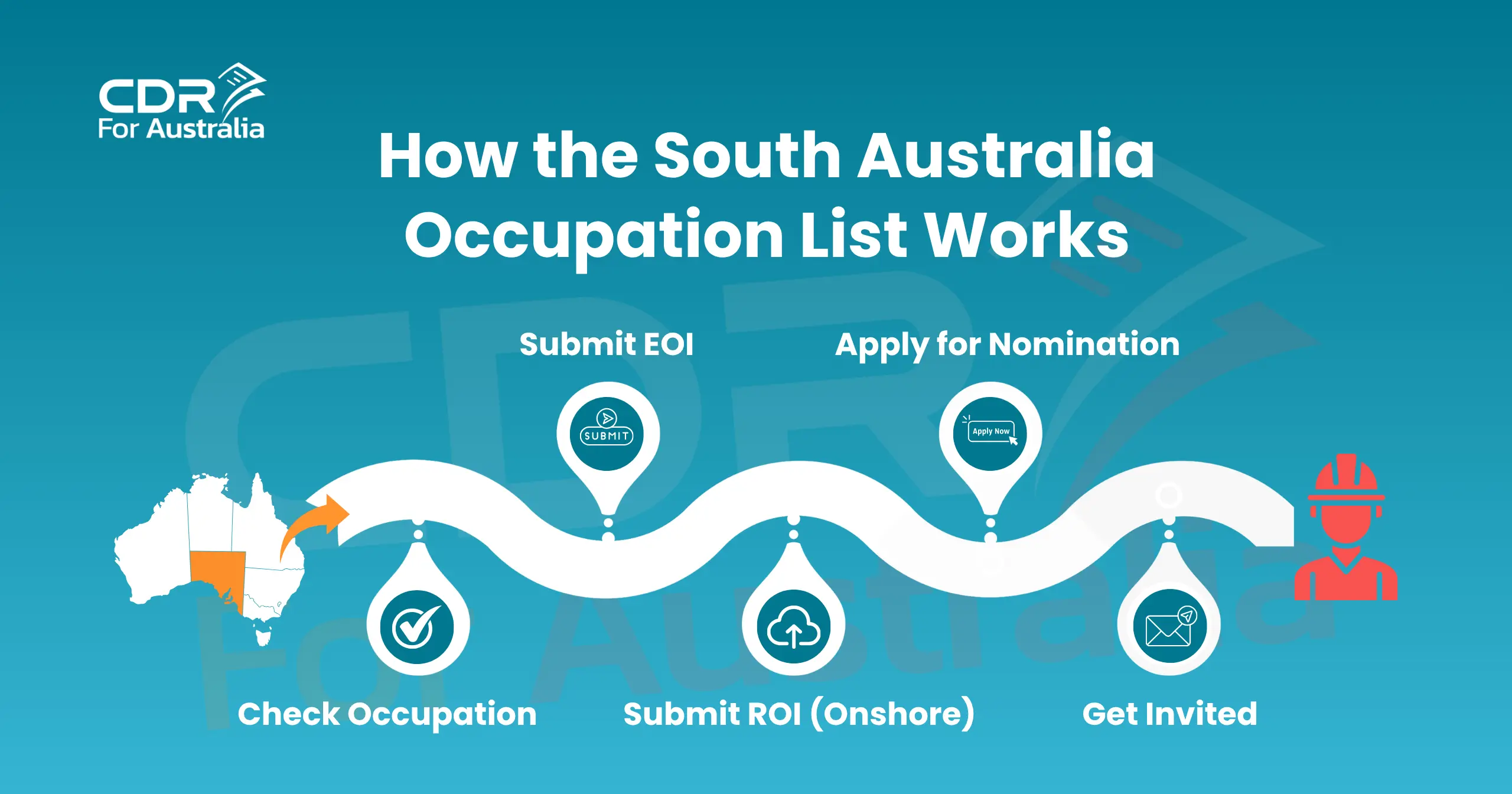
How the South Australia Occupation List Works
Finding your occupation on the list is really just step one; the list itself feeds into a longer nomination process, and several stages follow before anyone gets a visa decision. Roughly, it goes like this:
- Check your occupation. Search the list by job title or ANZSCO code to confirm current eligibility and which streams apply.
- Submit an Expression of Interest (EOI). This is lodged through the Department of Home Affairs’ SkillSelect system and is required for every applicant, regardless of location.
- Submit a Registration of Interest (ROI), if onshore. Applicants already living in South Australia lodge this through the Apply Portal, along with all supporting documents.
- Wait for an invitation. Skilled and Business Migration reviews submitted applications and invites eligible candidates to proceed with nomination.
- Apply for state nomination. Once invited, applicants lodge a full nomination application with the required documentation attached.
One thing to flag: access to the list and its application streams isn’t always open. Depending on the point in the year, things get paused. Right now, for instance, Skilled ROI and general skilled migration applications are on hold, and Skilled and Business Migration isn’t expected to pick things back up until the 2026–27 program year starts. Check the government website every so often this kind of status can change with little warning.
In-Demand Occupations on the South Australia Occupation List
The list covers a lot of ground, industry-wise, and it tends to track wherever South Australia’s workforce gaps are biggest at the time. A few broad categories keep showing up:
- Healthcare and social assistance – registered nurses, medical practitioners, aged care workers, and disability support roles
- Engineering – civil, mechanical, electrical, and mining engineers
- Information and communications technology – software engineers, developers, and systems analysts
- Trades and construction – electricians, plumbers, carpenters, and other licensed technical trades
- Education – early childhood, primary, and secondary teachers
- Agriculture and food production – agricultural scientists, farm managers, and food technologists
Every occupation has its own six-digit ANZSCO code attached, and getting that code right counts for more than matching a job title. Software Engineer sits under 261313. Civil Engineer is 233211. Electrician (General) is 341111, and Primary School Teacher is 241213. Two people doing what sounds like the same job can land under totally different codes depending on their actual day-to-day duties so check the code against what you actually do, not just what your business card says.
This demand tracks South Australia’s wider priorities: health services, renewable energy, defence, advanced manufacturing, all of it growing. If you’re in professional occupations like engineering, IT, or healthcare, double-check your ANZSCO code against the current list before you apply. Even small classification differences can change how eligible you are. Same warning applies to trade occupations: skill level, licensing, and supervised experience requirements can differ between roles that sit under one broad heading.
South Australia Occupation List vs DAMA Occupation List
There are actually two separate occupation lists in South Australia, and it’s easy to confuse them when you’re researching online.
Feature | South Australia Occupation List | DAMA Occupation List |
Purpose | State nomination for subclass 190 and 491 visas | Employer sponsorship under a labour agreement |
Visa pathway | Points-tested skilled visas | Sponsored visas, such as subclass 482 and 494 |
Sponsor required | No employer sponsor needed for most streams | Requires an approved South Australian employer |
Concessions | Standard skill and salary requirements apply | May allow reduced English, salary, or experience thresholds |
Occupation scope | ANZSCO-classified occupations only | Includes some non-ANZSCO occupations |
The occupation list is generally where applicants start if they’re going the independent, points-tested route on their own merits. DAMA works differently; it’s built around employer sponsorship and regional labour agreements, so it suits people who already have a job offer sorted. If that’s closer to your situation, take a look at the Skills in Demand visa pathway too, since it sits alongside DAMA as another employer-sponsored route into the state.
Offshore and Onshore Eligibility on the SA Occupation List
Your location when you apply changes how eligibility works out under this list. If you’re already onshore living and working in South Australia you’ll generally go through the Skilled Employment or Outer Regional streams covered above. Offshore applicants use a different route entirely: the dedicated Offshore stream.
For those offshore, the first move is lodging an EOI through SkillSelect. From there, top-ranking candidates whose occupation is on the list might get invited to apply for nomination, though that depends on the state’s current priorities and how many spots are left for that program year. And not every occupation stays open to offshore applicants the whole time; some get prioritised for onshore candidates first, especially when capacity is tight. Reading the specific notes on each occupation entry is still your best bet for confirming offshore eligibility before you put in the work on an application.

Looking for expert CDR Writer for Engineers Australia?

Creating a CDR Report may be difficult due to Engineers Australia’s standards and rules ( EA ). Our experienced engineers have assisted many people in obtaining approval for their report from the EA via the use of powerful projects.
How to Check Your Occupation on the SA Occupation List
A few practical steps get you there:
- Search the list by job title or ANZSCO code using the official search tool on the government website
- Note which nomination streams and visa subclasses apply specifically to your occupation
- Check whether a skills assessment is required before you can apply for nomination
- Confirm any special conditions attached to your entry, such as offshore restrictions or regional-only eligibility
Almost every occupation on the list needs a positive skills assessment from the relevant assessing authority before nomination can go ahead. That’s true across nearly every industry category here. Engineers, for example, usually go through Engineers Australia or an equivalent body, which is why a lot of applicants start with a VETASSESS skills assessment or whatever assessment matches their own profession. Get this step sorted early, and matched correctly to your entry on the list, and you’ll avoid a lot of delay further down the line.
What If Your Occupation Isn't on This List
Your occupation missing from this list isn’t the end of the road. A few other options are still on the table:
- Check the DAMA occupation list. South Australia’s Designated Area Migration Agreement covers a wider range of roles, including some non-ANZSCO occupations, through employer sponsorship rather than points-tested nomination.
- Look at employer-sponsored visa options. The Skills in Demand visa (subclass 482) and Skilled Employer Sponsored Regional visa (subclass 494) both let South Australian employers sponsor workers directly, independent of the standard occupation list.
- Check other state and territory lists. Each Australian state and territory publishes its own occupation list, so a role left off South Australia’s list may still be eligible elsewhere.
- Watch for list updates. South Australia reviews its list periodically based on labour market needs, so something not listed today could easily show up in a future update.
Frequently Asked Question (FAQs)
What jobs are needed in South Australia?
Demand runs across healthcare, engineering, IT, trades, education, and agriculture, and it doesn’t stay fixed. The state reviews shortages regularly, and the specific roles shift as those reviews come through.
What is the South Australia occupation list?
It’s the official list of occupations eligible for South Australian state nomination under the subclass 190 and subclass 491 visas, published and updated by Skilled and Business Migration, part of the South Australian government.
What are the priority occupations on the South Australia occupation list?
These shift with labour market data and reported shortages, so nothing stays fixed for long. Health, engineering, and technology roles have generally stood out, but it’s worth checking the current list directly rather than trusting old blog posts.
What is the difference between the 190 and 491 pathways?
190 is permanent. 491 is provisional, valid for up to five years, with a pathway to permanent residency down the line. Not every occupation qualifies for both; some are limited to 491 only.
Which occupations are in high demand under the South Australia occupation list?
Nurses, engineers, software professionals, teachers, and a range of trades roles keep showing up as in-demand, along with agricultural and food production occupations linked to regional growth.
What is the South Australia DAMA occupation list?
It’s a separate list, used for employer-sponsored migration under South Australia’s Designated Area Migration Agreement. It includes some occupations that aren’t on the standard skilled list, plus concessions on certain requirements.
What is the easiest occupation to get PR in Australia through South Australia?
There isn’t really a single easiest one; it comes down to skills assessments, points, and which nomination stream you’re using. Occupations with fewer offshore restrictions and less competition can sometimes move faster than the high-demand professional roles.
How many points do I need for the South Australian state nomination?
You need to clear the Department of Home Affairs’ general points test threshold for skilled visas, plus whatever nomination criteria South Australia sets for your chosen stream.
Do I need a skills assessment to apply through the South Australia occupation list?
Most occupations do a positive skills assessment from the relevant assessing authority, before a nomination application can even be lodged with Skilled and Business Migration.
Can offshore applicants apply through the South Australia occupation list?
Yes, through the dedicated Offshore stream, though not every occupation stays open to offshore candidates all the time it depends on current program priorities.