


Skills in Demand Visa Australia (Subclass 482): What You Need to Know
Australia was already a top destination for skilled workers. Then on 7 December 2024, the country overhauled its entire employer-sponsored visa system. The Skills in Demand Visa Australia, officially called the Subclass 482 replaced the old Temporary Skill Shortage (TSS) visa. The change was not cosmetic. It restructured how employers sponsor workers, how occupations qualify, and how people reach permanent residency. If you are a skilled worker looking to move to Australia through employer sponsorship, this is the visa that applies to you. It covers a wide range of sectors healthcare, engineering, IT, trades, education, and more.
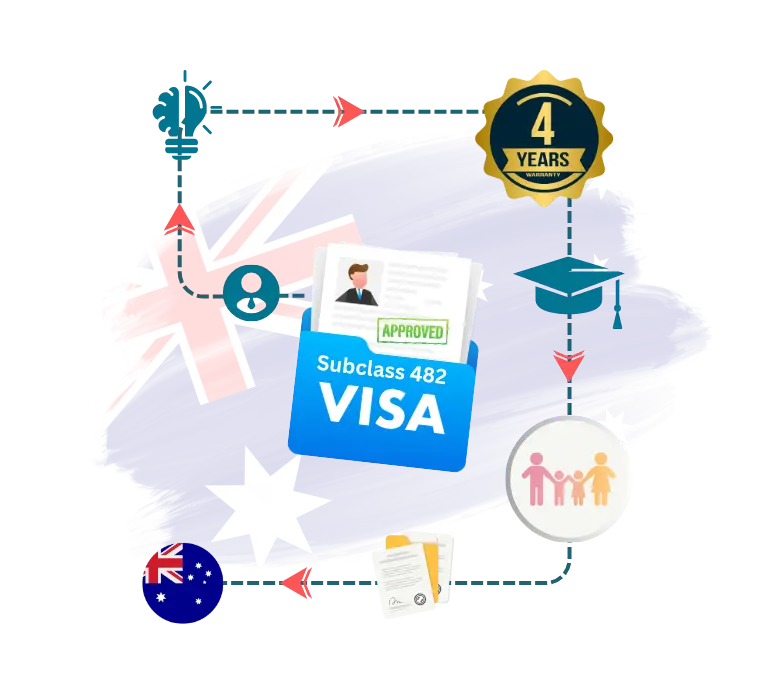
The visa runs for up to 4 years. It lets you bring your family. And it now offers a clearer path to permanent residency than the old TSS ever did. One of the biggest practical changes: the window to find a new sponsor after losing your job went from 60 days to 180 days. Another: you now need just 2 years of work before applying for permanent residency, down from 3. The Skills in Demand Visa Australia works through three separate streams. Each targets a different salary level and skill type. Knowing which stream fits your situation is the first step.
What Is the Skills in Demand Visa Australia?
The Subclass 482 is a temporary, employer-sponsored work visa. An Australian employer must nominate you before you can apply. The employer has to prove they could not find a suitable local worker for the role first.
This is not a points-tested visa. You do not need to score 65 points or go through SkillSelect. Your eligibility comes from your employer, your job, your qualifications, and your salary.
Once granted, you can work full-time with your sponsoring employer. Your partner and dependent children can come with you. They get full work and study rights too. The visa lasts up to 4 years, and in most cases leads toward permanent residency through the Subclass 186 visa.
The Three Streams of the Subclass 482
The Subclass 482 is split into three streams. Your stream depends on your salary and occupation.
Stream | Salary Threshold (2025–2026) | How It Works |
|---|---|---|
Specialist Skills | AUD 141,210 or above | No occupation list needed; 7-day processing |
Core Skills | AUD 76,515 – AUD 141,210 | Occupation must be on the CSOL |
Labour Agreement | Below the CSIT (sector-specific) | Requires a formal Labour Agreement with the government |
Specialist Skills Stream
This one is for high earners. If your offered salary is AUD 141,210 or more, your employer can sponsor you without checking any occupation list. The processing target is just 7 business days. That makes it one of the fastest employer-sponsored visa pathways in Australia. From 1 July 2026, the salary threshold goes up to AUD 146,717.
Core Skills Stream
This is where most 482 visa holders sit; around 70% of all grants fall under this stream. Your occupation has to be on the Core Skills Occupation List (CSOL). Your salary has to meet the Core Skills Income Threshold (CSIT) of AUD 76,515. From 1 July 2026, the CSIT rose to AUD 79,499. Both amounts are adjusted every year based on Australian wage data (AWOTE).
Labour Agreement Stream
This stream runs through a formal agreement between the employer and the Australian Government. It is used in sectors with very specific or hard-to-fill needs mainly aged care, disability support, and some regional industries. The government is planning to rebrand this as the Essential Skills Stream, but that transition is still underway.
Skills in Demand Visa Occupation List (CSOL)
The Core Skills Occupation List CSOL is the official list of jobs eligible under the Core Skills Stream. It replaced three older lists: the STSOL, MLTSSL, and ROL. The CSOL has 456 occupations. All sit within ANZSCO Skill Levels 1 to 3.
Jobs and Skills Australia (JSA) manages the list. They update it based on real vacancy data and employer feedback. Some roles were recently added Data Analyst, Supply Chain Analyst, Child Care Worker, and Tour Guide among them. Others were removed, including Café and Restaurant Manager and Graphic Designer.
Not on the CSOL? You may still qualify under the Specialist Skills Stream if your salary clears AUD 141,210.
Engineers can check their ANZSCO code and occupation category through the CDR ANZSCO Code guide on CDR for Australia.
Skills in Demand Visa Australia Eligibility Requirements
Both the employer and the applicant have to meet conditions. Here is what each side needs:
What the employer must do:
The employer needs Standard Business Sponsor (SBS) approval. They have to run labour market testing first, usually 28 days of job advertising on platforms like SEEK or Indeed to show no local worker was available. They also pay the Skilling Australians Fund (SAF) levy and must prove the business is financially viable.
What the applicant must meet:
Your nominated occupation has to match your qualifications and work history. You need at least 1 year of full-time relevant work experience within the past 5 years. That dropped from the 2-year requirement under the old TSS visa. Your English has to meet the minimum for the Core Skills Stream, that is IELTS 5.0 overall with no single band below 5 (for tests sat on or after 13 September 2025). A medical exam and police clearance are also required.
Most occupations also need a skills assessment from a relevant authority. For engineering, that is Engineers Australia. Engineers whose qualifications are not recognised under international accords need to submit a CDR a Competency Demonstration Report. Without a positive outcome from Engineers Australia, the visa application cannot proceed. The Engineers Australia CDR approval process page walks through exactly what is involved.
How to Apply for the Skills in Demand Visa Australia
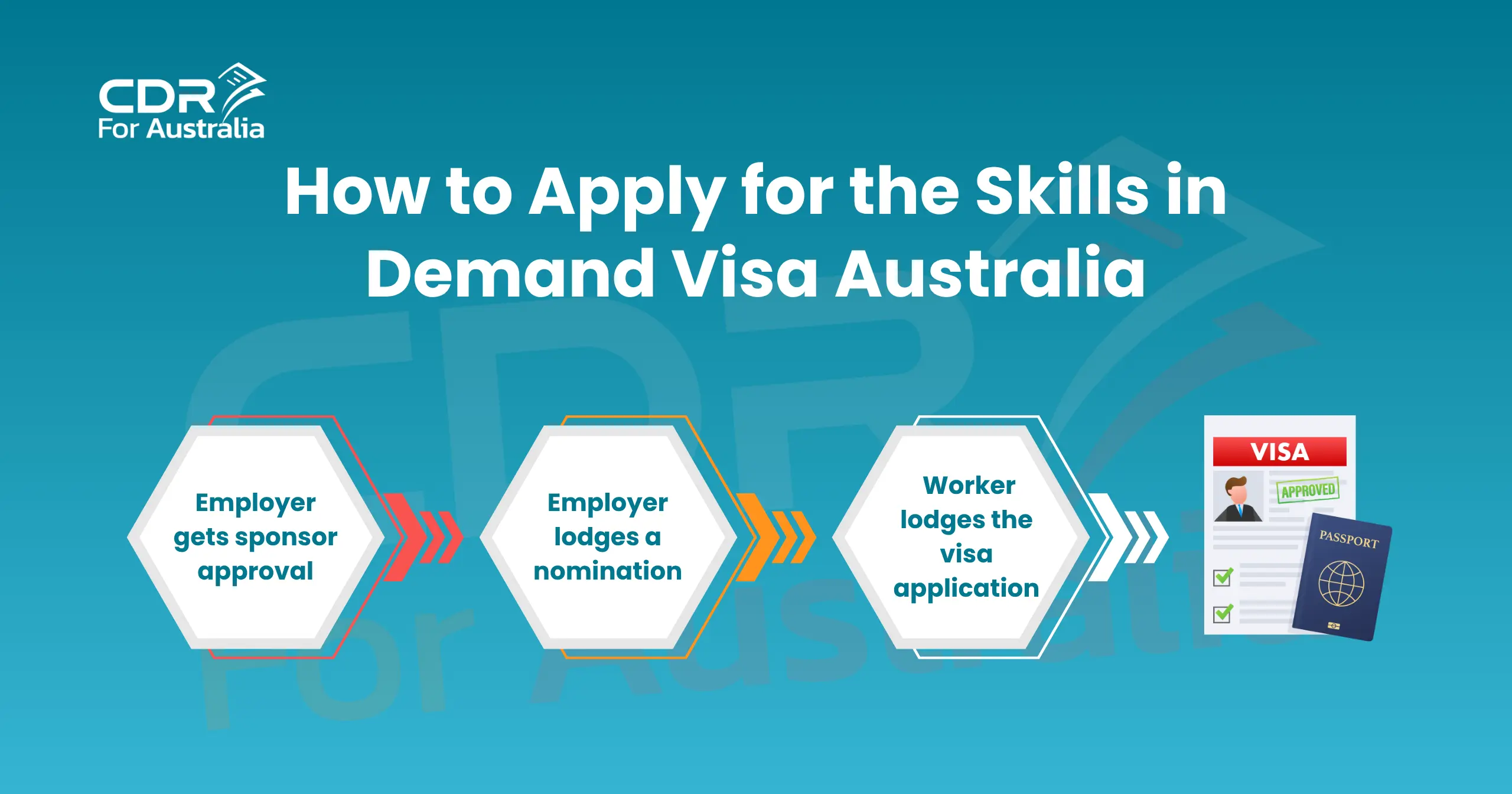
There are three stages to the application. All three must happen in order.
Stage 1 – Employer gets sponsor approval. The employer applies to become a Standard Business Sponsor through ImmiAccount. Approval lasts up to 5 years for businesses that have operated for more than 12 months.
Stage 2 – Employer lodges a nomination. The employer nominates the position and the overseas worker. They submit labour market testing records, salary details, and role information.
Stage 3 – Worker lodges the visa application. You apply online through ImmiAccount with qualifications, work experience, English test results, health assessments, and your skills assessment outcome.
For engineers, the skills assessment from Engineers Australia comes before anything else. Those with non-accredited qualifications need a CDR for Australia, a Competency Demonstration Report that includes three career episodes, a summary statement, and a CPD list. For IT professionals, the ACS RPL skills assessment is the relevant pathway.
Most In-Demand Occupations in Australia
Australia’s labour shortages are real and spread across multiple sectors. Jobs and Skills Australia’s 2025 Occupation Shortage Report found that Skill Level 3 trades roles have a national fill rate of just 54.5%. That means more than 4 in 10 trade vacancies are going unfilled.
The occupations that see the most employer sponsorship under the Subclass 482 fall across these sectors:
- Healthcare: Registered Nurses, General Practitioners, Physiotherapists
- IT: Software Engineers, Data Analysts, Cybersecurity Specialists, Systems Analysts
- Engineering: Civil, Mechanical, Electrical, and Structural Engineers
- Trades: Electricians, Plumbers, Construction Project Managers
- Education and Care: Early Childhood Teachers, Child Care Workers
For engineers, the path to sponsorship starts with a skills assessment. The CDR report format for Engineers Australia explains the structure required and what assessors look for.
Subclass 482 Visa Fees
Visa Application Charges (Applicant Pays)
Applicant | Visa Application Charge (AUD) |
Primary Applicant | 3,210 |
Additional Applicant (18 years and over) | 3,210 |
Additional Applicant (Under 18 years) | 805 |
Employer Sponsorship Fees (Employer Pays)
Fee | Amount (AUD) |
Standard Business Sponsorship (SBS) Application (Valid for 5 years) | 420 |
Nomination Application Fee | 330 |
Skilling Australians Fund (SAF) Levy (Employer Pays)
Business Size | SAF Levy |
Annual turnover under AUD 10 million | 1,200 per year (or part thereof) |
Annual turnover AUD 10 million or more | 1,800 per year (or part thereof) |
Other Costs (Applicant Pays)
Expense | Cost |
Skills Assessment (if required) | Varies by assessing authority |
English Language Test | Varies by test provider |
Medical Examination | Varies |
Police Clearance Certificate | Varies |
Biometrics (if required) | Varies |
Potential Additional Charge
Charge | Amount (AUD) | When It Applies |
Subsequent Temporary Application Charge (STAC) | 700 | Applies only to certain applicants already in Australia on eligible temporary visas. |

Looking for expert CDR Writer for Engineers Australia?

Creating a CDR Report may be difficult due to Engineers Australia’s standards and rules ( EA ). Our experienced engineers have assisted many people in obtaining approval for their report from the EA via the use of powerful projects.
Subclass 482 Processing Time
Speed depends on the stream.
- Specialist Skills applications are processed within approximately 7 business days. That fast turnaround is built into the system to attract high-earning talent quickly.
- Core Skills Stream applications typically take 2 to 6 months. The exact time depends on how complete your documents are, whether your occupation needs a skills assessment, and how long health and character checks take.
- Labour Agreement Stream timing varies. It depends on the terms of the specific agreement your employer holds.
One practical point: incomplete applications slow everything down. Getting all documents right before lodgement saves significant time.
Age Limit for the Skills in Demand Visa Australia
There is no age limit on this visa. You can be 50, 55, or older and still get sponsored. The Subclass 482 does not cap applicants by age.
The age question becomes relevant when you apply for permanent residency later. Under the Subclass 186 Temporary Residence Transition stream, you generally need to be under 45 when you lodge that PR application. Some exemptions apply for example, if your annual earnings exceed AUD 175,000, or if you work in certain occupation groups like medicine or academia.
Skills in Demand Visa Australia Pathway to PR
One of the biggest improvements under the new framework is the PR pathway. It is now open to all streams, and the timeline is shorter.
The main route is through the Employer Nomination Scheme Subclass 186 via the Temporary Residence Transition (TRT) stream. You need 2 years of full-time work in your nominated occupation on a valid 482 visa. That time can be split across more than one approved sponsor, as long as the occupation stays the same.
At the PR stage, you also need Competent English IELTS 6.0 in all four bands, or equivalent and be under 45, unless an exemption applies. The 2-year rule replaced the old 3-year requirement. That is a meaningful difference for long-term planning.
For a closer look at how skills assessment fits into the PR timeline, the VETASSESS skills assessment pathway page covers the process for non-engineering occupations.
Frequently Asked Question (FAQs)
What is the Skills in Demand Visa Australia and who is it for?
If you are from another country and are an Australian employer that has a skill gap and simply cannot fill it with local talent then the Subclass 482 can be used for skilled workers. That gap can be in health, engineering, IT, trades, education etc.
What are the salary thresholds for the Skills in Demand Visa Australia?
Your pay has to meet a minimum depending on which stream you’re applying through. Right now, through June 2026, that’s AUD 76,515 for Core Skills and AUD 141,210 for Specialist Skills. Come July 2026, those go up to AUD 79,499 and AUD 146,717. It’s not a one-time figure either; the thresholds get adjusted every year to keep pace with Australian wages.
Is there an age limit for the Skills in Demand Visa?
None at all for the 482 itself. Whether you’re 28 or 58, age won’t stop you from being sponsored. That said, if permanent residency is your long-term goal through the Subclass 186, you’d need to be under 45 when you apply for that unless an exemption applies to your situation.
How long does the Skills in Demand Visa Australia take to process?
Specialist Skills applications move fast; there’s a 7-business-day processing target. Core Skills is a different story; it usually lands somewhere between 2 and 6 months. What affects that timeline most is how complete your application is from day one. Missing documents, pending skills assessments, or health checks that take time can all slow things down. The cleaner your submission, the smoother things tend to go.
Can I bring my family on the Skills in Demand Visa?
Absolutely. Your partner and kids can come with you and be included in the same application. They won’t have restrictions on work or study once they’re in Australia, and their visa runs for the same length as yours. Do budget for the extra costs though each family member adds government fees on top, plus you’ll need to arrange health insurance to cover them.
What is the pathway from the Skills in Demand Visa to PR?
Two years of full-time work in your nominated role gets you to the front door of permanent residency. From there, you apply through the Subclass 186 Temporary Residence Transition stream. You’ll need to show Competent English and be under 45 when you lodge though exemptions exist for some applicants. One thing that catches people off guard: those two years don’t have to be with the same employer. You can move between approved sponsors, as long as you stay in the same occupation throughout.
What occupations are on the Skills in Demand Visa occupation list?
The Core Skills Occupation List sits at 456 occupations right now, covering everything from nurses and engineers to electricians and teachers. It’s not a permanent, set-in-stone document Jobs and Skills Australia revisits regularly and adjusts based on where the country actually needs workers. If your job isn’t on the list, don’t write yourself off just yet. The Specialist Skills Stream doesn’t use the occupation list at all. It’s purely salary-based, so if your earnings clear the threshold, the door may still be open.