


South Australia State Nomination 2026: Increase Your PR Chances
South Australia state nomination gives skilled workers a real shot at strengthening their case for permanent residency in Australia. Once the South Australian government nominates someone, that person can apply for either the Skilled Nominated visa (subclass 190) or the Skilled Work Regional Provisional visa (subclass 491). The nomination itself is worth five extra points on the 190 visa and fifteen on the 491, and for a lot of applicants, that bonus is what turns a borderline Expression of Interest into a competitive one.

South Australia has been unusually active in this space lately, sending out invitations by the hundreds in almost every round, even as some other states and territories have scaled back or shut their programs for the year. The occupation range is wide too, covering everything from engineers and nurses to teachers, agricultural specialists, and IT professionals. Both onshore applicants already based in South Australia and offshore applicants overseas can apply, though the two paths aren’t identical in how they work.
What follows covers how South Australia state nomination actually operates, who qualifies, which jobs make the list, how invitation rounds are run, and what paperwork gets asked for. There’s also a comparison with other state programs, including Western Australia state nomination and NSW state nomination, so applicants can weigh up where their occupation might land better odds.
What Is South Australia State Nomination?
At its core, South Australia state nomination is an official endorsement from the state government, given to skilled workers whose background fits the state’s current labour gaps. It’s a separate step from the visa itself; the Department of Home Affairs still issues the actual visa, but nomination from South Australia is usually the prerequisite for both the subclass 190 and subclass 491 routes.
Before any of that happens, applicants submit an Expression of Interest through SkillSelect, the government’s online skilled migration system. Those already living and working in South Australia have an extra option: a Registration of Interest through the state’s own migration portal, lodged before an invitation even arrives. If everything checks out, the applicant is nominated, and from there they can apply for the visa itself with Home Affairs, usually within a fixed window.
This pathway is attractive to many applicants because it opens up occupations the federal skilled independent visa (subclass 189) doesn’t cover. Quite a few roles ineligible for the 189 sit comfortably on South Australia’s own list. That’s part of why the program keeps drawing applicants whose points score doesn’t quite clear the 189 threshold.
Benefits of South Australia State Nomination
There are a handful of practical reasons this pathway keeps coming up in migration planning:
- An additional five points (190 visa) or fifteen points (491 visa) on the points test
- Access to a wider occupation list than the federal skilled independent visa
- A clear route to permanent residency immediate for the 190, or after three years for the 491
- Local support for skills recognition, job hunting, and settling in
- Room to include eligible family members on the same application
None of this guarantees success, but it explains why so many applicants keep South Australia on their radar even when other options look shakier.
South Australia State Nomination Streams
South Australia runs a handful of nomination streams, and each one is built for a different kind of applicant. Knowing which one fits your situation matters more than most people expect.
Skilled Employment in SA
for people already living and working in South Australia in their nominated occupation
South Australia Graduates
A fast-track option for international students who studied and worked locally
Outer Regional Employment
For applicants based in outer regional South Australia, outside Greater Adelaide
Offshore Migration Stream
For applicants overseas who submit an EOI through SkillSelect and get invited directly
South Australia State Nomination Requirements
Requirements here come from two directions: the South Australian government sets its own conditions, and the Department of Home Affairs adds its own on top. Applicants need to clear both before nomination is even on the table.
Broadly, this means having an occupation on South Australia’s Skilled Occupation List and holding a positive skills assessment from whichever body assesses that occupation. Applicants also need to meet the minimum points test score generally 65 once the nomination bonus is factored in plus the English requirement, usually Competent English or above. On top of that, there’s a commitment to actually live and work in South Australia for at least two years after the visa comes through, and sometimes occupation-specific conditions like a minimum stretch of work experience or a particular licence.
The table below breaks down how the two main visa subclasses compare.
Feature | Subclass 190 | Subclass 491 |
Visa type | Permanent | Provisional (5 years) |
Location requirement | Live in South Australia | Live in regional South Australia |
Points bonus | 5 points | 15 points |
Pathway to PR | Immediate on grant | After 3 years, via subclass 191 |
SA nomination fee | AUD 381 | AUD 381 |
Home Affairs visa application fee (approx.) | AUD 4,640 – 4,765 | AUD 4,640 |
Note: The Home Affairs visa fee is separate from the SA nomination fee and is generally lower for the provisional 491 visa than the permanent 190. Confirm the current rate on the Department of Home Affairs website before lodging.
For applicants short on points for the 190, the 491 visa is often the more workable choice, the bigger points bonus tends to offset slightly less competition in some occupations.
South Australia State Nomination Occupation List
The occupation list is what decides whether a job qualifies for nomination at all. South Australia keeps two separate lists one for onshore applicants, one for offshore and they’re not the same length or the same content.
The onshore list is fairly generous, running into several hundred occupations for people already settled in South Australia. Offshore is a tighter list, built to plug specific shortages the local workforce can’t fill fast enough. It’s worth double-checking the current version before applying, since South Australia updates it periodically as labour needs shift.
Health and aged care sit near the top of the priority list right now, alongside engineering and IT. Education, agriculture and food production, and defence-linked manufacturing round out the rest, each reflecting a gap the state is actively trying to close.
Engineers usually need a positive skills assessment before their occupation even gets considered for nomination. Getting the Competency Demonstration Report right matters a lot here mistakes in this document are one of the more common reasons assessments get delayed or knocked back.
Applicants can check the current Skilled Occupation List straight from the state government’s migration website before lodging an EOI. For a broader look at how occupation lists work across the country, our own Skilled Occupation List page covers that in more detail.
South Australia State Nomination for Offshore Applicants
Offshore applicants make up a sizable chunk of nominations issued each year. Unlike onshore candidates, they don’t lodge a Registration of Interest at all, just an Expression of Interest through SkillSelect, then wait to be picked directly by the state.
That usually means having an occupation on the offshore list, a positive skills assessment completed before the EOI goes in, and enough points to be genuinely competitive offshore places are limited compared to onshore, so the bar tends to sit higher. There’s also the expectation of actually intending to live and work in South Australia once the visa lands, not just using it as a stepping stone.
Competition can get tight for popular offshore occupations like accounting or software engineering, simply because so many applicants overseas are chasing the same limited spots. Less crowded occupations, especially ones tied to regional shortages, often move faster.
South Australia State Nomination Invitation Round
Rather than accepting applications on a rolling basis, South Australia works through scheduled invitation rounds. Each one targets a set number of places split across the 190 and 491 subclasses.
The pattern is fairly consistent: South Australia reviews whatever EOIs and ROIs are sitting in the system, then selects candidates based on occupation demand, points, and stream eligibility. Once invited, applicants generally have around 14 days to lodge their nomination application.
How many invitations go out in a given round depends heavily on how many places are left in that year’s allocation. Early rounds tend to be larger, since most of the annual quota is still untouched. As the months pass and places fill up, rounds shrink, and certain occupations can close off well before others.
It pays to keep an eye on announcements an invitation round can open and close for a specific occupation with very little warning.
How to Apply for South Australia State Nomination
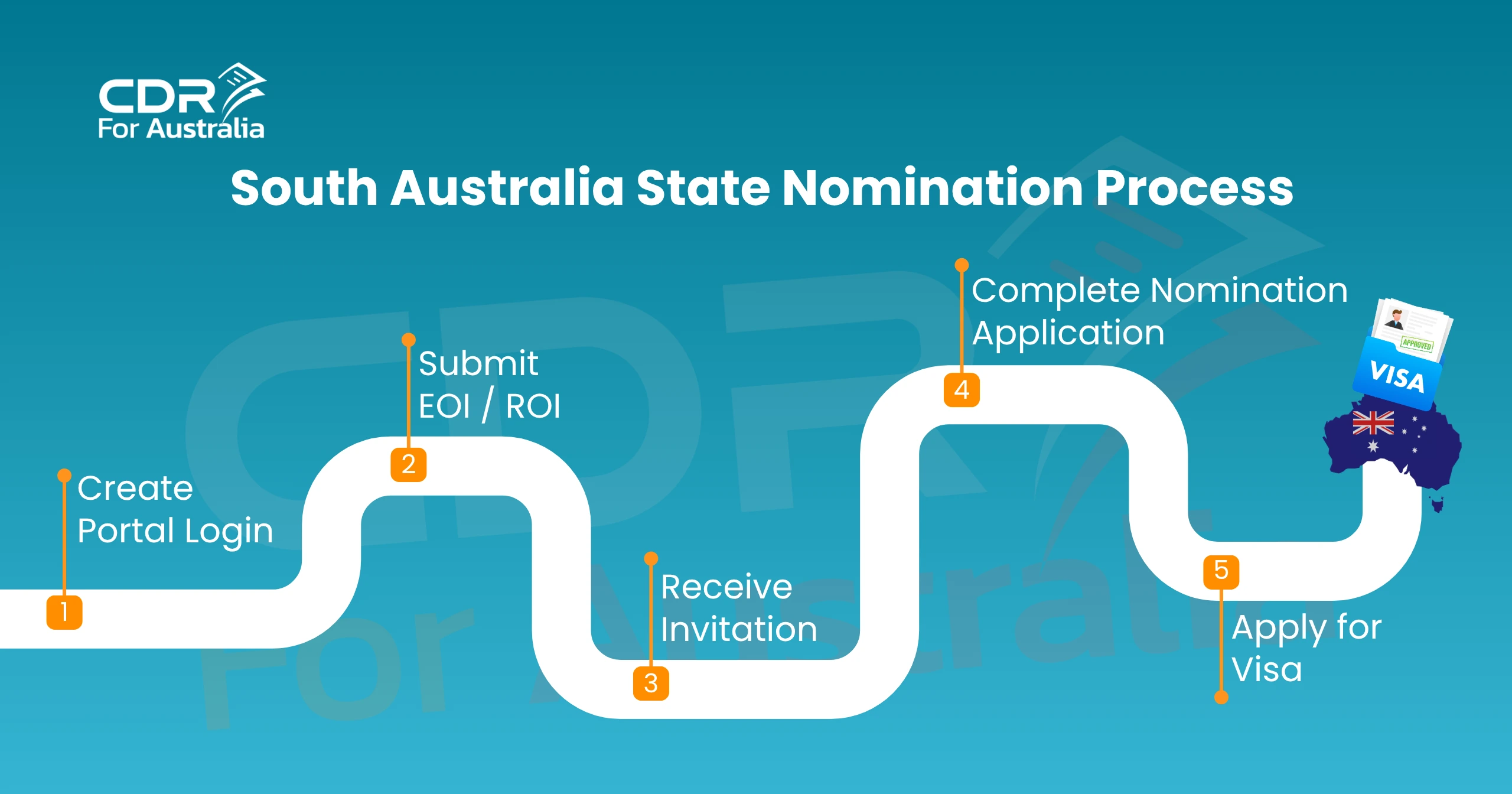
Once invited, applicants work through the state’s Skilled and Business Migration portal. Setting up a login is one of the first things to do, since every document and form goes through that account from that point on.
- Create a login for the South Australian migration portal
- Submit an EOI through SkillSelect (offshore applicants) or an ROI through the state portal (onshore applicants)
- Wait for an invitation during a nomination round
- Complete the nomination application inside the portal once invited
- Upload supporting documents, skills assessment, English test results, employment evidence
- Pay the nomination application fee
- Wait for the nomination decision
- If nominated, apply for the visa with the Department of Home Affairs within the required window
Hold onto those portal login details. That account is how applicants track progress and hear from the South Australian government throughout the whole process.
SA State Nomination Compared to Other States
This program is just one of several state and territory options running across the country, each with its own occupation list, points expectations, and invitation schedule. Comparing them side by side can make it easier to pick the right target, especially for applicants juggling more than one Expression of Interest at once.
Western Australia state nomination
for instance, leans heavily toward resources and mining occupations, along with health and construction roles. Its occupation list runs through a separate process and doesn’t line up neatly with South Australia’s trades and technical roles prioritised often differ quite a bit.
NSW state nomination
It tends to pull candidates directly from the SkillSelect pool, skipping a separate application stage for many streams, and it generally favours higher points scores often north of 90 for competitive occupations. That makes it noticeably more selective than the South Australian program for a lot of applicants.
South Australia
By comparison, is often seen as more accessible across a wider spread of occupations, particularly through the 491 regional pathway. Applicants who don’t quite measure up for NSW or Western Australia sometimes find better odds here, especially if a regional posting rather than a capital city is on the table. Whichever state ends up being the target, it’s worth running a full points test calculation and locking in a positive skills assessment first both are the foundation every state nomination application rests on.
South Australia also runs a couple of concessions that aren’t always obvious from the headline criteria. The age limit sits higher than the federal cutoff in some cases, and certain occupations qualify for a reduced salary threshold or relaxed English requirement compared to the standard rules. These concessions shift from year to year depending on which sectors are under the most pressure, so it’s worth checking the current criteria for a specific occupation. South Australia has also extended its Designated Area Migration Agreements, which let employers in certain regions sponsor overseas workers outside the usual occupation list, a separate pathway worth knowing about if a regional job offer is already on the table.

Looking for expert CDR Writer for Engineers Australia?

Creating a CDR Report may be difficult due to Engineers Australia’s standards and rules ( EA ). Our experienced engineers have assisted many people in obtaining approval for their report from the EA via the use of powerful projects.
Documents Required for the Application
Getting documents together early tends to save time later, since incomplete applications are one of the more common causes of delay. You’ll typically need:
- A positive skills assessment for your nominated occupation like VETASSESS, Engineers Australia.
- English test results (IELTS, PTE Academic, or equivalent)
- Proof of employment history, along with reference letters
- Educational qualifications and transcripts
- Identity documents, including a valid passport
- Evidence of ongoing employment in South Australia (depending on the stream)
It’s worth checking the official document checklist for the specific stream being used, since requirements shift a little between the skilled migrant, graduate, and business migration pathways.
Processing Time and Fees
Processing time isn’t fixed. It shifts depending on the visa subclass, how complete the application is, and how many applications the state is working through at that moment. Most nomination decisions land somewhere between a few weeks and a few months, though busy periods and peak invitation rounds can stretch that out further.
The nomination fee is billed separately from the visa application fee charged by Home Affairs. Applicants should budget for both, plus skills assessment costs, English testing, and any translation or certification work their documents might need.
Managing Your Portal Login
The portal login is essentially a single dashboard for the entire application. Once it’s set up, applicants can update contact details, upload anything a case officer asks for, and read messages as they come in. Losing access can genuinely slow things down if a document request lands and nobody’s checking the account so it’s worth keeping login details somewhere safe and logging in regularly during an active round. Most portals allow a password reset tied to the registered email if access does get lost, though re-verifying identity is often part of that process.
Frequently Asked Question (FAQs)
Which state in Australia gives PR easily?
No state hands out an easy path to permanent residency every nomination decision comes down to occupation demand, points score, and how many places are left. South Australia state nomination is often viewed as more accessible than some alternatives, mostly thanks to its broader occupation list and steady invitation rounds through the 491 pathway.
How to get nominated by a state in Australia?
It starts with an Expression of Interest through SkillSelect, confirming the occupation sits on the relevant state’s list, and holding a positive skills assessment. From there, it’s a waiting game for an invitation, followed by a formal nomination application to whichever state is chosen.
Which occupation is in high demand in South Australia?
Healthcare workers, engineers, ICT professionals, teachers, and agricultural specialists tend to dominate South Australia’s priority list. The exact mix shifts over time, so it’s worth checking the current Skilled Occupation List before applying.
How to check nomination status?
Status updates show up inside the Skilled and Business Migration portal once an applicant logs in progress gets posted directly against the account as it happens.
What is South Australia state nomination 491?
It’s a five-year provisional visa aimed at applicants willing to settle in regional South Australia. The points bonus is larger than the 190’s, and after three years it opens a route to permanent residency through the subclass 191 visa.
Is South Australia state nomination open to offshore applicants?
Yes. Offshore candidates apply through the Expression of Interest system, though the offshore occupation list is generally shorter and more selective than the onshore one.