


Invitation Round Australia 2026: SkillSelect Rounds Explained
If you’re planning a skilled migration move to Australia, you’ll run into the term invitation round Australia sooner or later. It refers to the process the Department of Home Affairs uses to pick candidates out of the SkillSelect pool and invite them to apply for a skilled visa. Before any of that can happen, though, you need an Expression of Interest, or EOI, sitting in the system. Submit one, and it joins thousands of others, all ranked by points score.

Then, during each invitation round Australia holds, the highest scorers in each occupation get pulled out and offered a chance to apply. This applies across the Skilled Independent visa (subclass 189), the Skilled Nominated visa (subclass 190), and the Skilled Work Regional visa (subclass 491). States and territories run their own nomination rounds too, on their own timelines, with their own rules. None of it lines up neatly, which is exactly why so many applicants get confused about when to expect a result. Understanding how these rounds are timed and scored makes that waiting period a lot less stressful, and a lot more strategic.
What Is an Invitation Round Australia?
An invitation round is simply a scheduled event where the Department of Home Affairs goes through all the active EOIs in SkillSelect and decides who gets invited. Not everyone does. Only applicants whose score clears the cut-off for their specific occupation in that round move forward; everyone else waits for the next one. Sixty-five points is the bare minimum to even submit an EOI, but hitting that number guarantees nothing. Competitive fields like accounting, ICT, and engineering routinely need scores well above it. What drives each round is a mix of workforce demand, occupation ceilings, and simply how many EOIs are already sitting in the pool for that occupation.
EOI vs Invitation Round Australia: What Is the Difference?
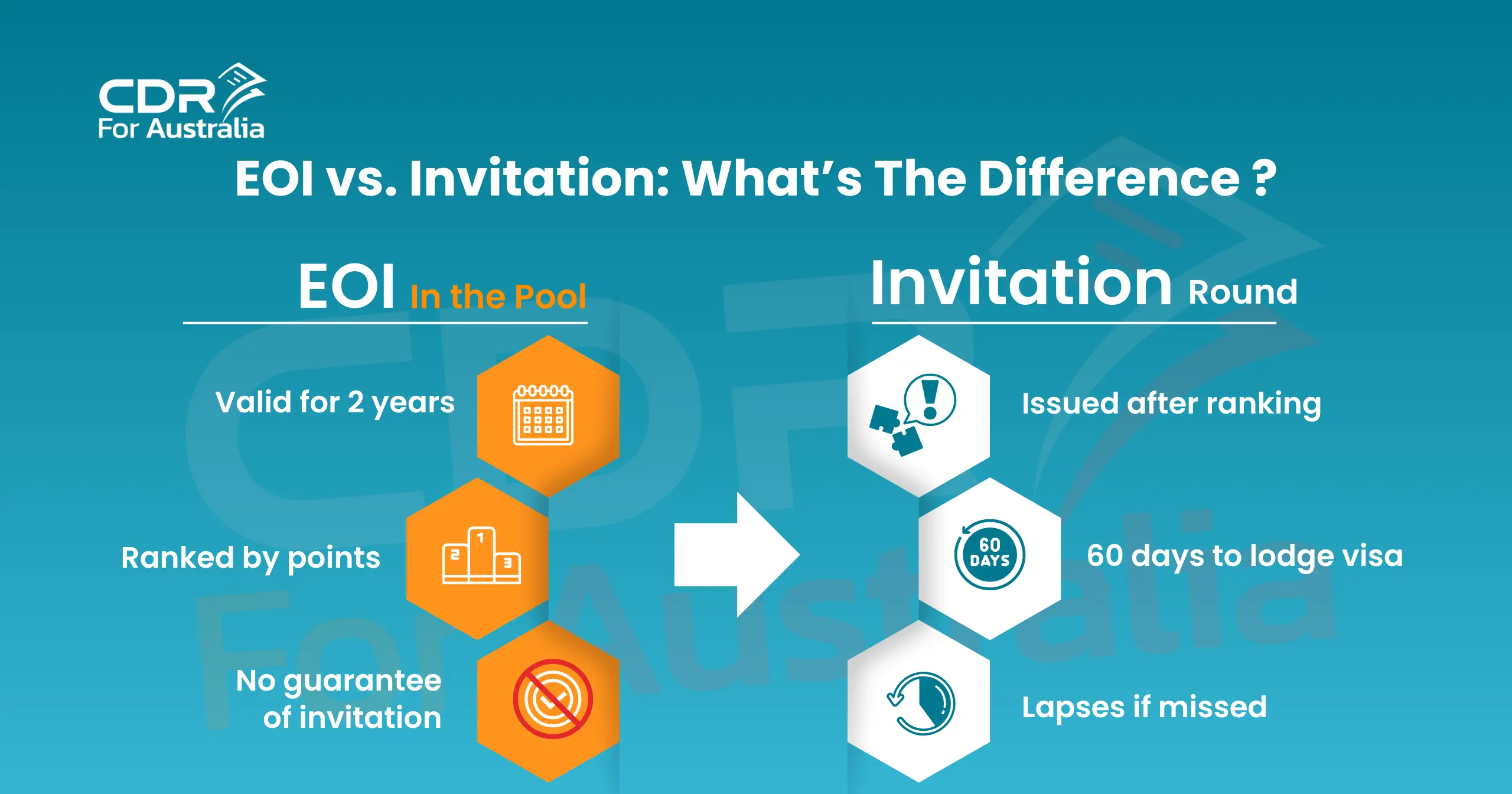
People mix these two up constantly. An EOI is just your profile sitting in the SkillSelect pool, waiting. An invitation is what happens once that EOI has actually been ranked and cleared the bar for a round.
Expression of Interest (EOI) | Invitation | |
What it is | Your profile in the SkillSelect pool | The formal outcome of a round |
When it happens | Submitted any time, before any round | Issued only after ranking against other EOIs |
What it guarantees | Nothing on its own | The right to lodge a visa application within 60 days |
How long it lasts | Valid for up to 2 years, and can be updated | Lapses if not acted on by the deadline |
You could hold a valid EOI for two years and never get drawn, if your score or occupation never clears the bar. That’s the reason experienced applicants treat their EOI as something to keep updating, not a form you fill out once and forget.
How the SkillSelect Invitation Round System Works
SkillSelect is the government’s online system for managing all of this. Once you lodge an EOI, your profile gets ranked on a points test covering age, English ability, experience, qualifications, and other factors. When a federal round runs, EOIs are ranked by score within each occupation. If two people land on the same score, the one who reached it first gets priority, a rule known as the date of effect. Not every state plays by this rule, though. New South Wales and Queensland both say outright they don’t use date of effect at all; they rank on points and overall profile strength instead. So the timing advantage really only matters for the federal 189 round and most other states.
Occupation ceilings matter here too, but only for the federal subclass 189 round and the family-sponsored 491 stream. These are yearly caps on how many invitations a single occupation can receive. Hit the cap, and that occupation is closed for invitations until the next program year, no matter how many strong EOIs are still waiting. State-nominated visas including the state-nominated 190 and 491 streams sit outside these federal caps, though individual states set their own limits.
If your background is in engineering and your qualifications still need formal recognition, a properly structured Competency Demonstration Report is usually the right place to start, well before you touch your EOI. Your occupation has to be positively assessed before you can claim points for it at all.
Types of Invitation Rounds: 189, 190, and 491
Search around for invitation round Australia updates and you’ll find two broad categories: the federal invitation round, and the state or territory nomination round.
Visa Subclass | Round Type | Managed By |
Subclass 189 | Federal invitation round | Department of Home Affairs |
Subclass 190 | State nomination round | State/territory government |
Subclass 491 | State/territory nomination, or family-sponsored round | State/territory government, or Home Affairs for the family-sponsored stream |
The 189 doesn’t need sponsorship or nomination at all; it lives or dies on your points score in the federal round. The 190 needs a state or territory nomination. The 491 is a bit more split: you can get there through state nomination, or through sponsorship by an eligible family member in a designated regional area. That split matters, because occupation ceilings apply to the 189 and to the family-sponsored 491 pathway, but not to the state-nominated streams. Anyone tracking their 190 visa or 189 visa timeline should watch both schedules separately; a strong federal score doesn’t automatically translate into a state offer.
How Often Does the Next Invitation Round Australia Take Place?
There’s no fixed weekly or monthly schedule for the federal round. The Department of Home Affairs runs them periodically across the program year, based on program capacity and how demand is tracking. Plenty of applicants search for exactly when the next invitation round Australia will hold, hoping to time their EOI submission around it. Honestly, submitting early with an accurate score works better than trying to guess a date the date of effect rule rewards whoever reaches their score first.
State rounds tend to be more frequent and easier to predict than the federal one. Quite a few states issue nominations on a rolling or monthly basis rather than waiting for one big annual event.
State and Territory Invitation Rounds
Every state and territory runs its own process, and the rules differ noticeably from one to the next. The most searched terms tend to be the Western Australia invitation round, the Victoria invitation round, and the Canberra Matrix invitation round used by the ACT but South Australia, New South Wales, Queensland, Tasmania, and the Northern Territory all matter too, and your chances can look completely different depending on which one you’re aiming at.
Western Australia
Western Australia keeps its own occupation lists separate from the federal system, generally favouring healthcare, trades, and regional shortage roles. WA has also run rounds outside its usual schedule when a specific occupation faces urgent shortages.
Victoria
Victoria issues invitations for its 491 and 190 visa streams under its own scoring criteria, and tends to favour applicants who already live and work in the state.
The Australian Capital Territory
This territory uses something called the Canberra Matrix instead of the standard SkillSelect points test, so a Matrix score can look nothing like a federal EOI score. ACT rounds come around roughly every few weeks, more often than most other jurisdictions.
South Australia
SA nominates through several streams tied to existing ties to the state current skilled employment or study there, mostly plus a dedicated stream for offshore applicants. Healthcare, engineering, and ICT occupations have consistently taken the largest share of invitations.
New South Wales
NSW runs invitation rounds continuously through the financial year, with no fixed public dates, and ranks purely on points and profile strength rather than date of effect. Queensland runs a separate Registration of Interest system and often favours offshore applicants for healthcare, engineering, and trade roles.
Tasmania and the Northern Territory
This territory generally has smaller allocations than the bigger states, which can mean less competition, a realistic option for applicants who might struggle to hit competitive scores elsewhere.
Every one of these regions has its own occupation list, so check the specific list for your nominated occupation before assuming you’re eligible. A round of invitation Australia-wide almost never applies evenly, since demand shifts heavily by region and sector.
Points Needed to Receive an Invitation
Sixty-five points gets your EOI in the door, but the score that actually gets you invited is almost always higher. In a typical round for the 189 visa, lower-competition occupations, some trades, and some healthcare roles might get invited near that minimum. Accounting, software engineering, and civil engineering, on the other hand, routinely need scores in the 85 to 95-plus range.
Much of that comes down to occupation ceilings combined with sheer volume popular categories simply attract more EOIs than the cap allows. If you’re in engineering, checking whether your occupation sits on the Core Skills Occupation List gives you a clearer read on demand before you fixate on a target score. Applicants working through the professional occupations pathway should double-check their ANZSCO code lines up correctly with the ceiling data published for each round.
Common Reasons Applicants Miss Out in an Invitation Round Australia
Missing out is common, and it usually doesn’t mean you did anything wrong. Most of the time it comes down to one of these:
- Score below the cut-off: Clearing the general 65-point minimum doesn’t mean you’ve cleared the cut-off for your specific occupation in that round.
- Occupation ceiling reached. Once an occupation hits its yearly limit, invitations stop for it regardless of score.
- Outdated EOI details: Points claimed for work experience, English ability, or qualifications no longer match where you actually stand, which drags down your ranking.
- Bad timing on date of effect: For the federal round and most states, applicants with equal scores are ranked by how long they’ve held that score. A late update can push you behind someone who reached the same score earlier. This doesn’t apply everywhere; NSW and Queensland rank on points and profile strength instead.
Knowing these factors helps you troubleshoot a missed round instead of assuming your profile just isn’t good enough.
What Happens After You Receive an Invitation?
Once you’re selected in an invitation round Australia has scheduled, you’ll get a formal notification through your SkillSelect account. From there, you have 60 days to lodge a complete, valid visa application, and there’s no extension for a missed deadline. Get your supporting documents ready well ahead of time skills assessment outcomes, English test results, all of it.
That 60-day window is specifically for the final visa application stage. If you’re going the state-nominated route, the state’s invitation to apply for nomination is an earlier, separate step, and some states give you far less time to respond. NSW, for instance, allows only 14 days to respond to a nomination invitation, with no extensions. Don’t assume 60 days applies at every stage, check whatever deadline is actually stated in the notification you receive.
For engineers, this usually means the skills assessment needs to be locked in well before the EOI stage. You can’t claim points for your nominated occupation without a positive assessment behind it.

Looking for expert CDR Writer for Engineers Australia?

Creating a CDR Report may be difficult due to Engineers Australia’s standards and rules ( EA ). Our experienced engineers have assisted many people in obtaining approval for their report from the EA via the use of powerful projects.
Tips to Prepare for the Next Invitation Round Australia
A few habits genuinely improve your position heading into the next round. Keep your EOI accurate and updated the moment anything changes it affects your date of effect and your ranking more than most applicants realise. If your occupation is competitive, aim well above the 65-point minimum, since many rounds close out far above that floor anyway.
It also pays to track both federal and state-specific occupation lists side by side. Eligibility and demand can look completely different between them. An occupation that struggles to clear the federal cut-off might be in strong demand under a particular state’s criteria. Improving your English test score is another lever worth pulling, since it carries real weight in the points test. And make sure your skills assessment is finalised and still valid before you submit your EOI; an expired or incomplete one can hold up your entry into the pool entirely.
Reviewing recent visa processing time trends alongside invitation activity helps set realistic expectations for how long the whole pathway might take once an invitation lands. For the most current data on cut-off scores and occupation ceilings, the Department of Home Affairs SkillSelect page publishes results after every round.
Frequently Asked Question (FAQs)
When was the last invitation round Australia?
The most recent federal and state nomination rounds are published directly on the Department of Home Affairs SkillSelect page, along with occupation-specific cut-off scores for each round.
What is an invitation round for an Australian skilled visa?
It’s the process where Home Affairs, or a state and territory government, selects EOIs from the SkillSelect pool and invites the highest-ranking applicants to apply for a skilled visa such as the 189, 190, or 491.
When can we expect the next 189 invitation round?
There’s no fixed date. Home Affairs schedules subclass 189 rounds periodically across the program year based on occupation ceilings and workforce demand, so it’s worth monitoring SkillSelect announcements directly.
When is the Western Australia invitation round held?
WA runs its own nomination schedule separate from the federal system, often issuing invitations on a rolling basis depending on occupation demand and its priority lists.
When is the next invitation round for Australia expected?
Federal rounds don’t follow a fixed monthly pattern, while several states issue nominations more often. Checking both the federal SkillSelect page and your relevant state migration website gives the clearest picture.
How is the minimum score decided in each round?
The cut-off depends on how many EOIs are competing within an occupation and how many places remain under that occupation’s ceiling for the program year.
Do state nomination rounds follow the same points test as the federal round?
Not always. Most states use the same points test, but the Australian Capital Territory runs its own separate scoring system called the Canberra Matrix.
What is the latest invitation round for Australia in 2026?
Details on the latest round, including invitation numbers and minimum points by occupation, are updated on the official SkillSelect results page once each round is finalised.