


Training Visa Australia (Subclass 407): Eligibility and Application Process
The Training Visa Australia program gives overseas professionals a structured way to build job-specific skills inside an Australian workplace. Officially called the Subclass 407, it is not a general work visa. It is built around one clear purpose: helping a person complete occupational training, gain professional registration, or take part in a formal development program under the supervision of an approved Australian sponsor. Many applicants confuse this pathway with employer-sponsored work visas, but the intent behind it is different from the start.
The visa holder trains under a fixed plan, works only for the sponsoring organisation, and can stay for up to two years. Sponsorship can come from an Australian business, an overseas company sending staff to Australia, or a government agency. From March 2026, the Department of Home Affairs also changed how applications move through the system, so sponsorship and nomination now need approval before the visa application itself can be lodged. Anyone weighing this pathway needs a clear picture of eligibility, the three training streams, required documents, fees, working hours, and processing timelines before preparing their case.
What Is the Training Visa Australia (Subclass 407)?
The Subclass 407 is a temporary visa that lets someone travel to Australia to complete workplace-based occupational training or a professional development program. It’s issued for a maximum of two years, tied directly to an approved training plan. It doesn’t lead to permanent residency on its own. Plenty of holders, though, later use the Australian work experience they gained during training to strengthen applications for other skilled or employer-sponsored pathways.
Unlike a standard employment visa, this route isn’t meant to fill a staffing gap. The Department of Home Affairs checks that the applicant’s main reason for coming to Australia is genuine skill-building rather than ongoing paid employment. That distinction shapes almost every part of the application, from the training plan itself to the questions a case officer might ask during assessment.
Who Can Sponsor a Training Visa Australia Applicant?
Sponsorship is where every Subclass 407 application starts. An individual can’t sponsor themselves, and a sole trader can’t act as sponsor either. Eligible sponsors are limited to an Australian business that wants to provide structured training to an overseas staff member or new trainee, an overseas company sending its own employee to an Australian branch or partner organisation for skill development, or an Australian or overseas government agency running a formal training or capacity-building program.
Before nominating anyone, the sponsoring organisation has to become an Approved Temporary Activities Sponsor first. That approval is generally valid for five years, and it requires the business to show financial stability, its ability to meet sponsorship obligations, and details of the training program it intends to run. Only once this approval is granted can the sponsor go on to lodge a nomination for a specific applicant.
Streams Under the Subclass 407
The Training Visa Australia Subclass 407 covers three distinct training streams. Picking the right one matters, because each carries its own documentation requirements.
Registration or Licensing
For applicants who need supervised, workplace-based training to gain professional registration, membership, or a licence in their occupation, in Australia or their home country.
Skill Enhancement
For applicants with recent, relevant experience who need a formal training program to strengthen an existing skill set in their nominated occupation.
Overseas Capacity Building
For applicants supported by a government agency, or sent by an overseas employer, to complete practical training, research, or observation applied outside Australia.
Each stream requires a tailored training plan that outlines learning objectives, the split between hands-on work and classroom instruction, and how the training addresses a genuine skill gap. Generic or vague plans are one of the most common reasons applications are refused.
Eligibility Requirements for the Training Visa Australia
To qualify for this visa, applicants generally need to meet the following:
- Nominated by an approved sponsor under one of the three training streams
- At least 12 months of relevant full-time work, part-time equivalent, or recent study connected to the nominated occupation
- Functional English, sufficient to understand training instructions and workplace safety procedures
- Standard health and character requirements
- Genuine temporary intent, meaning plans to return home or move to another visa pathway once training ends
- Adequate health insurance for the entire stay
- No outstanding debts to the Australian Government, or a repayment arrangement in place
Applicants without direct work experience can still qualify as recent graduates, provided they’ve completed a closely related qualification in Australia within the last 12 months. That makes the pathway a realistic option for recent graduates on a Subclass 500 or Subclass 485 visa who want practical, employer-based experience before moving on to other skilled visas.
Subclass 407 Application Process
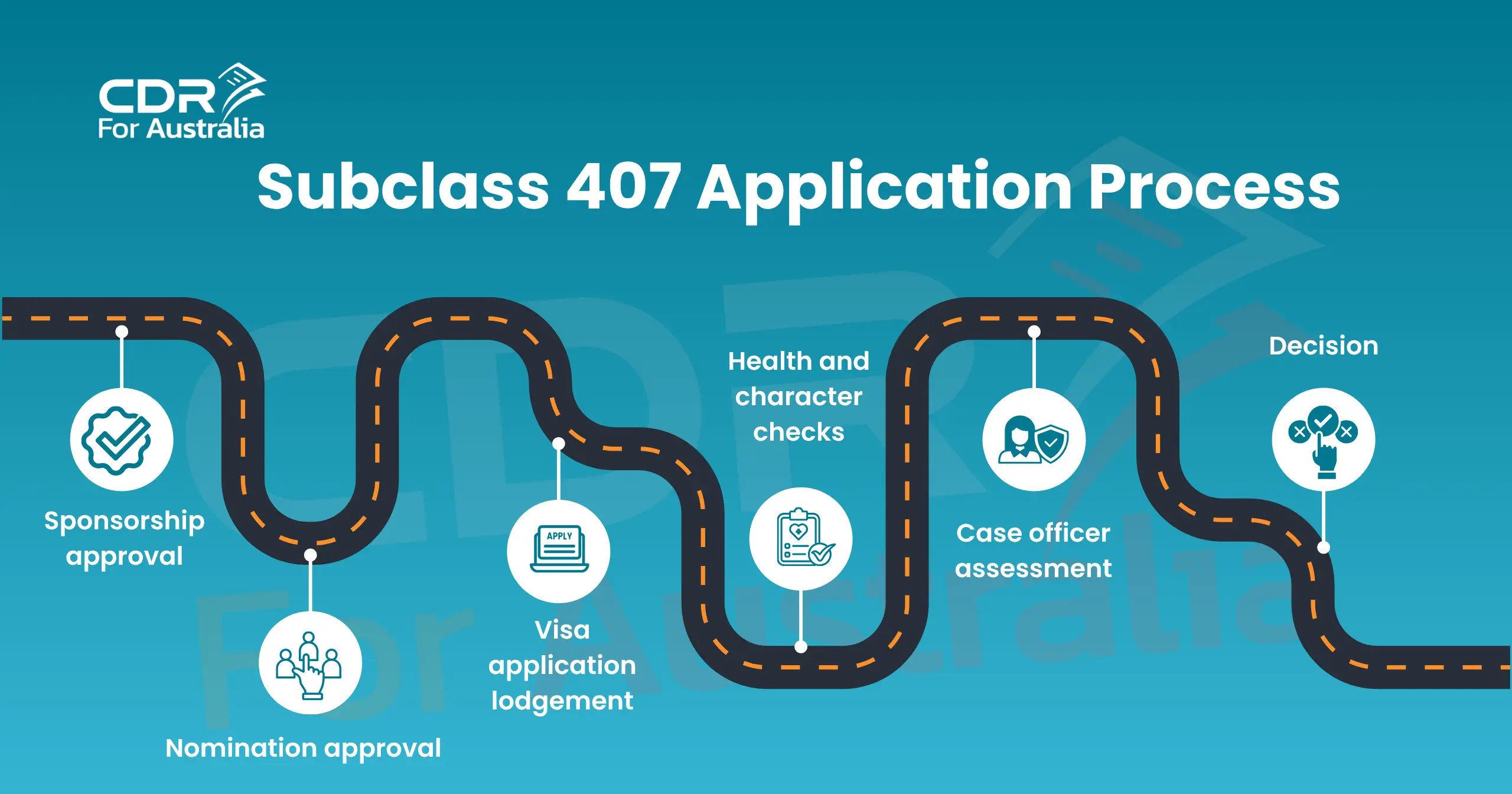
The application process follows a strict sequence now, especially since the March 2026 policy change removed the option of lodging sponsorship, nomination, and visa applications together.
- Sponsorship approval. The Australian or overseas organisation applies to become an Approved Temporary Activities Sponsor through ImmiAccount.
- Nomination approval. Once approved, the sponsor submits a nomination identifying the applicant, the training stream, and the structured training plan.
- Visa application lodgement. Only after both sponsorship and nomination are approved can the applicant lodge the visa application, with supporting documents and the visa fee.
- Health and character checks. The Department may request a health examination through a panel physician, and police clearances, at any stage of assessment.
- Case officer assessment. A visa officer reviews the full application and may issue a Section 56 request if further information is needed.
- Decision. The applicant receives a grant or refusal notice by email. If granted from outside Australia, the applicant should wait for written confirmation before booking travel.
Because sponsorship and nomination now have to be approved before the visa is lodged, applicants should build in a longer overall timeline than in previous years. Employers who regularly bring in trainees would do well to start the sponsorship and nomination stages well ahead of the intended training start date.
Documents Required for the Application
A complete application reduces the chance of delays or a Section 56 request for extra information. Here’s what applicants typically need:
- A valid passport with at least six months’ validity beyond the intended stay
- Evidence of the approved nomination and sponsorship
- The detailed training plan prepared by the sponsor
- Proof of relevant work experience or study, such as employment references or academic transcripts
- English language test results, unless exempt
- Health examination results, if requested
- Police clearance certificates for any country lived in for 12 months or more in the past 10 years
- Proof of health insurance coverage for the visa period
- Financial evidence showing the applicant, and any accompanying family members, can be supported during the stay
All documents are lodged online through ImmiAccount, the government’s official application portal. Applicants preparing supporting evidence for a related skilled visa sometimes need professional help with a CDR writing service to present their engineering competency and career episodes clearly before moving on to a training placement or a longer migration pathway.
Training Visa Australia Fee
Visa fees for the Subclass 407 are set by the Department of Home Affairs and indexed every year on 1 July. The figures below give a general indication, though applicants should always confirm the current fee on the official government website before lodging.
Applicant Type | Approximate Fee (AUD) |
Primary applicant | From AUD 430 |
Additional applicant aged 18 or over | From AUD 430 |
Dependent child under 18 | From AUD 110 |
This is the government application charge only. Total costs are usually higher once health examinations, police certificates, English test fees, health insurance, and preparation of the training plan are factored in. Sole traders can’t act as sponsors, and unlike some employer-sponsored visas, this pathway doesn’t attract a Skilling Australians Fund levy, which keeps overall sponsorship costs lower for many businesses.
Working Hours and Visa Conditions
Training scope & hours:
Condition 8102 is the one that matters most here. It ties the visa holder to their approved training program, so picking up unrelated work isn’t an option. Trainees need at least 30 hours of training a week, and most hands-on classroom instruction can’t make up more than 30 percent of that time.
Health insurance:
Condition 8501 covers this one. Since Subclass 407 holders don’t get Medicare access, health cover has to run for the entire stay, not just the training period, usually through an Overseas Visitor Health Cover policy.
Pay & family work rights:
Trainees are paid under normal Australian salary laws in most cases. Unpaid placements do happen, but they need an Acknowledgement of Unpaid Placement form on file to be valid. Family members who come along don’t get the same work rights as the trainee; a partner is typically limited to around 40 hours per fortnight.
No extensions:
This one’s straightforward. The visa expires on its set date, no exceptions, so anyone wanting to stay longer has to lodge a fresh application, whether that’s another training visa or a different pathway entirely.
Processing Time Training Visa Australia
Processing times for the Training Visa Australia Subclass 407 vary depending on how complete the application is, which training stream applies, and individual circumstances such as police checks or health assessments. A large share of straightforward applications are finalised within roughly 3 to 6 months. More complex cases, or ones needing extra information, can take 9 months or longer. From March 2026, the sponsorship and nomination stages also have to be finalised before the visa application clock even starts, which adds to the total time from first submission to final decision.
Applicants shouldn’t book flights or make firm accommodation arrangements until they get written confirmation that the visa has been granted. Checking the sponsor’s documentation early, and making sure the training plan is detailed and specific, is still the most reliable way to avoid unnecessary delays.

Looking for expert CDR Writer for Engineers Australia?

Creating a CDR Report may be difficult due to Engineers Australia’s standards and rules ( EA ). Our experienced engineers have assisted many people in obtaining approval for their report from the EA via the use of powerful projects.
Subclass 407 vs Subclass 482
Applicants often weigh the Training Visa Australia option against the Subclass 482 Skills in Demand visa, since both involve employer sponsorship. The table below highlights the main differences.
Feature | Subclass 407 (Training Visa) | Subclass 482 (Skills in Demand Visa) |
Purpose | Structured occupational training or professional development | Filling a genuine skill shortage with ongoing employment |
Occupation list required | Not required | Yes, occupation must be on the relevant skilled list |
Maximum stay | Up to 2 years | Up to 4 years, depending on the stream |
Skills assessment | Generally not required | Often required, depending on occupation |
Pathway to permanent residency | No direct pathway | Can lead to permanent residency through other visas |
SAF levy | Not applicable | Applies to the sponsoring employer |
Knowing this difference helps applicants decide whether their goal is short-term skill-building through the Training Visa Australia Subclass 407, or longer-term employment through the Subclass 482 pathway. Many who later move toward a skilled migration visa find that Australian training experience strengthens their overall profile. Engineers considering this route can review the Australia PR pathway for engineers to see how a training placement fits into a longer migration plan.
Getting the supporting evidence right matters at every stage of that longer plan. Some applicants use a VETASSESS skill assessment service once their training period is complete, and a well-structured resume writing service can help present training and work history clearly for a subsequent visa. For the most current and official information on this visa, refer directly to the Department of Home Affairs website.
Frequently Asked Question (FAQs)
How do I get a training visa in Australia?
Start with a genuine job offer from an approved Australian sponsor, in an occupation that matches the relevant list. From there, you’ll need to clear skill, English, health and character requirements. Your employer handles sponsorship and nomination on their end; you apply for the visa itself once that’s approved.
Who can sponsor a training visa?
Yes, spouse/de facto partner and dependent children can usually be included, with work or study rights depending on the subclass. On the subclass 186, they get PR immediately too. Each family member still needs their own health and character checks, so start those early.
What is the difference between the 407 and 482 visa?
Depends what you’re optimising for. The 482 suits workers who want to start quickly, in any location. The 494 suits workers open to regional Australia, with a clear three-year path to permanent residency built in.
How long is a training visa in Australia?
It varies by subclass, and there’s no fixed number. The 482 is generally the faster of the two main options – weeks to a few months once the nomination clears. The 186 usually takes significantly longer, since it involves the added checks that come with granting permanent residency.
What are the requirements for the 407 training visa?
Search job boards for sponsorship-friendly listings, target businesses already registered as Standard Business Sponsors, build genuine industry connections, and apply for roles that actually match your occupation list and salary threshold. Fit matters more than volume here.
What is the Training Visa Australia fee?
It’s a government-approved list of occupations eligible for sponsorship – the Core Skills Occupation List and the Specialist Skills stream between them cover most professional and skilled roles.
What are the working hours for a 407 training visa?
Not on the 482 – no age limit applies. The 186 and 494 generally require applicants to be under 45, though exemptions exist for specific occupations and circumstances.
What is the training visa occupation list?
As of July 2026, the 482 visa application charge sits at AUD 4,015, and the 186 at AUD 6,140. On top of that, employers pay a $420 sponsorship fee, a $330 nomination fee, and the SAF levy – anywhere from $1,200 a year to a $5,000 one-off payment, depending on business size and visa type.
How long does 407 training visa processing take?
It’s the Employer Nomination Scheme, a permanent visa for skilled workers nominated by an Australian employer, available through Direct Entry, Temporary Residence Transition, or Labour Agreement streams.
Can family members join a Training Visa Australia holder?
It’s the Employer Nomination Scheme, a permanent visa for skilled workers nominated by an Australian employer, available through Direct Entry, Temporary Residence Transition, or Labour Agreement streams.