


What Is a System Administrator and How Do You Become One in Australia?
One of the most demanded technology specialists today in Australia is a System Administrator. Due to the high dependence on digital infrastructure by the businesses, the demand of skilled IT managers who are able to maintain, operate and secure the networks has increased tremendously. Regardless of whether you are planning on relocating to Australia or you are already here in search of career growth, you must know this profession. This guide is a comprehensive one that goes into the salary rates, ANZSCO categorization, and skills evaluation channels, and visa sponsorship chances. Moreover, it is explicitly authored so as to assist international applicants who apply CDR to migrate to Australia make wise choices.
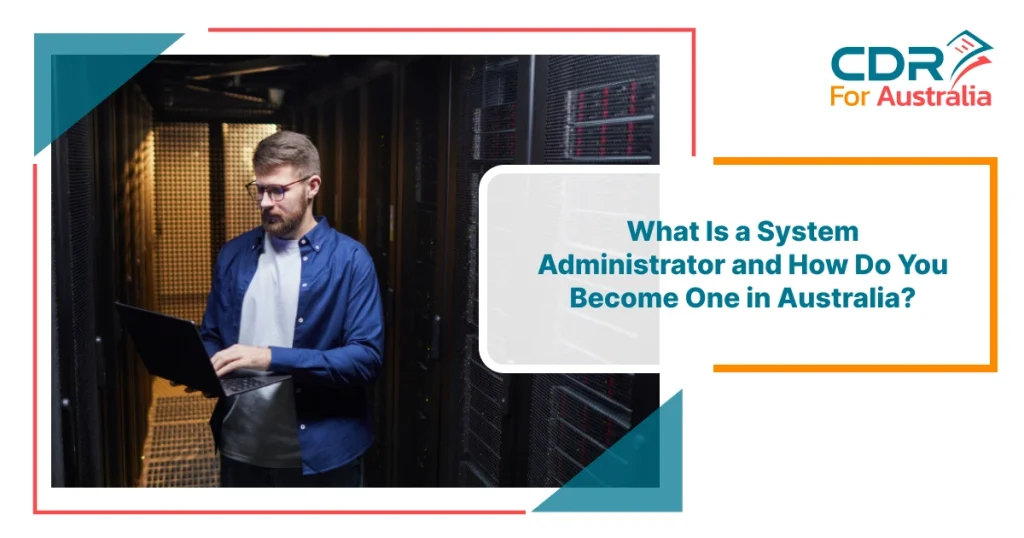
What Is a System Administrator?
A System Administrator or known by many as a system admin is an individual in reality who is in charge of the installation, maintenance and sound functioning of computer systems and servers. They are the final problem-solvings and make sure that the IT infrastructure of an organization is both secure and efficient. Their workplace could be a small business with one single server or a multinational company with huge and complicated networks and cloud environments.
In addition, they are separate from other ICT positions. Whereas a Network Administrator is concerned with the network hardware and communication protocols, a sysadmin is more comprehensive. They handle operating systems (such as windows server or Linux), servers, software deployment, user accounts and system security. Moreover, due to the emergence of cloud computing, contemporary sysadmins now specialize in such platforms as Amazon Web Services (AWS) and Microsoft Azure, operating virtual servers and services. In effect, when a computer system belongs to a network of an organization, a sysadmin will maintain it.
Get Free Consultation
Our Amazing Features
✅ EA Assessed Engineers as CDR Writers
✅ 10+ Years of Experience
✅ Australia Based Company
✅ All Engineering Disciplines
✅ 100% Success Rate with EA
✅ 100% Plagiarism Free Report or Turnitin
✅ Unlimited Free Modification or Corrections
✅ Negative Assessment? Get Refund within 2 hours
✅ 24*7 Live Chat, Phone Call and WhatsApp Facility
✅ Direct Conversation with The CDR Experts
✅ Beat the value offer
✅ Complete CDR Before the Agreed Due Date
Salary Expectations
One of the initial questions which professionals put into mind before venturing into any career is salary. Hence, it is important to learn the earning potential in Australia in order to plan your migration trip.
Average Annual Earnings
According to recent labour market data, a systems administrator in Australia earns between AUD $75,000 and $115,000 per year. The exact figure depends on experience, location, and industry sector.
Experience Level | Average Annual Salary |
Entry-Level (0–2 years) | AUD $65,000 – $80,000 |
Mid-Level (3–6 years) | AUD $85,000 – $100,000 |
Senior-Level (7+ years) | AUD $100,000 – $120,000+ |
Salary by City
Location plays a major role in earnings. As a result, the professionals in Sydney and Melbourne are more likely to receive higher income as the cost of living and demand are higher.
Sydney: AUD $90,000 – $115,000
Melbourne: AUD $85,000 – $110,000
Brisbane: AUD $80,000 – $100,000
Perth: AUD $78,000 – $105,000
Canberra: AUD $95,000 – $120,000 (government roles)
Industry-Based Salary Differences
The government and finance sectors are usually the ones that have the best pay packages. In the meantime, health and education offer good employment security with good salaries. Roles that are cloud-based and cybersecurity-related positions also attract a high premium rate.
ANZSCO Code and Its Significance.
The official designation that is used by immigration agencies and other evaluating institutions is the ANZSCO (Australian and New Zealand Standard Classification of Occupations). The interpretation of this code is important in visa applications and skills tests.
Official ANZSCO Classification
- ANZSCO Code: 262113
- Occupation Name: Systems Administrator.
- Skill Level: Level 1 (Bachelor degree or higher qualification)
- Unit Group: 2621 Database and Systems Administrators and ICT Security Specialists.
The meaning of this Classification.
This category makes the position one of the most talented ICT jobs in Australia. Thus, the applicants should provide either a corresponding bachelor’s degree or have at least five years of work experience of a similar kind. Moreover, the level of the skill directly determines the visa subclasses that can be offered to the applicants.
Occupations related to the same group.
- Database Administrator (ANZSCO 262111)
- ICT Security Specialist (ANZSCO 262112)
- Network Administrator (ANZSCO 263112)
These differences allow applicants to provide the correct documentation in the migration process. Also, engineers are frequently required to explain what particular position their experience fits before applying.
The Skills Assessment Process
Most skilled migration visa pathways require the skills assessment process to be carried out. Consequently, this is often the most challenging step for applicants without Australian work experience.
Who Conducts the Assessment?
ACS (Australian Computer Society) is the designated assessing body for ICT occupations, including systems administrators. ACS evaluates your academic qualifications and professional experience to determine whether they meet Australian standards.
Types of ACS Assessment Pathways
- ACS Skills Assessment (RPL Pathway)
This pathway is for applicants who lack a formal ICT degree but have substantial work experience. Moreover, it requires a detailed Recognition of Prior Learning (RPL) document outlining two key episodes of work.
- Formal Qualifications Pathway
Applicants with a relevant bachelor’s degree may apply through the standard qualifications pathway. However, ACS still reviews whether the degree content matches Australian ICT standards.
- CDR (Competency Demonstration Report)
Although CDR is mostly related to Engineers Australia, ACS also has a comparable competency based documentation requirement. Hence, it is necessary to learn how to compose powerful career episode narratives.
Typical Assessment Rejection Reasons.
- General or indistinct job descriptions.
- Lack of technical information in career episodes.
- ANZSCO code selection is mismatched.
- The absence of statutory declarations or references.
Suggestions to a Successful Assessment.
- Specifically identify your technical tasks and explain them.
- Specify the tools and technologies that you utilized (e.g., Active Directory, Linux, VMware).
- Measure your success at any opportunity.
- Make sure that your employment references are in line with your resume dates.
Duties and Responsibilities of a Systems Administrator
Knowledge on what this profession entails assists the applicants and the employers to match their expectations. In addition, proper description of your tasks in visa documents can greatly enhance the outcome of the assessment.
Primary Technical Duties
An expert systems administrator deals with a wide variety of infrastructure work on a daily basis. These include:
- Server Management: Installing, configuring and maintaining windows and linux servers.
- User Account Administrator: Adding, updating, and deleting user access to systems.
- Network Monitoring: Nagios, Zabbix, or SolarWinds can be used to monitor the health of the network.
- Backup and Recovery: Automated backup system and disaster recovery.
- Security Patch Management: Implementing updates on the operating system and software on a regular basis.
- Virtualisation Management: VMware, Hyper-V, or cloud (AWS, Azure) management.
- Documentation: Keeping proper records of system configurations and changes.
Secondary Administrative Duties
In addition to the technical activities, systems administrators also:
- Negotiate with suppliers and third party service providers.
- Train junior IT personnel on system usage procedures.
- Develop IT policies and standard operating procedures
- Periodic system review and audit.
Skills Required
Technical Skills | Soft Skills |
Windows Server & Linux Administration | Problem-Solving |
Active Directory & Group Policy | Clear Communication |
Cloud Platforms (AWS, Azure, GCP) | Attention to Detail |
Scripting (PowerShell, Bash, Python) | Time Management |
Cybersecurity Fundamentals | Team Collaboration |
Networking (TCP/IP, DNS, DHCP) | Adaptability |

Looking for expert CDR Writer for Engineers Australia?

Creating a CDR Report may be difficult due to Engineers Australia’s standards and rules ( EA ). Our experienced engineers have assisted many people in obtaining approval for their report from the EA via the use of powerful projects.
Migration Pathways and Visa Sponsorships.
One of the greatest opportunities offered to qualified ICT professionals who want to work in Australia is visa sponsorship. In addition, the Australian government is proactive in promoting skilled migration of IT to overcome the increasing shortage of digital employees.
Eligible Visa Subclasses
- Skilled Independent Visa (Subclass 189)
This is a points-tested visa that does not require employer sponsorship. Consequently, systems administrators who score 65 or more points on the SkillSelect system can apply independently.
- Skilled Nominated Visa (Subclass 190)
Applicants can be nominated by state and territory governments. Thus, this visa fits perfectly well in the case of professionals, who would like to reside and work within a particular state.
- Skilled Work Regional Visa (Subclass 491)
The visa aims at attracting professionals who are interested in residing in regional Australia. Moreover, it provides an avenue to permanent residence in three years.
- Employer Sponsored Visa (Subclass 482 -TSS)
The Temporary Skill Shortage visa will allow many Australian companies to sponsor overseas systems administrators. In this channel, the employer must prove that he or she was unable to identify a qualified local applicant.
- Employer Nomination Scheme (Subclass 186)
This permanent visa is available to applicants sponsored by an approved Australian employer. Furthermore, it requires at least two years of relevant work experience.
State Nomination Opportunities
Several states actively nominate systems administrators on their occupation lists. Notably:
- Victoria -Government and finance sectors are in high demand.
- Queensland -Emerging technology centres in Brisbane and Gold Coast.
- South Australia State nomination with reduced competition.
- Western Australia -Mining and resources sector IT roles in high demand.
Conclusion
A career as a system administrator in Australia is an excellent earning opportunity, has good visa prospects, and has promising career growth. Since preparations are one thing and requirements are another, you need to plan and document every step of your ANZSCO classification to skills assessment preparation and visa sponsorship. Moreover, the IT professionals demand in Australia will keep rising in the years to come as the country continues to invest in the digital infrastructure. CDR for Australia is there to help you on your migration journey, or polish your application.
Frequently Asked Questions About CDR Writing Assistance
Is the systems administration in the Australian skilled occupation list?
Yes. The occupation is listed under ANZSCO 262113 and is listed on various skilled migration lists such as the MLTSSL and state-based occupation lists.
What are the qualifications required in a skills assessment?
A bachelor’s degree in IT, computer science, or something similar is normally required. Or, the RPL pathway may substitute significant work experience with ACS.
What is the duration of the ACS skills assessment?
The processing duration is usually 812 weeks. Nonetheless, complicated applications that are not well documented can be time consuming.
Is it possible to become a permanent resident as an IT administrator?
Yes. Subclass 186 (Employer Nomination) and Subclass 189 (Skilled Independent) both provide avenues to permanent residency to qualified IT professionals.
Is a CDR required to migrate as an IT professional?
IT professionals who are evaluated by ACS do not require a conventional CDR. Yet, they have to provide comprehensive RPL documentation. This can be done with the help of our CDR team in Australia.