


How Can the Sydney Accord Fast-Track Your Engineers Australia Skills Assessment?
The journey towards engineering a new life in Australia may itself be a complex project. You have the ability, the qualifications and the drive. But there are specific terms and pathways in the Australian skilled migration process, particularly the Engineers Australia (EA) skills assessment, that can be confusing. The Sydney Accord is one term that is often mentioned. It’s important to understand this agreement because it could be the key to a much simpler and quicker migration skills assessment.
This complete guide is written for you, the ambitious engineering professional wishing to migrate to Australia. We will explain what this international agreement is, why it is so significant and what it means for your specific EA assessment pathway. Let’s make it simple, let’s chart your course to success.
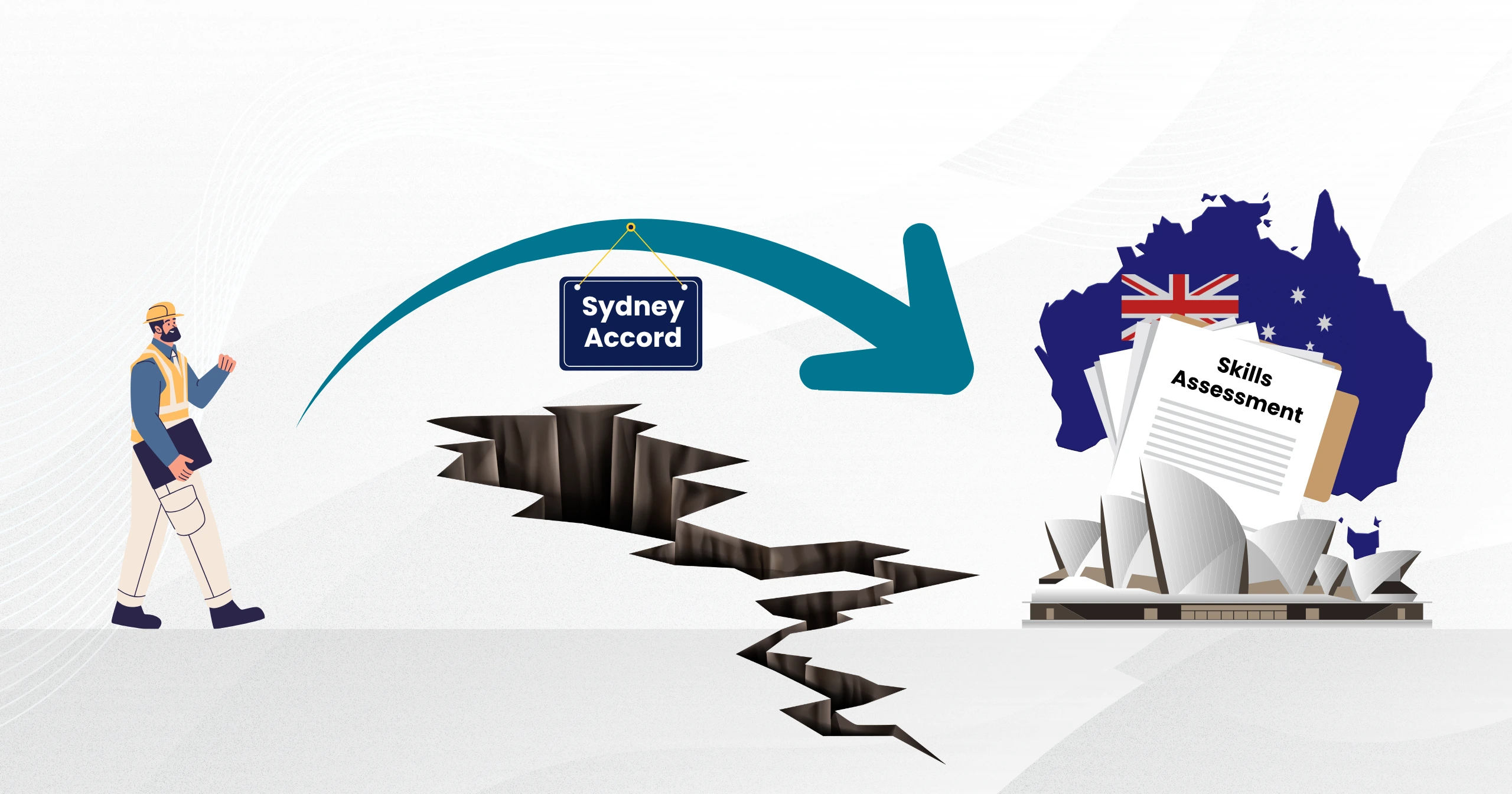
What Is the Sydney Accord and Why Does It Exist?
The Sydney Accord is an international agreement which provides for the recognition of engineering technology qualifications.
What you need to know:
- It offers mutual recognition of engineering technology education programs throughout member countries.
- It applies to engineering and technology qualifications at the Bachelor’s level, and not the complete engineering qualifications offered under the Washington Accord.
- It emphasizes practical engineering skills and not theoretical or research based knowledge.
- When the degree is from an approved program, countries around the world recognize that it is at a comparable level.
In simple terms: It is similar to a passport for your engineering technology program but lacks a license to practice. You still have to undergo a skills analysis procedure.
Signatories and Governance: Who's Behind This International Framework?
Sydney Accord is part of the International Engineering Alliance (IEA). The IEA manages several international agreements for the engineering profession, and this accord is one of three major qualification-recognition frameworks it oversees.
Current Signatory Bodies
Country | Signatory Body |
Australia | Engineers Australia |
Canada | Engineers Canada |
Hong Kong | Hong Kong Institution of Engineers |
Ireland | Engineers Ireland |
New Zealand | Engineering New Zealand |
South Africa | Engineering Council of South Africa |
UK | Engineering Council UK |
USA | ABET |
Malaysia | Board of Engineers Malaysia |
Sri Lanka | Institution of Engineers Sri Lanka |
Here’s how the governance of the Sydney Accord works:
- International Engineering Alliance (IEA): The IEA Secretariat coordinates meetings and policy updates for all member countries.
- Peer Review with regard to Accreditation for New Members: New countries are able to join once they have successfully demonstrated that their accreditation process meets agreed standards.
- Decentralized Authority: Engineering education standards are left to each member country to manage, but the member countries agree to recognise qualifications from other member countries.
- Regular Reviews: The IEA periodically reviews to keep standards aligned over time.
- Trust Based System: Engineers Australia believe that an accredited engineering technology course from another member country (e.g. Malaysia, UK) is of an acceptable standard.
Sydney Accord vs Washington Accord vs Dublin Accord: Understanding the Key Differences
Engineers will perhaps find it strange that there is more than one accord. It’s crucial to understand the differences, as applying under the wrong one can lead to an unsuccessful assessment. The main difference is the engineering profession they serve, and Engineers Australia matches this to three occupational groups.
The Sydney Accord Vs Washington Accord Vs Dublin Accord is simply a comparison table that explains the role of each of these accords and determines which one would be applicable to your qualification.
Feature | Washington Accord | Sydney Accord | |
Target Occupation | Professional Engineer | Engineering Technician | |
Typical Qualification | 4-year Bachelor of Engineering degree (or equivalent postgraduate qualifications) | 3-year Bachelor of Technology or Engineering Technology degree (or equivalent) | 2-year National Diploma or Advanced Certificate in Engineering (or equivalent) |
Focus of Role | Complex engineering problem-solving, overall system design, and strategic management. | Bridging the gap between theory and practice. Focuses on the application and implementation of existing technology. | Hands-on and practical tasks. Works under the supervision of engineers and technologists. |
Example Tasks | Leading entire project lifecycles, developing new technologies, high-level analysis. | Detailed design, system modification, project management of specific components, advanced testing. | Drafting (CAD), equipment installation, routine testing, maintenance, and data collection. |
EA Assessment Category | Professional Engineer | Engineering Technologist | Engineering Technician |
Therefore, the specific accord that applies to you depends entirely on the nature, length, and accredited outcome of your undergraduate qualification. Your choice determines the occupational category Engineers Australia will assess you against. You can’t simply choose the one you prefer; it must match the accreditation of your academic program.
What This Means for Your EA Skills Assessment Pathway
The step-by-step process for an Engineers Australia assessment if you have an engineering technology qualification.
Step 1: Confirm Your Qualification
- Check if your degree is in engineering technology.
- Check your program’s accreditation with the IEA qualification checker online whether it is accredited under the Sydney Accord.
Step 2: Select the appropriate assessment pathway:
- Accredited Program Pathway: This is the quickest and easiest pathway when your degree is accredited.
- Full CDR – If the degree is not accredited, a complete CDR will be required.
Step 3: Prepare Your Documents
- The Accredited Pathway is composed of the following:
- Academic certified transcripts, certificate of degree.
- Identity documents.
- Work verification (if applicable).
- Further, the following is needed for the CDR Pathway:
- Three Career Episodes.
- A Summary Statement.
- A Continuing Professional Development (CPD) record.
Step 4: Submit Your Application
- Submit your application online.
- Processing usually takes 4 to 12 weeks.
- Engineers Australia will issue a positive assessment or request more information.
What happens if your qualification is not accredited?
You must use the CDR pathway. Your report will need to demonstrate that your skills meet the standard for an Engineering Technologist, not a Professional Engineer.
Why This Agreement Matters Specifically for Engineers Migrating to Australia
The Sydney Accord is an international agreement that is important for engineers applying for a skills assessment with Engineers Australia. Why it is important:
- It applies to engineering technology qualifications which are assessed differently from full professional engineering degrees, determining Your Assessment Pathway.
- Streamlines assessment: For students with degrees granted by programs recognized under the Sydney Accord, the skill assessment process will likely be more streamlined and require less paperwork.
- Suitability of the visa: For most skills visas a successful skills assessment would have to be done. The nature of the qualification that is obtained and how it is linked to the accord would influence how this would be assessed.

- Sets Competency Standards: Engineers Australia assesses Sydney Accord graduates against the competency standards for an Engineering Technologist, which is different from the standard for a Professional Engineer.
- Furthermore, many engineers from countries like Malaysia, South Africa, India, and the UK are surprised to learn their qualification falls under this accord rather than the Washington Accord. Understanding the difference early saves months of confusion and wasted effort.

Looking for expert CDR Writer for Engineers Australia?

Creating a CDR Report may be difficult due to Engineers Australia’s standards and rules ( EA ). Our experienced engineers have assisted many people in obtaining approval for their report from the EA via the use of powerful projects.
Key Takeaways: The Engineering Migration done right, the first time.
International engineering agreements (specifically the Sydney Accord for Engineering Technologists) form part of the skilled migration program within Australia. Knowing what it does or doesn’t do can make the difference between a simple, quick evaluation and the drawing up of a comprehensive CDR. You can check your qualification against the signatory list and timelines to easily establish your appropriate assessment pathway with Engineers Australia.
If you don’t qualify in this direct route, please don’t be discouraged. The CDR pathway is a tried and tested path to success, and is open to every competent engineer. But at CDR For Australia we specialize in helping engineers go through this process and showcase their expertise.
Frequently Asked Question (FAQs)
Does recognition under this accord mean I'm automatically registered as an engineer in Australia?
No. Recognition means your educational qualification is acknowledged. Professional registration with Engineers Australia or a state registration board is a separate process that happens after migration.
Can I apply for a Professional Engineer category if my degree is an engineering technology qualification?
Generally, no. Engineers Australia assesses you based on your qualification level. An engineering technology degree is assessed under the Engineering Technologist category.
My country is not a signatory. Does this mean my qualification won't be recognised?
Not necessarily. You can still apply through the CDR pathway. However, you won’t benefit from the simplified accredited program pathway.
How do I know if my specific university program was accredited?
Check the IEA’s qualification checker tool or contact your university’s engineering faculty directly.
Is an engineering technologist eligible for skilled migration to Australia?
Yes, the Engineering Technologist occupation (ANZSCO 233914) appears on the skilled occupation list of numerous visa sub-classes.