


Subclass 187 Visa Australia: Eligibility, Streams, and Current Status
Subclass 187 visa Australia is a permanent visa enabling employers in regional Australia to sponsor qualified workers for long-term positions. It was one of the most popular avenues to permanent residency via an employer in regional Australia and people are still enquiring. But the criteria for this visa have changed since 2019. The Direct Entry stream which was once open to most qualified workers with a regional job offer has been closed since November 2019.
There’s currently only one stream left open, and even that’s restricted to former visa holders. It means that this is not the new entry ticket for anyone looking for a new beginning. If you’re considering the Subclass 187 visa Australia, do find out who can still be considered, which documents are necessary and what other avenues are available for those no longer fitting this very restricted scope. I’ll run through the streams, who qualifies, the costs and the time it’ll take to be granted a visa based on the latest information on the Department of Home Affairs.
What Is the Subclass 187 Visa Australia?
The Subclass 187 visa, also called the Regional Sponsored Migration Scheme (RSMS), is a permanent visa for skilled workers nominated by an employer in regional Australia, as defined by the Department of Home Affairs. The goal of this visa was to help regional businesses fill long-term skill gaps that they could not fill locally. Regional Australia, for this visa, does not include Sydney, Melbourne, Brisbane, Perth, the Gold Coast, Newcastle, or Wollongong. Once granted, this visa gives full permanent residency rights from day one. Holders can live, work, and study anywhere in Australia, even though the original nomination was tied to a regional employer. They can also access Medicare, and apply for citizenship once residency requirements are met.
RSMS Visa Streams
The Subclass 187 visa originally had two main streams. Only one is open today.
Stream | Status |
Direct Entry | Closed since 15 November 2019 |
Temporary Residence Transition (TRT) | Open, but only for transitional 457/482 workers |
Direct Entry stream
This stream was for skilled workers who had little or no prior work history in Australia. It closed permanently when the Skilled Employer Sponsored Regional (Provisional) visa, subclass 494, was introduced, a visa with its own distinct 494 visa processing time and requirements. If you never lodged a Direct Entry application before that date, this option is no longer available to you.
Temporary Residence Transition (TRT) stream
This is the only active stream of the Subclass 187 visa Australia. It is for people who already hold, or previously held, a Subclass 457 or Subclass 482 visa and meet specific transitional rules. You generally qualify if you held a Subclass 457 visa on or after 18 April 2017, or if you held (or applied for) a medium-term Subclass 482 visa by 20 March 2019. If your visa history does not match these dates, this stream will not be open to you either.
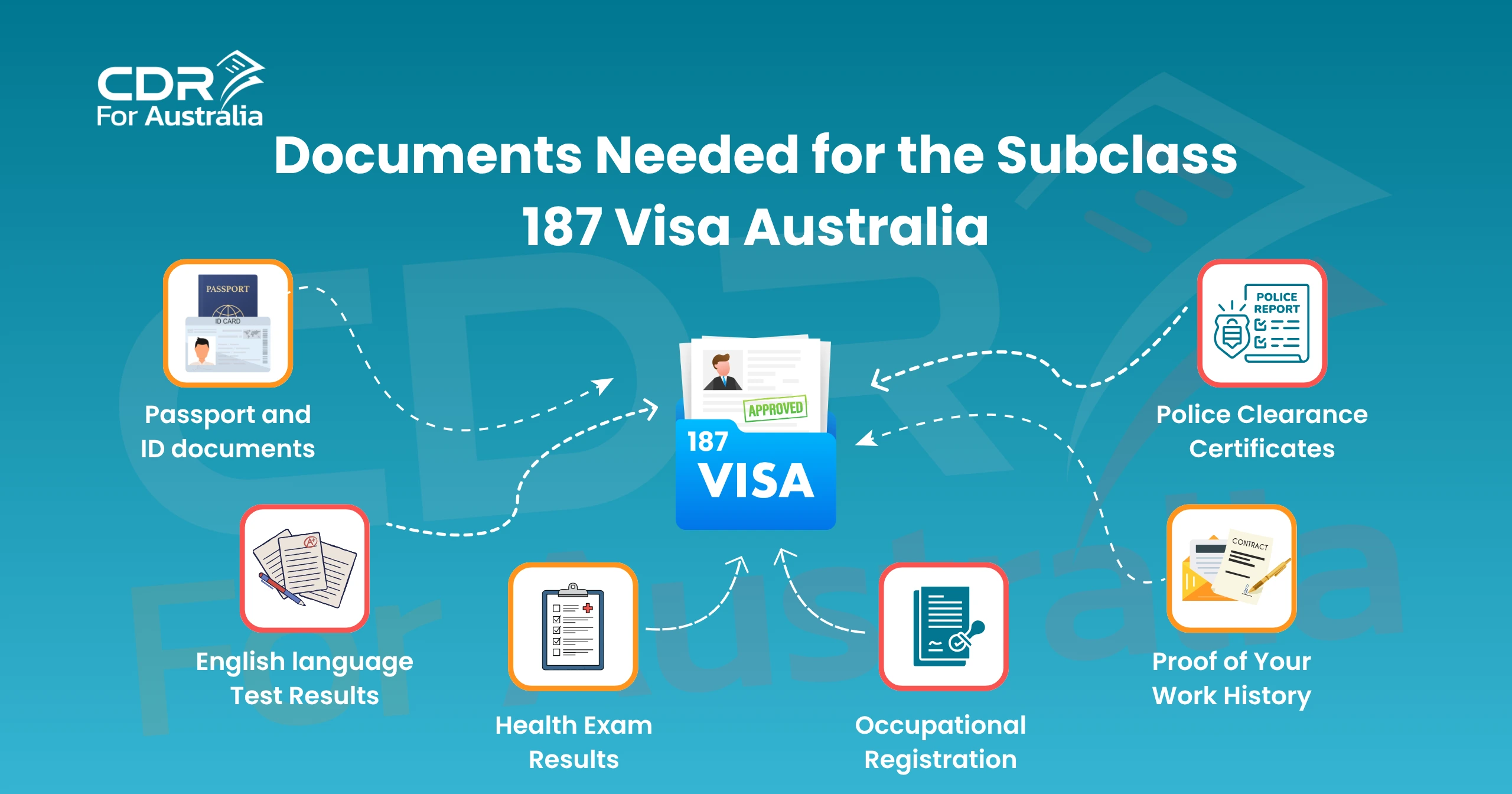
Documents Needed for the Subclass 187 Visa Australia
Once the nomination clears, it’s your turn. You’ll need to put together your own application. Here’s what’s usually asked for:
- Passport and ID documents, for you and any family members on the application
- Proof of your work history with the employer, things like payslips and contracts
- English language test results, unless you’re exempt
- Health exam results
- Police clearance certificates from any country where you lived for 12 months or more in the last 10 years
- Proof of any occupational registration or licence your job requires
Delays usually come down to one thing: missing paperwork. Gather everything upfront instead of waiting for the Department to ask for more. If your occupation also needs a formal skills assessment, the CDR report format for Engineers Australia is worth a look. It shows what assessors actually expect to see.
Eligibility Requirements for the RSMS Visa
To qualify under the TRT stream, you need to meet a few conditions. Here is what the Department looks for:
- An approved employer must nominate you for a real, ongoing job in regional Australia
- You must be a transitional 457 or transitional 482 worker, based on the dates explained above
- You must have worked full-time in the same job, with the same employer, for the required period
- You must be under 45 years old when you apply, unless you qualify for an exemption
- You need competent English, unless you are exempt
- You and any family members included in the application must meet health and character checks
- You must hold the right registration or licence, if your job needs one
Some people do not need to meet the age limit. It includes scientists, researchers, and technical specialists sponsored by the Australian university or government agency. So before you assume age rules you out, check if you fit one of these exempt groups. Occupation eligibility for most employer-sponsored visas is now checked against the Core Skills Occupation List, so it is worth confirming your role is still listed.
How the Employer Nomination Works
Your employer has to act first. They lodge a nomination and wait for approval before you can even apply. This nomination is separate from your own eligibility. It has its own rules.
- The employer proves the business operates lawfully in regional Australia.
- The employer shows the job is real, full-time, and likely to last two years or more.
- The employer confirms your pay and conditions match what an Australian worker would get in the same role.
- The Department of Home Affairs reviews the nomination and decides.
- Once it’s approved, you get six months to lodge your visa application.
A refused nomination ends things right there. You can’t move to the visa stage. This is why the employer’s paperwork needs to be right the first time.
RSMS (Subclass 187) Visa Fees
In 2026, the base application charge sits around AUD 4,240 for the main applicant. Extra applicants pay separately, and dependents under 18 pay less. These numbers shift over time. Always check the current fee through the Department of Home Affairs fee estimator.
Applicant type | Approximate fee (AUD) |
Main applicant | 4,240 |
Secondary applicant (18+) | 2,060 |
Secondary applicant (under 18) | 1,030 |
These amounts do not include costs for health checks, police certificates, English testing, or any migration agent fees you may choose to pay separately. If your occupation also requires a formal skills assessment, it is worth budgeting separately for the Engineers Australia (EA) fee or the equivalent cost charged by your assessing authority.

Looking for expert CDR Writer for Engineers Australia?

Creating a CDR Report may be difficult due to Engineers Australia’s standards and rules ( EA ). Our experienced engineers have assisted many people in obtaining approval for their report from the EA via the use of powerful projects.
RSMS Visa Processing Time
Processing times for the Subclass 187 visa Australia vary depending on how complete the application is and how the Department prioritises it under current ministerial directions. Many applicants report processing times in the range of 11 to 17 months, though this can shift depending on application volume and whether your case falls into a priority category, such as roles in designated regional areas. Lodging a complete application with all supporting documents, including health and character checks and any required skills assessment, generally helps avoid added delays.
What If You Do Not Qualify for Subclass 187 Visa?
Since the Subclass 187 visa Australia is largely closed to new applicants outside the TRT stream, many skilled workers now look at other employer-sponsored pathways instead. Workers without prior 457 or 482 history are generally directed toward the Subclass 482 visa, now operating under the Skills in Demand framework, as their main entry point into employer sponsorship, and current 482 visa processing times are worth checking before applying.
For those specifically wanting to settle in a regional area the way the Subclass 187 visa Australia once required, the Subclass 494 visa directly replaced the closed Direct Entry stream and follows a similar regional employer-sponsorship structure. The Subclass 186 visa, meanwhile, is the modern equivalent of what Direct Entry used to offer outside regional areas, and 186 visa processing times currently run on a separate timeline to RSMS.
If your occupation requires a formal skills assessment as part of any of these pathways, a properly prepared Competency Demonstration Report can be a key part of meeting that requirement for engineering occupations specifically.
Frequently Asked Question (FAQs)
Can the 187 visa lead to permanent residency?
Yes. The Subclass 187 visa Australia is itself a permanent visa. Once granted, holders receive permanent residency immediately, with full work, study, and Medicare access.
How long does a 187 visa take to process?
Processing times typically range from around 11 to 17 months, though this depends on application completeness and current departmental workload.
Who is eligible for the 187 visa?
Only transitional 457 or 482 workers are currently eligible, under the Temporary Residence Transition stream. The Direct Entry stream has been closed since November 2019.
What is the difference between 187 and 186 visas?
The Subclass 187 visa Australia required a position in a designated regional area, while the Subclass 186 visa has no such location restriction. Since the Direct Entry stream closed, the 186 visa has effectively taken over that role for most employer-sponsored permanent applicants.
What is the SID visa Australia?
The SID visa, or Skills in Demand visa, is the current name for the Subclass 482 visa. It replaced the old Temporary Skill Shortage visa in December 2024 and is the visa most transitional workers held before becoming eligible for the Subclass 187 visa Australia under the TRT stream.
Is there still a priority occupation list for Australian visas?
The original Priority Migration Skilled Occupation List (PMSOL) ceased in October 2022 and no longer applies. Today, occupation eligibility for employer-sponsored visas is generally checked against the Core Skills Occupation List or the relevant state and territory occupation lists, rather than a single national priority list.
What is the Western Australia skilled occupation list?
This is a state-based list, separate from the Subclass 187 visa, used for Western Australian state nomination under visas such as the Subclass 190 and Subclass 491. It does not apply to RSMS nominations.
For official and up-to-date details, including any future policy changes, it is worth checking directly with the relevant government department before lodging an application.