


National Innovation Visa (Subclass 858): Eligibility & Requirements
Not every skilled professional fits neatly into a points system and Australia knows that. The National Innovation Visa, officially Subclass 858, was built for exactly those people. The ones who have already made a mark globally. Researchers pushing boundaries, entrepreneurs who have built something real, tech leaders, elite athletes, artists, people whose work speaks louder than any points score ever could. It replaced the Global Talent Visa Australia on 7 December 2024, but the thinking behind it stayed the same: find the best, and give them a permanent home in Australia from day one.

What makes it different from every other visa out there is what it skips entirely. No points test. No occupation list. No employer needed to vouch for you. The Department of Home Affairs built this visa around one thing: the actual depth and global recognition of what you have achieved. If your work has made an impact at an international level and Australia stands to benefit from having you here, that is what matters. The rest takes care of itself.
Researchers, entrepreneurs, innovators, elite athletes, artists, and technology leaders are among those the program targets. The visa grants immediate permanent residency to the main applicant and eligible family members from the day of grant with no provisional stage, no investment minimum, and no restriction on where in Australia the holder must live or work. For globally recognised professionals seeking a direct pathway to Australian permanent residency, the National Innovation Visa(Subclass 858) stands out as one of the most merit-based options available today.
What Is the National Innovation Visa (NIV)Subclass 858?
The NIV, Subclass 858, is an invitation-only permanent visa. It targets migrants with an internationally recognised record of exceptional and outstanding achievement in their field. The program is not limited to specific occupations. It includes multiple sectors like technology, academia, arts and sports.
The NIV did not come out of nowhere. It built on what the Global Talent Visa Australia and the Global Talent Independent (GTI) program already started, the same merit-first thinking, just sharper. Sector priorities were updated, the assessment framework was tightened, and the whole program was realigned to match where Australia’s economy is actually heading.
Key features of the 858 visa Australia include:
- Direct permanent residency
- No points test
- No occupation list restriction
- No strict age limit
- No mandatory English requirement
- Family inclusion
Who Is Eligible for the National Innovation Visa Australia?
Eligibility for innovation visa centres on three core pillars.
Internationally Recognised Achievement
Applicants must have an internationally recognised record of exceptional and outstanding achievement. This must be in one of the eligible fields: a profession, sport, the arts, or academia and research. And it has to be provable awards, patents, publications, business outcomes, media coverage. Evidence that exists independently of you. Past achievement alone does not cut it either. You need to still be active and recognised in your field right now.
Continued Prominence
Applicants must still be active and prominent in their field. Past achievement alone is not enough. The Department looks at whether the applicant is currently recognised and whether they can continue contributing at a high level in Australia.
Potential Benefit to Australia
The applicant must demonstrate they would be an asset to the Australian community. This includes showing the ability to find employment or establish themselves in their area of expertise. Applicants are also generally expected to show earning capacity at or above the Fair Work High Income Threshold, which stood at approximately AUD 183,100 for 2025–26. This income threshold is a benchmark indicator, not a mandatory requirement particularly for recent PhD graduates and early-career researchers.
National Innovation Visa Priority Tiers and Occupation List
It uses a four-tier priority system to determine invitation order. Applicants in higher tiers receive invitations faster.
Priority | Category | Who Qualifies |
1 | Global Experts | Top-of-field international award recipients- Nobel Prize, Fields Medal, Turing Award, Olympic Gold Medal, and similar global honours |
2 | Government Nominated | Individuals nominated by an Australian Commonwealth, State, or Territory Government agency via Form 1000 |
3 | Tier One Sector Experts | Exceptional achievers in Critical Technologies, Health Industries, and Renewables & Low Emission Technologies |
4 | Other Eligible Applicants | Exceptional achievers in Tier Two sectors and other eligible fields not covered above |
Tier One sectors
The highest priority within Priority 3 include Critical Technologies such as artificial intelligence, quantum computing, and robotics; Health Industries including biotechnology and medical research; and Renewables and Low Emission Technologies. Applicants who demonstrate that their expertise reduces Australia’s reliance on foreign supply chains carry the most weight under current assessment criteria.
Tier Two sectors
It covers a broader range including resources and energy, agri-food and agri-tech, education, advanced manufacturing, infrastructure and tourism, and platforms for the humanities, arts, and social sciences.
There is no fixed occupation list for the Subclass 858 Visa the way there is for points-based skilled migration streams.
Subclass 858 Visa Requirements: What You Need
To be considered for the visa, applicants must satisfy the following Subclass 858 visa requirements.
- Invitation: The Department of Home Affairs must invite you before you can apply. You cannot self-lodge a Subclass 858 application. The process begins with an Expression of Interest (EOI).
- Achievement evidence: Think awards, patents, published research, media coverage, business results, leadership roles, speaking at major international events. Anything that shows the world already knows who you are.
- Nomination: You need someone credible in your corner, an Australian citizen, permanent resident, eligible New Zealand citizen, or a well-regarded Australian organisation in your field. They nominate you through Form 1000. No financial strings attached, just a professional vouching for your work.
- Identity documents: Standard stuff certified copies of your passport, national identity card where relevant, and birth certificate.
- Health and character: A medical exam plus police clearances from every country you have called home for 12 months or more in the past decade.
- English language: You need functional English. If you or your partner are not quite there, an extra charge applies at lodgement rather than it being a hard stop.
For engineers exploring all available pathways alongside the NIV, a Competency Demonstration Report (CDR) for Engineers Australia remains the standard requirement under the points-tested skilled migration route.
National Innovation Visa EOI: Application Process
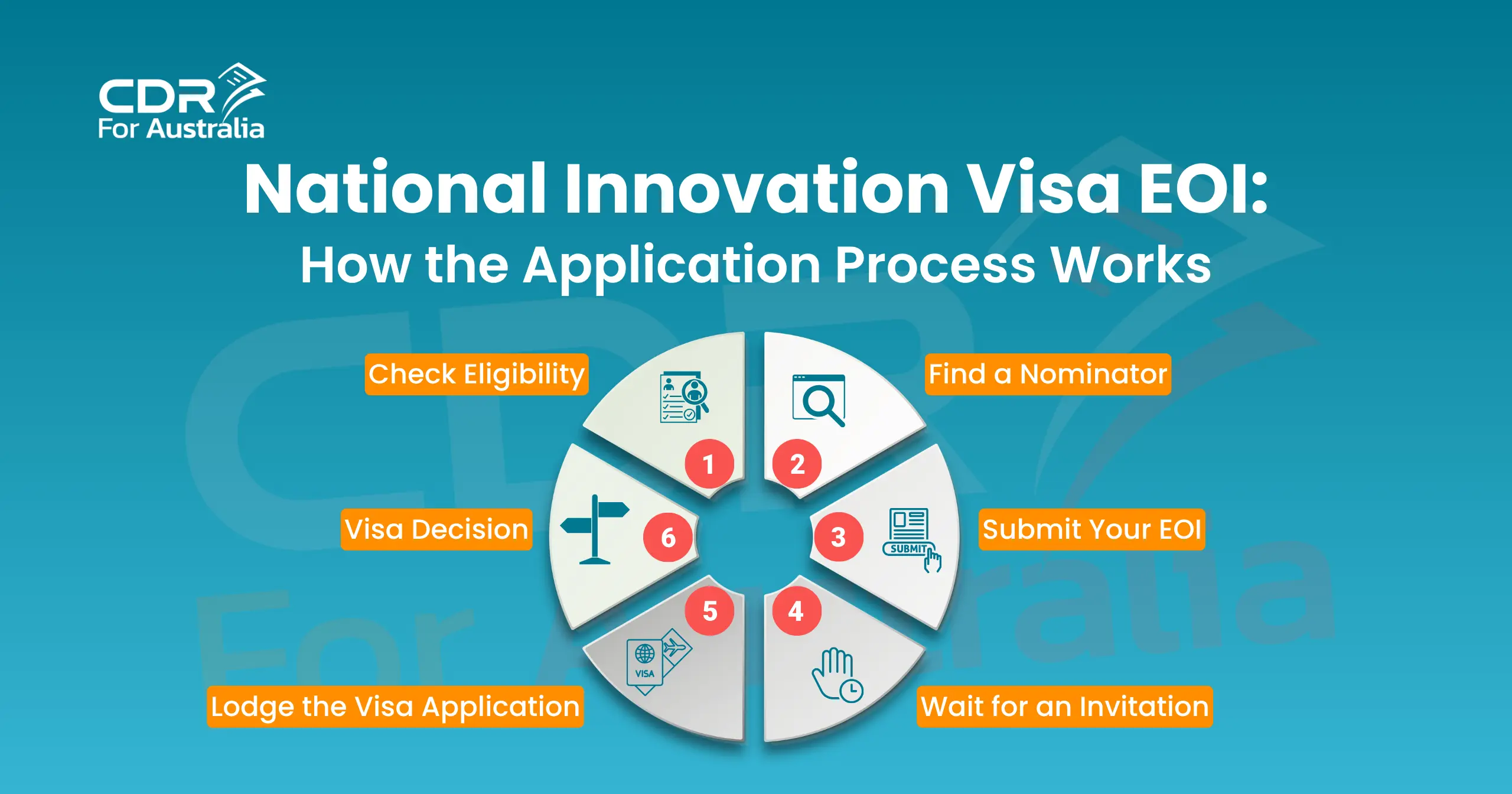
The NIV EOI is the first and most critical step. The process runs as follows.
Step 1 – Check Eligibility: Assess what you’ve accomplished in relation to the NIV in an honest way. How high of a priority are you? Your answers here will directly determine your length of time waiting for an invitation.
Step 2 – Find a Nominator: You need someone with genuine national standing in your field. They fill out Form 1000 and make the case for why your achievements matter to Australia. Choose this person carefully. A weak nominator hurts your EOI.
Step 3 – Submit Your EOI: Lodge your Expression of Interest through ImmiAccount. It stays valid for two years. One thing worth knowing, vague, generic EOIs rarely get picked up. Every claim needs independent evidence behind it. That is where most people lose their shot.
Step 4 – Wait for an Invitation: The Department runs invitation rounds periodically, but there is no fixed schedule. Depending on your tier and how strong your EOI is, the wait can be anywhere from a week to several months.
Step 5 – Lodge the Visa Application: Once invited, you have 60 days to submit everything: personal documents, achievement evidence, nomination materials, health results, and police clearances. Sixty days sounds like a lot. It is not. Start pulling documents together well before the invitation arrives.
Step 6 – Visa Decision: Permanent residency is granted on approval. The 858 visa can be lodged from both inside and outside Australia.
For those who need well-structured professional documents to support nominations or other migration applications, a professionally written resume tailored to migration standards can strengthen how your career achievements are presented.
National Innovation Visa Processing Time and Fees
858 Visa Processing Time
Stage | Timeframe |
50% of applications processed | Within 4 months of lodgement |
90% of applications processed | Within 7 months of lodgement |
Full EOI to visa grant (including invitation wait) | 4 to 12 months (varies by tier) |
Priority 1 & Priority 2 applicants | Typically faster than standard |
Processing times can extend when documentation is incomplete, health or character checks require additional review, or high application volumes coincide with your lodgement period. Always check the Department of Home Affairs global visa processing times tool for the most current figures, as these are updated monthly.
Visa Application Fees (as of 1 July 2025)
The government visa application charges for the 858 visa Australia are:
Applicant Type | Fee (AUD) |
Main applicant | AUD 4,985 |
Dependent applicant over 18 (each) | AUD 2,495 |
Dependent applicant under 18 (each) | AUD 1,250 |
Submitting an EOI | No charge |
A second application charge applies if the main applicant or partner does not meet the functional English requirement at the time of lodgement.
How the National Innovation Visa Differs from Other Visas
The National Innovation Visa works nothing like the Subclass 189 or Subclass 190. Those visas run on a points system, your age, English level, qualifications, and work experience all get scored. You also need to be on an eligible occupation list. The NIV has none of that. It also replaced the Business Innovation and Investment Program (BIIP-Subclass 188), which closed on 7 December 2024. Where the BIIP looked at investment amounts and business turnover, the NIV looked at the depth of your achievements and global recognition. Net worth does not come into it.
For engineers pursuing the standard route, a CDR prepared to Engineers Australia standards is the core requirement for a Subclass 189 or 190 application. Professionals in management, science, finance, and other non-engineering fields follow the VETASSESS skilled migration route instead. Both are entirely separate from the NIV framework and suited to professionals at a different career stage.

Looking for expert CDR Writer for Engineers Australia?

Creating a CDR Report may be difficult due to Engineers Australia’s standards and rules ( EA ). Our experienced engineers have assisted many people in obtaining approval for their report from the EA via the use of powerful projects.
National Innovation Visa Age Limit
There is no strict age limit, Applicants of any age can apply. Two exceptions apply at the boundaries. Applicants under 18 must demonstrate they offer exceptional benefit to the Australian community. Applicants aged 55 or over must also demonstrate exceptional benefit to Australia, beyond their field achievements alone. The Victorian Government’s state nomination program, for example, specifically requires applicants to be under 55, though this is a state-level criterion, not a federal requirement.
Common Reasons for 858 Visa EOI Rejection
The NIV does not hand out invitations freely. Most EOIs that get passed over share the same problems: generic narratives, overstated achievements with nothing independent to back them up, a nominator who lacks real credibility in the field, no clear national benefit argument, or a sector focus that simply does not match current priority tiers. Any one of these is enough to cost you the invitation.
Strong applications share a common thread; they present a clear, credible story of global recognition and make a specific case for why Australia benefits from this individual’s permanent residency.
For professionals who need well-structured supporting documentation, a Statement of Purpose can strengthen related visa applications, and career episode-style professional writing is valuable for those documenting technical achievement in detail.
State Nomination for the National Innovation Visa Australia
State and territory governments across Australia offer nominations under Priority 2 of the NIV Subclass 858. States including NSW, Victoria, Queensland, and South Australia have active nomination programs. A state nomination places the applicant in the second-highest priority tier ahead of Tier One sector experts and can result in a faster invitation from the Department of Home Affairs.
Each state runs its own Registration of Interest (ROI) process with separate criteria. For NSW, the ROI is valid for six months. If an invitation is not received during that period, the ROI expires automatically, and a new one can be submitted after a further six-month waiting period. An applicant can only hold one active state ROI at a time.
State nomination supports the EOI but does not guarantee an invitation. The final decision on all invitations rests solely with the Department of Home Affairs.
For a broader look at how professional occupations connect to various Australian visa pathways from skilled migration to talent-based streams the landscape covers several distinct options depending on your profession, experience level, and field.
The official and most up-to-date information on the NIV (Subclass 858) Visa is available on the Department of Home Affairs website.
Frequently Asked Question (FAQs)
Which visa is best for PR in Australia?
The right visa depends on your qualifications, career profile, and field. For globally recognised professionals with exceptional achievement, the NIV (Subclass 858) offers direct permanent residency without a points test. Engineers typically pursue the Subclass 189 or 190 pathway via skills assessment and CDR. Each route suits a different type of applicant profile.
Who is eligible for the National Innovation Visa in Australia?
Established and emerging leaders with internationally recognised exceptional achievement in a profession, sport, the arts, or academia and research are eligible. Applicants must also have a nominator, demonstrating continued prominence in their field.
What is the National Innovation Visa 2026?
The NIV Subclass 858 for 2026 operates under a four-tier priority framework. It continues to attract globally recognised talent with stronger emphasis on applicants in Critical Technologies, Health Industries, and Renewables.
How hard is it to get a National Innovation Visa?
Genuinely tough. The invitation rate in late 2025 was very low; most EOIs did not make it through. What gets people through is proof that the world already recognizes their work, not just a polished application.
Who is eligible for Australia's Global Talent Visa?
That visa does not exist anymore. Australia replaced it with the National Innovation Visa on 7 December 2024. The Subclass 858 is now the pathway, with criteria that have been updated to match Australia’s current priorities rather than the old framework.
How long does it take to get a 858 visa?
It varies. Once lodged, half of applications get a decision within 4 months and most within 7. But that is just the processing part. If you include waiting for an invitation after submitting your EOI, the whole process can stretch anywhere from 4 months to just over a year.
What is the 858 visa for Australia?
The 858 visa is the subclass number for the National Innovation Visa . It is a permanent visa for individuals with an internationally recognised record of exceptional and outstanding achievement. It grants immediate permanent residency to the holder and eligible family members from day one.
Is there an age limit for the National Innovation Visa Australia?
There is no strict age limit. However, applicants under 18 or aged 55 and above must demonstrate exceptional benefit to the Australian community. Some state nomination programs apply their own age criteria separately from the federal requirements.