


NAATI Certification: Types, Cost & Migration Points
Anyone planning to work as a translator or interpreter in Australia will come across NAATI certification early in their research. NAATI stands for the National Accreditation Authority for Translators and Interpreters, and it is the only body in Australia authorised to certify language professionals. This credential confirms that a translator or interpreter has met the skill and ethical standards expected across courts, hospitals, government departments, and private businesses.
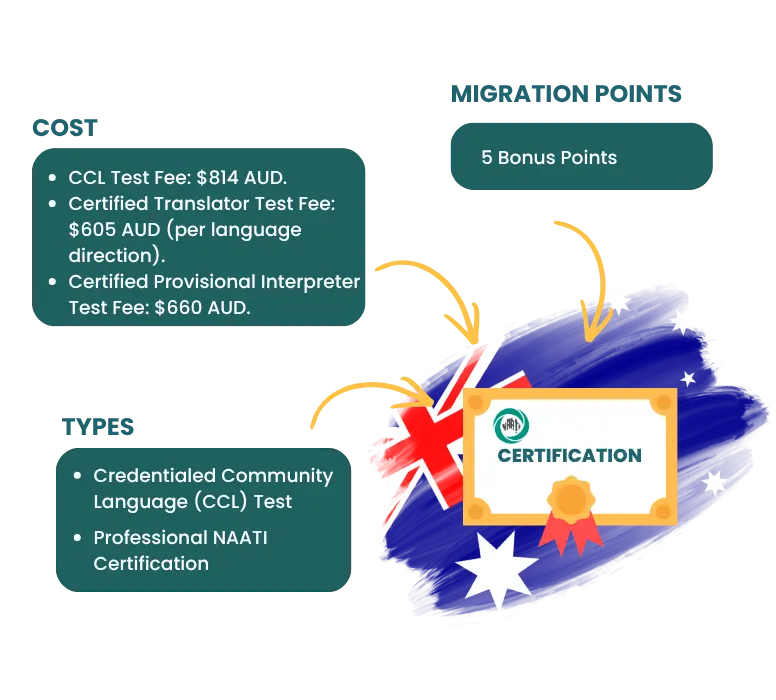
For skilled migrants, there is also a separate but related pathway called the Credentialed Community Language test, which can add points to a skilled visa application. Because both paths carry the NAATI name, many applicants confuse them, even though the requirements, cost, and purpose are quite different. This article explains what the certification actually involves, the credential types on offer, the requirements you need to meet, and the fees you should expect to pay in the current fee year.
It covers how the CCL test connects to Australia’s points-tested skilled visas, since many engineers and other skilled professionals sit this test while their skills assessment or visa application is in progress. Read on for a clear, accurate breakdown of the system, so you know exactly which pathway applies to your situation before you commit time or money to it.
What Is NAATI Certification
NAATI is the national standards and certifying authority for translators and interpreters in Australia. Holding this credential means a person meets the standard expected of language professionals working within the community. The system was not created overnight. It followed years of research and consultation into the knowledge, skills, and attributes that translators and interpreters need to succeed in their roles.
In simple terms, NAATI certification is a formal credential. It tells employers, courts, hospitals, and government agencies that the holder can translate or interpret to a defined professional standard. Without it, most government and legal bodies in Australia will not accept a translation or engage an interpreter for official work.
It is worth separating certification from NAATI recognition. Recognition is granted only in languages where formal testing is not available, usually because demand is too low to justify running a test. Certification, on the other hand, is the standard pathway for the vast majority of language combinations, and it is what most applicants should aim for if a test exists in their language pair. The full, current list of credentials and test languages is maintained on the official NAATI website, which is worth checking directly since availability changes periodically.
Why This Credential Matters
Government departments across Australia, including the Department of Home Affairs, require translated documents to carry a certified translator’s stamp or seal. Universities, migration agents, and courts follow the same rule. A translation completed by someone without the right credential is often rejected outright, regardless of how accurate the translation actually is.
This matters directly for skilled migrants. If you are applying for a VETASSESS skill assessment, any academic transcript, degree certificate, or reference letter not originally in English must be translated by a certified translator. Missing this step is one of the more common and avoidable reasons applications get delayed, so it pays to plan document translation early, alongside other paperwork such as your resume or supporting statements.
Applicants often underestimate how long a proper translation takes, especially during peak application periods when certified translators have long booking queues. Building in extra weeks for this step, rather than assuming it can be arranged at the last minute, keeps the rest of the migration timeline on track.
Types of NAATI Certification
NAATI offers several credential types, and the right one depends on the language pair, the training completed, and the type of work planned. The table below summarises the main credentials currently on offer.
Credential | What It Covers | Typical Use |
Recognised Practising Translator/Interpreter | Granted where no test is available; based on work practice evidence | Emerging or low-demand languages |
Certified Provisional Interpreter (CPI) | Entry-level generalist interpreting test | Community dialogue interpreting |
Certified Interpreter (CI) | Higher-level interpreting; requires passing CPI first | Complex non-specialised interpreting |
Certified Translator | Translation of non-specialised texts and revision work | General document translation |
Certified Specialist Interpreter (Legal or Health) | Advanced testing in a specific sector | Court or medical interpreting |
Certified Conference Interpreter / Advanced Translator | Highest professional tier, often tied to international body membership | Conference-level or highly specialised work |
Applicants choose a credential based on the kind of work they want to do and the level of formal training they have completed or plan to complete. It also helps to know that the Credentialed Community Language test sits outside this table entirely. A pass in that test does not certify a person to work as a translator or interpreter, which is a distinction covered in more detail further down.
NAATI Certification Requirements
The requirements for this credential follow a structured pathway rather than a single test. The first step is completing formal training and meeting the prerequisite requirements, since applicants must finish an approved course in interpreting or translation before applying.
Beyond formal training, applicants typically need to demonstrate the following:
- English language proficiency, usually shown through completed education in English or an accepted English test result
- Ethical competency, assessed through a screening test covering the relevant professional code of ethics
- Intercultural competency, which is built into most endorsed training courses
- A completed application submitted through the myNAATI portal, along with any supporting documents requested
The prerequisite pathways set out the exact criteria applicants must meet to sit their chosen test, and it is worth reviewing this information specifically for the credential being applied for. Requirements shift slightly depending on the language and credential level, so checking the current official page before applying is a sensible step rather than relying on general advice found elsewhere.
How to Get NAATI Certification
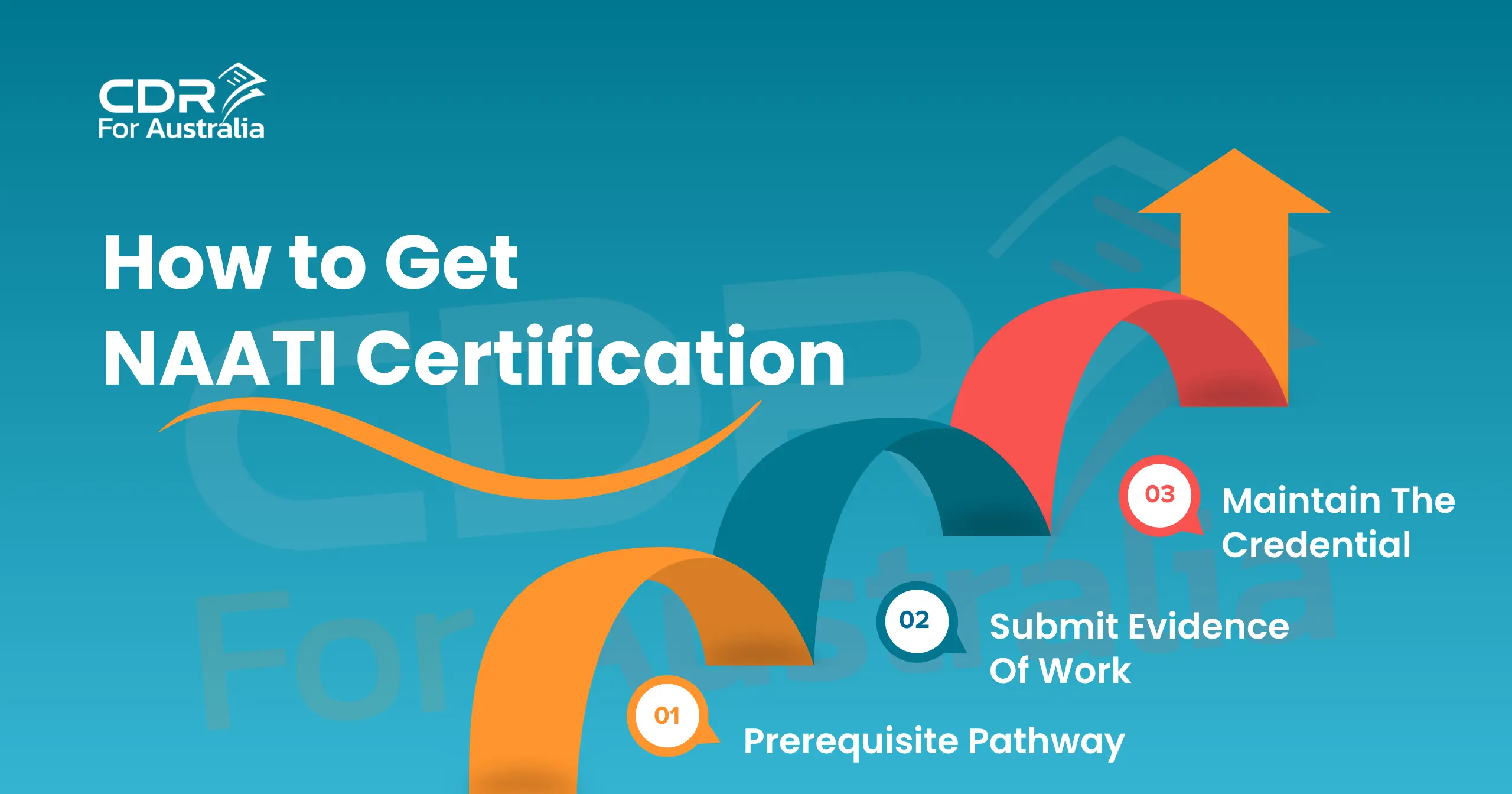
Getting certified follows three broad stages, and understanding them in order avoids wasted time and money.
Step 1: Complete an endorsed course or meet the prerequisite pathway. Most tests require candidates to have finished an approved qualification, though some credentials allow a direct entry pathway based on prior work experience.
Step 2: Sit the test or submit evidence of work practice. The test itself is performance-based, assessing real translation or interpreting skills rather than theory. Passing it results in certification being awarded. For Recognised Practising credentials, no test applies. Instead, applicants submit documented proof of work history.
Step 3: Maintain the credential through recertification. Once awarded, holders are required to meet certain criteria to retain their status, and this process repeats on a fixed cycle described below.
Applicants preparing academic documents for a skills assessment often go through this process at the same time they are compiling other paperwork, such as a Competency Demonstration Report or a VETASSESS application. Planning translation work early avoids last-minute delays later in the migration timeline, since both a certified translation and a well-prepared CDR take real time to complete properly.
NAATI Certification Cost
Cost is one of the most searched questions around this credential, and the answer depends heavily on which pathway is chosen. Fees are reviewed annually and published on the official NAATI fees page, so figures should always be checked close to the date of application. As a general guide for the current fee year:
- Certified Interpreter status for spoken languages, which requires passing both the Provisional and full Interpreter tests, costs around $440 per test.
- A test review, where a candidate disputes a result, costs around $275 per application.
- A supplementary test, available under certain conditions, costs around $220.
- The Credentialed Community Language test, separate from professional testing, currently costs $814 per sitting.
These figures cover the assessment fee only. Training courses, English test fees, and any preparation resources sit outside this cost and should be budgeted separately. Anyone comparing the total cost against other migration expenses, such as a CDR writing service, a Statement of Purpose, or a skills assessment application, should treat it as one line item among several rather than the only cost to plan for.
It also helps to separate a one-time cost from a recurring one. The certification or CCL fee is paid once per attempt, while recertification, covered later in this article, carries its own smaller ongoing cost every three years. Budgeting for both keeps the credential active without any unplanned lapses.
NAATI CCL Test and Australia Migration Points
The Credentialed Community Language test, usually shortened to CCL, is where this credential most often intersects with skilled migration. The CCL test is generally taken by people who plan to apply for a points-based skilled visa in Australia that rewards Credentialed Community Language holders.
A pass in the CCL test can add 5 points to an Expression of Interest lodged through SkillSelect. These points apply to a defined set of visa subclasses:
- Skilled Independent visa (subclass 189)
- Skilled Nominated visa (subclass 190)
- Skilled Work Regional visa (subclass 491)
The test itself involves two pre-recorded dialogues, each around 300 words long, split roughly evenly between English and the chosen community language. Candidates interpret short segments as they play, switching direction between the two languages throughout the dialogue.
NAATI does not provide migration advice. Before booking the test, applicants should confirm with the Department of Home Affairs or a registered migration agent that these points are accepted for their specific visa application. This confirmation step is easy to skip but important, since visa rules and points tables are reviewed periodically and can change without much notice.
It is worth repeating that a CCL pass is a separate outcome from full professional status. A CCL result does not qualify someone to work as a translator or interpreter, though holding professional certification is itself one recognised route into claiming related migration outcomes. For engineers and other skilled professionals whose main goal is points rather than employment as a linguist, CCL is usually the more relevant and more affordable option to pursue.
NAATI Exam Format and Languages Available
Exam format differs depending on the pathway chosen. The CCL test is delivered online only, with two dialogues assessed for accuracy, completeness, and natural delivery. Professional tests, by comparison, run longer and assess a wider range of skills, including sight translation, consecutive interpreting, and in some cases simultaneous interpreting.
Language availability also varies by pathway. Which languages have direct testing available is reviewed periodically based on community demand, and the list changes over time. Widely spoken languages such as Hindi, Punjabi, Mandarin, Vietnamese, and Arabic are generally well covered, while less common languages may only be available through the Recognised Practising route rather than a direct test.

Looking for expert CDR Writer for Engineers Australia?

Creating a CDR Report may be difficult due to Engineers Australia’s standards and rules ( EA ). Our experienced engineers have assisted many people in obtaining approval for their report from the EA via the use of powerful projects.
Certified Translator vs Certified Interpreter
These two credentials are often confused, but they cover different tasks entirely. A certified translator works with written text, converting documents such as certificates, transcripts, and legal papers between languages. A certified interpreter works with spoken language in real time, supporting conversations in settings such as medical appointments, legal proceedings, or business meetings.
Some practitioners hold both credentials, since translation and interpreting draw on related but distinct skill sets. Applicants should be clear about which service they actually need before enrolling in training, since courses and tests differ for each pathway, and studying for the wrong one wastes both time and money.
How Long Does the Process Take
Timelines vary by pathway and by how prepared the applicant already is. Completing an endorsed course typically takes six months to two years, depending on the study mode chosen. Once training finishes, booking and sitting the test can add several more weeks, and results are not always immediate.
For the CCL test specifically, results are usually delivered by email within four to six weeks of the test date. Candidates who fail with a borderline score and wish to dispute the result can apply for a review, which adds further processing time on top of the original wait. Anyone planning to use these results as part of a visa application should build this processing time into their overall timeline, alongside other steps such as a skills assessment or supporting documentation.
Engineers in particular tend to run several processes side by side: a skills assessment, document translation, and sometimes English testing all happen within the same few months. Mapping out each deadline on a single timeline, rather than tackling them one after another, is usually the more efficient approach and reduces the chance of one step holding up the whole application.
Recertification
This credential is not permanent once awarded. Every three years, certified translators and interpreters must submit information showing they continue to meet the required standards, and their status will expire if this requirement is not met. Recertification generally asks for evidence of continued professional development, ongoing work practice, and compliance with the relevant code of ethics.
This structure keeps the system meaningful over time rather than treating it as a one-off qualification earned and forgotten. Practitioners who let their status lapse usually need to reapply and, in some cases, resit the original test, so keeping recertification up to date is far less costly in the long run than letting a credential expire and starting again from scratch.
Frequently Asked Question (FAQs)
What is NAATI certification?
NAATI certification is a professional credential issued by the National Accreditation Authority for Translators and Interpreters. It confirms that a translator or interpreter has met the required standard of skill, knowledge, and ethical practice to work in Australia.
Which NAATI is required for PR?
For most skilled visa applicants seeking migration points, the Credentialed Community Language test is the relevant pathway rather than full professional certification. A pass adds 5 points to an Expression of Interest for eligible visa subclasses.
Is NAATI hard to pass?
Difficulty depends on the pathway and the candidate’s preparation. The CCL test is demanding for candidates who are conversational but not used to interpreting under time pressure. Professional tests, aimed at working translators and interpreters, require a higher and more specialised skill level.
How much does NAATI certification cost?
Cost depends on the credential chosen. Professional tests range from a few hundred dollars to over a thousand, depending on the language and level, while the CCL test carries its own separate fee, reviewed annually.
How long does it take to get NAATI certification?
Full professional certification, including endorsed training, can take from several months to a few years. The CCL test, which does not require formal training, can be booked and sat much sooner, with results issued within weeks.
Can I do NAATI certification online?
The CCL test is delivered entirely online. Professional tests vary by credential, with some conducted online and others requiring an approved test venue, depending on the language and test type.
What languages are available for NAATI certification?
Availability depends on demand and changes periodically. Common languages generally have direct testing available, while low-demand languages may only qualify through the Recognised Practising pathway.