


In Demand Jobs in Australia: Top Occupations 2026
Skilled professionals worldwide have Australia on their radar, and for good reason. Jobs and Skills Australia (JSA) data shows 293 out of 1,022 assessed occupations roughly 29% are currently in national shortage. Local supply is not closing that gap. In demand jobs in Australia have become central to both the country’s migration policy and its long-term economic planning. The government updates shortage lists regularly and adjusts visa programs around them, actively targeting overseas professionals in fields where gaps are widest.
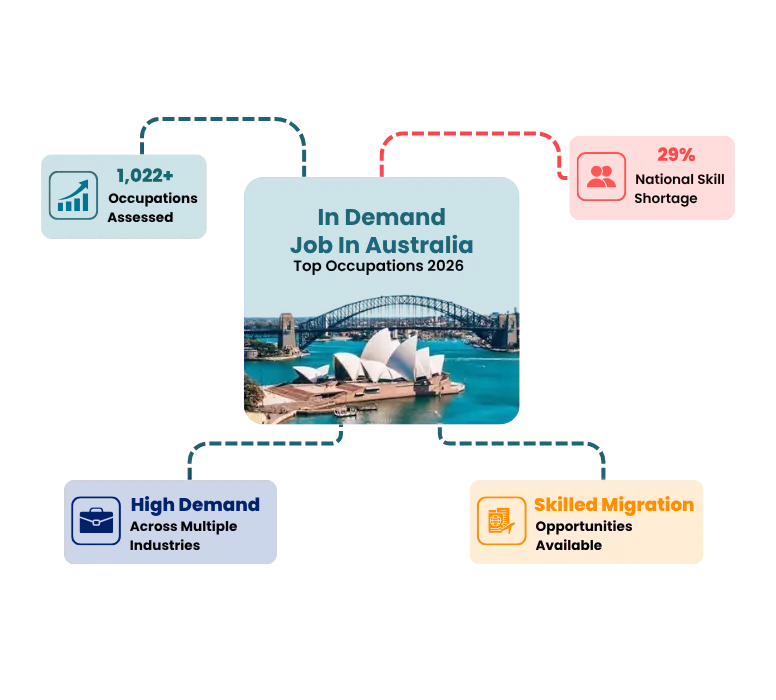
In demand jobs in Australia are across multiple industries. Healthcare, construction, IT, engineering, aged care, mining, and education are all short-staffed and have been for years. Three things are pushing demand further ahead of supply: an ageing population expanding healthcare needs, a massive infrastructure pipeline keeping engineers and tradespeople in steady work, and fast-moving digital change creating technology roles faster than local graduates can fill them. These are not short-term gaps. They are structural, and the data shows they are getting wider.
For overseas professionals, that gap is a real opening. But not every role connects to the same visa pathway, and not every occupation carries the same PR eligibility. Knowing which roles qualify, which lists they sit on, and how they link to permanent residency is what separates a strong migration plan from one that stalls.
High Demand Jobs in Australia: What the Data Actually Shows
When people search for high demand jobs in Australia, the picture the official data paints is consistent and has been so for several years. According to the Jobs and Skills Australia (JSA) September 2025 Occupation Shortage Report, 139 occupations have been in persistent shortage every single year since 2021.
Metric | Figure |
Occupations in persistent shortage since 2021 | 139 |
National vacancy fill rate | 70.2% |
Fill rate for trades and technical roles (Skill Level 3) | 54.3% |
That 54.3% fill rate tells the real story for every two trade vacancies open right now, fewer than one gets filled. These are not temporary gaps. They reflect structural workforce needs Australia’s domestic supply cannot meet alone. Healthcare, technology, engineering, and construction sit at the top of every shortage list and the gaps in each are broad, persistent, and actively shaping government migration policy.
In Demand Jobs in Australia for Foreigners: Who Qualifies
Australia actively recruits overseas professionals across engineering, healthcare, IT, and trades to fill growing workforce gaps. The pathway differs by profession, but the starting point is the same: a formal skills assessment confirming your qualifications meet Australian standards, followed by a points calculation and Expression of Interest through SkillSelect. No positive assessment means no visa application.
Trade workers go through Trades Recognition Australia or a state licensing body. Healthcare professionals must meet AHPRA registration requirements on top of the migration steps. Engineers from countries outside the Washington, Sydney, or Dublin Accords must submit a CDR to Engineers Australia covering Career Episodes, a Summary Statement, and a CPD list before any visa application can proceed.
Occupation | Salary Range (AUD) | Assessment Authority |
Registered Nurse | $65,000 – $120,000+ | AHPRA |
General Practitioner | $180,000 – $400,000 | AMC |
Software Engineer | $110,000 – $150,000 | ACS |
Cybersecurity Specialist | $110,000 – $187,000 | ACS |
Civil Engineer | $85,000 – $160,000 | Engineers Australia |
Mining Engineer | $150,000 – $200,000 | Engineers Australia |
Electrician | $75,000 – $200,000 | TRA / State Licensing |
Aged Care Worker | $55,000 – $80,000 | AHPRA / VETASSESS |
Secondary School Teacher | $65,000 – $90,000 | AITSL |
Construction Manager | $110,000 – $160,000 | Engineers Australia / AIPM |
Disability Support Worker | $55,000 – $75,000 | VETASSESS |
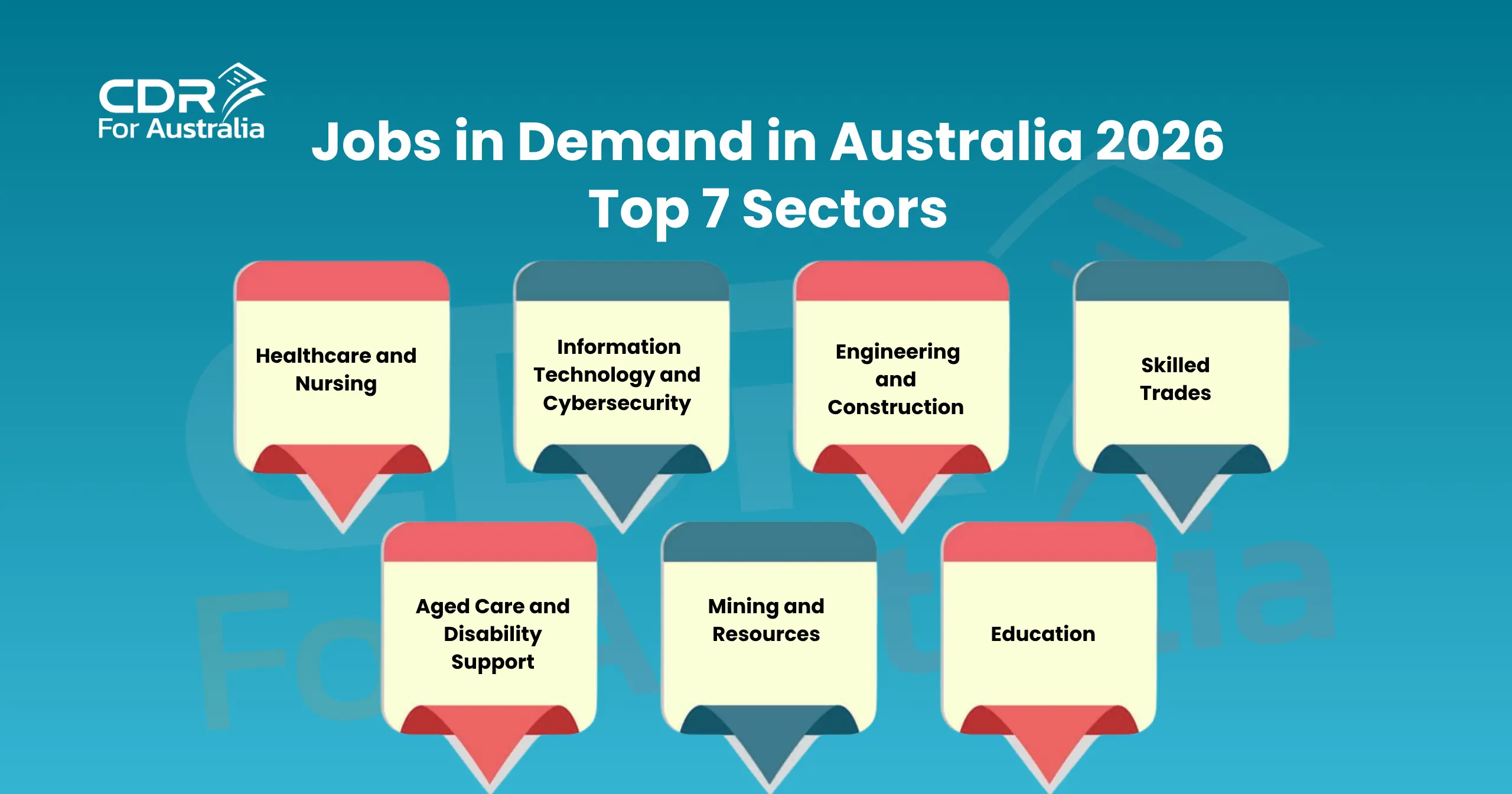
Jobs in Demand in Australia 2026: Top 7 Sectors
Seven sectors stand out in 2026 not just for the volume of open roles, but for how directly they connect to skilled migration visa pathways. Here is where the opportunities are clearest.
1. Healthcare and Nursing:
Registered Nurses have been on the JSA shortage list five years running. That alone says something. An ageing population and a growing NDIS are pushing demand across public hospitals, aged care facilities, mental health units, and regional clinics. Both the MLTSSL and CSOL list healthcare roles directly, so the Australian PR pathway from this sector is among the most straightforward available.
Salary: AUD 65,000 – 120,000+
2. Information Technology and Cybersecurity:
Tech hiring in Australia has not slowed. Software engineers, cybersecurity analysts, ICT systems architects, and security specialists are wanted across government and private sectors alike. ICT Business and Systems Analysts alone are tipped to reach 58,100 positions by May 2028 a 12.7% jump. The federal government’s target of 1.2 million technology workers by 2030 is ambitious, and the shortfall is real. International tech professionals should identify their ANZSCO code early to determine which migration route applies.
Salary: AUD $110,000 – $187,000+
3. Engineering and Construction:
Civil, mechanical, electrical, structural, and mining engineers hold a firm position on the MLTSSL. Project engineers, construction managers, and site supervisors are in demand too, as dwelling approvals climb and infrastructure spending runs deep across every state. Engineers from non-accredited countries start with their ANZSCO code and a Competency Demonstration Report (CDR) submission to Engineers Australia before anything else.
Salary: AUD 85,000 – 200,000+
4. Skilled Trades:
No sector is harder to staff right now. A 54.3% fill rate puts trades at the sharp end of the shortage problem. Electricians, plumbers, carpenters, and welders show up on federal and state occupation lists month after month. The Skills in Demand visa (Subclass 482) and Employer Nomination Scheme (Subclass 186) are the primary entry points for overseas tradespeople.
Salary: AUD 75,000 – 130,000+
5. Aged Care and Disability Support:
JSA puts the projected growth in this sector at close to 100,000 additional roles by 2030, all tied to the NDIS rollout and demographic shift. Disability Support Workers, Personal Care Workers, and Aged Care Nurses are on the CSOL. Regional facilities are recruiting internationally right now. VETASSESS Skill ssessment handles most skill assessments for workers coming through this pathway.
Salary: AUD 55,000 – 80,000+
6. Mining and Resources:
Western Australia, Queensland, and the Northern Territory drive the bulk of demand here. Mining Engineers, Petroleum Engineers, Geotechnical Engineers, and Drilling Supervisors are all short-supplied at a national level. The energy transition is adding battery-mineral and clean energy project demand on top of existing resource work. Most of these occupations sit on the MLTSSL, which opens up the Subclass 189 and state nomination routes.
Salary: AUD 150,000 – 200,000+
7. Education:
Maths, science, and special education teachers are wanted across the country. Early childhood educators are in persistent shortage, particularly outside major cities. Queensland, New South Wales, Western Australia, and the Northern Territory are actively offering relocation incentives to bring overseas teachers in. AITSL assesses school teachers; ACECQA handles early childhood professionals.
Salary: AUD 65,000 – 90,000+
What Is the Skilled Occupation List Australia
The Skilled Occupation List is the Australian government’s official list of roles eligible for skilled migration visas. If your occupation is not on it, you cannot apply for a skilled visa points-tested or employer-sponsored.
- CSOL – 456 occupations. Covers the Subclass 482 and Subclass 186 employer-sponsored visas. Updated in December 2024.
- MLTSSL – Covers the Subclass 189, 190, and 491 points-tested visas. Strongest route to permanent residency.
- State Lists – Each state publishes its own list for local labour market needs. These can differ from federal lists.
Every occupation has a six-digit ANZSCO code. That code determines which visa you can apply for and which authority assesses your skills. Lists are updated periodically. Always check your occupation’s current status before submitting an Expression of Interest. The current Skilled Occupation List Australia is available for reference.
In Demand Jobs in Australia for PR
Not all in demand jobs in Australia carry the same PR pathway. The visa route available depends directly on which occupation list your role sits on.
MLTSSL Occupations
Roles on the MLTSSL qualify for the Subclass 189 (no sponsor needed), Subclass 190, and Subclass 491 visas. Registered Nurses, Civil Engineers, Software Engineers, Electricians, and Mining Engineers all sit here. A points score of 85 or above gives a realistic chance of invitation.
CSOL Occupations
All 456 CSOL occupations are eligible for the Subclass 482 Skills in Demand visa. This is a temporary visa that leads to PR through the Subclass 186 after the required work period with a sponsoring employer. A practical option for those already working in Australia.
Subclass 491
The regional visa adds 15 points to your score and converts to PR faster. Useful for healthcare workers, teachers, and tradespeople open to regional work. For engineers specifically, the Australia PR pathway starts with an EA skills assessment followed by an EOI through SkillSelect.
How to Secure In Demand Jobs in Australia: Key Steps
The process has six clear milestones. Getting each one right matters skipping steps or getting the sequence wrong costs time and money.
Step 1 - Confirm Your Occupation Is Listed
Check whether your occupation appears on the CSOL, MLTSSL, or a relevant state list. Every occupation has an ANZSCO code. That code drives everything that follows the visa type, the assessing authority, and the points available.
Step 2 - Complete Your Skills Assessment
No assessment, no visa. Engineers go through Engineers Australia those from non-accredited countries need a CDR. IT professionals use ACS. Nurses and doctors go through AHPRA. Tradespeople use TRA. Timeframes vary from six weeks to six months or more. Start early.
Step 3 - Meet English Language Requirements
IELTS, PTE Academic, TOEFL iBT, and OET are all accepted. The baseline for most skilled visas is IELTS 6.0 across each band. Scoring higher than the minimum adds points to your profile. It is worth the preparation.
Step 4 - Calculate Your Points and Submit an EOI
SkillSelect requires a minimum of 65 points to submit, but 85 to 100 or above is what most occupations actually need for a real invitation. Age, qualifications, English score, work experience, and state nomination all count toward the total.
Step 5 - Receive an Invitation
An Invitation to Apply gives you 60 days to submit. Documentation needs to be consistent across every part of the application. Incomplete or mismatched paperwork is one of the most common causes of delay.
Step 6 - Health and Character Checks
A medical exam through an approved panel physician is required. Police clearance from every country where you have lived for 12 months or more is also mandatory. Neither can be skipped.

Looking for expert CDR Writer for Engineers Australia?

Creating a CDR Report may be difficult due to Engineers Australia’s standards and rules ( EA ). Our experienced engineers have assisted many people in obtaining approval for their report from the EA via the use of powerful projects.
High Demand Jobs in Australia in the Next 10 Years
Three forces are shaping Australia’s job market through to 2034: an ageing population, record infrastructure investment, and accelerating digital transformation. Jobs and Skills Australia’s long-term workforce projections confirm that current shortage occupations will not just remain in demand the gap will widen in most cases.
Healthcare and Aged Care
The largest growth sector by absolute numbers. JSA forecasts around 120,000 additional nursing positions by 2033. Disability and aged care support roles are set to add close to 100,000 positions by 2030. These roles cannot be automated, demand is structural, not cyclical.
Renewable Energy
Solar installers, wind turbine technicians, and clean energy engineers are picking up work fast across regional Australia. Big energy projects are the reason. State occupation lists are already reflecting this shift and the federal CSOL is expected to follow in coming updates.
Cybersecurity and AI
LinkedIn’s Jobs on the Rise 2026 report placed AI engineers and Directors of Artificial Intelligence among the fastest-growing roles in the country. Digital risk is not slowing down. Cybersecurity professionals are expected to stay in shortage for the rest of the decade.
Construction and Infrastructure
Housing targets, new transport corridors, and the energy transition are all keeping civil engineers, tradespeople, and project managers busy. Over 4,000 new civil engineering positions open each year. That number is not shrinking.
Frequently Asked Question (FAQs)
What jobs are in demand in Australia for international students?
Healthcare, IT, engineering, early childhood education, and social work offer the strongest prospects. Pick a CRICOS-registered course that lines up with the Core Skills Occupation List and build real work experience while studying it lifts both employment chances and PR eligibility after graduation.
Which job is best to get PR in Australia?
Registered Nurses, Software Engineers, Civil Engineers, Electricians, and General Practitioners are consistently strong choices. All sit on the MLTSSL or CSOL with persistent shortage status and clear pathways through Subclass 189, 190, 491, and 186.
What jobs are in demand in Australia in the next 10 years?
Healthcare and aged care, cybersecurity, renewable energy, construction, education, and AI are expected to generate the most sustained employment growth through to 2034, based on Jobs and Skills Australia workforce projections.
What jobs earn $500,000 a year in Australia?
Specialist surgeons, neurosurgeons, cardiothoracic surgeons and senior executives sit at this level. Most fall outside standard occupation lists and qualify under the Specialist Skills stream of the Skills in Demand visa, which covers workers earning above AUD 141,210 per year from July 2025.
What jobs pay $200,000 in Australia?
Specialist doctors, senior mining engineers in Western Australia, cybersecurity architects, power system engineers, and senior construction managers regularly hit this mark. Regional and FIFO arrangements often push the figure higher.
What are the in demand jobs in Australia for PR?
Engineering, nursing, software development, and skilled trades give the most reliable PR pathways. MLTSSL-listed occupations feed directly into the Subclass 189 Skilled Independent visa and the Subclass 190 Skilled Nominated visa.
What are the high demand jobs in Australia for foreigners?
Registered Nurses, Civil and Mechanical Engineers, Software Engineers, Electricians, GPs, Secondary School Teachers, Aged Care Workers, and Construction Managers are all on the CSOL and MLTSSL eligible for both the Skills in Demand visa and permanent residency pathways.
What are the in demand jobs in Australia for Filipino workers?
Nursing and allied health, aged and disability care, early childhood education, civil and mechanical engineering, and IT are the main areas. Filipino Registered Nurses in particular have a well-trodden AHPRA registration pathway and are recruited actively by metropolitan and regional healthcare facilities alike.
What are the high demand jobs in Australia in the next 10 years?
Based on JSA projections through to 2034, the roles expected to grow most are Registered Nurses, Aged Care Workers, Software Developers, Cybersecurity Specialists, Civil Engineers, Early Childhood Teachers, and Renewable Energy Technicians.
What is on the skilled occupation list Australia for 2026?
The CSOL covers 456 occupations across healthcare, engineering, IT, education, mining, and trades. The MLTSSL covers points-tested visa occupations. State lists add roles specific to local labour market needs. The Department of Home Affairs maintains and updates all three periodically.