


Employer Sponsored Visa Australia 2026: Eligibility, Subclasses & Process
An employer sponsored visa Australia pathway lets a skilled worker live and work in the country because an Australian business is willing to hire and back them. No points test. No invitation round. A genuine job offer is what the application is built on. The government set this system up so local businesses could fill roles when they can’t find a suitably skilled Australian for the job.

Some of these visas are temporary, some are permanent, and each comes with its own rules on cost and processing time. Engineers, nurses, tradespeople, IT professionals, hospitality workers they all use this route, and for good reason. It’s often the most direct way into the country. For the employer, sponsoring someone means real legal obligations: paying the correct market salary, covering certain visa costs, staying compliant.
For the applicant, it means proving skill, English ability, health and character before a visa gets granted. What follows covers how the system actually works – the visa types, who qualifies, occupation lists, age rules, current fees, and how long each step tends to take.
What Is an Employer Sponsored Visa Australia?
At its core, an employer sponsored visa in Australia depends on one thing: a genuine job offer from an approved Australian business. The employer applies to become a sponsor first. Then they nominate a specific role. Only after that does the worker lodge a visa application linked to the nomination. This structure exists because certain industries genuinely can’t fill positions locally – not because the government wants to hand out visas freely.
Rules around wages, occupation lists, and labour market testing keep the system balanced, so local workers aren’t undercut and businesses can still bring in skilled talent when they need it. The employer sponsored visa Australia framework spans both short-term arrangements and direct routes to permanent residency, depending on the subclass involved.
Once a business becomes an approved sponsor, the obligations don’t stop there. They have to pay the correct market salary rate, cover certain costs on the worker’s behalf, keep accurate records, and tell the Department of Home Affairs about major changes – like a worker leaving the role early. Get this wrong and the consequences are real: penalties, sponsorship cancellation, even a ban from sponsoring again. That’s why most established employers take the compliance side seriously rather than treating it as an afterthought.
Types of Employer Sponsored Visas in Australia
Several employer sponsored visa options exist in Australia, and they don’t all do the same job. Some are temporary. Some grant permanent residency outright. Here’s a quick comparison of the main subclasses.
Visa Subclass | Purpose | Duration | PR Pathway |
(Skills in Demand) | Main temporary employer sponsored visa | Up to 4 years | Yes, after 2 years in role |
(Employer Nomination) | Direct permanent employer sponsored visa | Permanent | Immediate PR |
(Skilled Employer Sponsored Regional) | Regional employer sponsored visa | Up to 5 years | Yes, after 3 years |
Subclass 407 (Training Visa) | Structured training, not full employment | Up to 2 years | No |
The 482 is the one most people mean when they say “employer sponsored visa Australia.” It replaced the old Temporary Skill Shortage visa back in December 2024 and now runs as the Skills in Demand visa. Two streams sit underneath it. Core Skills requires a salary at or above the Core Skills Income Threshold, currently AUD 79,423. Specialist Skills is open to almost any occupation, but the bar is higher – AUD 146,576 minimum.
Both figures get reviewed periodically, so check the current number before lodging anything. The 186, known as the Employer Nomination Scheme, is the permanent version of the pathway. You can apply through Direct Entry, or through the Temporary Residence Transition stream if you’ve already held a 482.
The 494 was built for regional employers who genuinely can’t source local talent – it leads to permanent residency after three years in the role. Then there’s the 407, which is different from the rest. It’s about structured workplace training, not standard employment, and it doesn’t lead anywhere near permanent residency on its own. Since March 2026, the process changed too, the employer’s sponsorship and nomination now have to be approved before.
Employer Sponsored Visa Australia Occupation List
Your job has to appear on an approved occupation list. That’s non-negotiable for most employer sponsored visa Australia applications. A few different lists apply, depending on the streams:
Core Skills Occupation List
covers a wide range of skilled roles under the 482 Core Skills stream and the 186 Direct Entry stream
Specialist Skills stream
open to almost any occupation, but the salary offered has to clear a much higher threshold
Subclass 491
applies to the 494 visa, covering occupations approved specifically for regional areas
Fall outside these lists and you’re not automatically out of options, a Labour Agreement between your employer and the government can sometimes cover niche cases, though this route is far less common. Worth knowing too: these lists change. An occupation that qualifies this year might not next year, since they get reviewed against labour market needs. Check your occupation against the right list first. Confirm your ANZSCO code lines up with what you actually do. Do this before applying, not after.
Employer Sponsored Visa Australia Requirements
Two parties, two sets of requirements. The applicant needs to meet one list, the sponsoring employer another.
For the applicant
- A genuine, full-time job offer from an approved Australian sponsor
- Skills and qualifications relevant to the nominated occupation
- A positive skills assessment, where the occupation requires one
- Competent English, usually through IELTS, PTE or an equivalent test
- Health and character clearances
- Salary that meets or exceeds the relevant income threshold
For the employer
- Approval as a Standard Business Sponsor or Accredited Sponsor
- A genuine need for the position, with no suitable local candidate available
- Labour Market Testing in most cases – proof the role was advertised locally first
- Payment of the required nomination and training levy fees
- Compliance with sponsorship obligations, including paying market salary rates
Employer Sponsored Visa Australia Age Limit
Age rules aren’t the same across the board. The 482 has no set age limit at all, which opens it up to a wider range of applicants than the permanent options. The 186 is different – generally under 45 at the time of application, though exemptions exist for cases like certain medical practitioners, senior academics and researchers, or high-income earners.
The 494 carries the same under-45 rule, with similar exemptions available. If you’re close to that line, check your eligibility early. It can shape which pathway actually makes sense for you.
Employer Sponsored Visa Australia Processing Time
There’s no single number here, and anyone who gives you one is oversimplifying. The process runs through separate stages, each assessed on its own clock. A first-time sponsor going for the 482 needs sponsorship approval first, then nomination for the specific role, and only then does the worker lodge the actual visa application.
Accredited Sponsors skip that first stage entirely and go straight to nomination, a real time saver. The 186 tends to run longer overall than the 482, often stretching from several months to over a year, mostly because of the added permanent residency checks. The 494 usually sits somewhere between the two. These figures shift month to month depending on volume and occupation, so the Department of Home Affairs publishes updated numbers through its Global Visa Processing Times tool that’s the most reliable place to check before you plan a start date.
Employer Sponsored Visa Australia Cost
Cost breaks down into pieces, and not all of them land on the applicant. As of July 2026, here’s what the government charges look like.
Fee | Amount (AUD) | Who Pays |
Standard Business Sponsorship approval | $420 | Employer |
Nomination fee | $330 | Employer |
SAF levy, Subclass 482 (per year of visa) | $1,200 small business / $1,800 other business | Employer |
SAF levy, Subclass 186 or 494 | $3,000 small business / $5,000 other business | Employer |
Visa application charge, Subclass 482 | $4,015 | Applicant |
Visa application charge, Subclass 186 | $6,140 | Applicant |
On top of this table, applicants generally cover health exams, English tests, police certificates, and skills assessments where required. Employers, by law, cannot pass the SAF levy or sponsorship costs onto the worker – that’s a compliance breach if it happens. A small business here means annual turnover under AUD 10 million. Add migration agent fees on top if you use one. Because these charges get reviewed and adjusted periodically, confirm the current amounts on the official Department of Home Affairs website before you budget for anything.
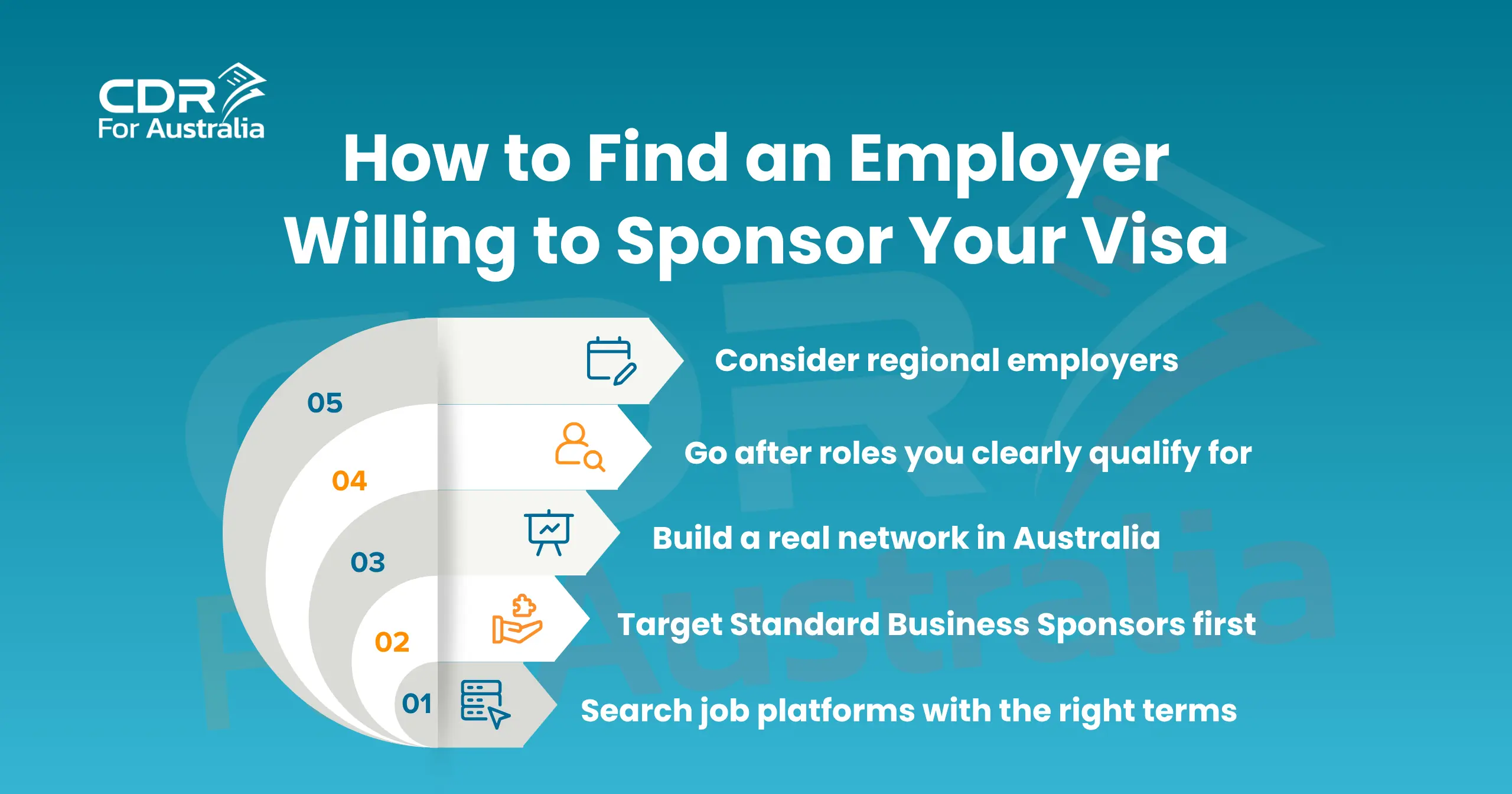
How to Find an Employer Willing to Sponsor Your Visa
This is usually the hardest part. Not every business is set up to sponsor, and plenty simply aren’t willing to go through the process even if they’d otherwise hire you. A few things genuinely help:
- Search job platforms with the right terms. Use phrases like “visa sponsorship available” alongside your occupation, rather than just the job title on its own.
- Target Standard Business Sponsors first. Businesses already registered as sponsors understand the process and tend to move faster than a first-timer employer would.
- Build a real network in Australia. LinkedIn and industry events open doors that job ads never show.
- Go after roles you clearly qualify for. If your occupation and salary already match the requirements, employers naturally prefer that over a case that needs extra approvals.
- Consider regional employers. Under the 494 pathway, competition outside the major cities tends to be lower, which can make sponsorship easier to land.
Employers take on real cost, time, and legal exposure when they sponsor someone. So they gravitate toward candidates who make the decision easy, a clear skills match, realistic salary expectations, an application that’s actually organised. A well-structured resume written to Australian standards helps a potential sponsor see, quickly, how your experience lines up with their role. A clear Statement of Purpose can tip things further in your favour, since it shows the employer you understand what sponsorship actually involves and aren’t approaching it casually.

Looking for expert CDR Writer for Engineers Australia?

Creating a CDR Report may be difficult due to Engineers Australia’s standards and rules ( EA ). Our experienced engineers have assisted many people in obtaining approval for their report from the EA via the use of powerful projects.
Employer Sponsored Visa 482 vs 186 vs 494: Which One Fits You?
Not sure which one applies to you? Start with your timeline and your flexibility on location. Want to work in Australia as soon as possible and don’t mind where? The 482 gets you there fastest. Already meet PR criteria and see no reason to wait? Skip straight to the 186. Open to regional areas in exchange for a clear three-year path to residency? The 494 is built for that. And if what’s on the table is training rather than a real job, that’s the 407 worth knowing about, but it won’t move you toward PR.
Your Goal | Best Visa | Why |
Start working fast, in any location | Subclass 482 | Fastest to process, no age limit, leads to PR later |
Already meet PR criteria, want to skip the temporary stage | Subclass 186 | Direct Entry or TRT gives immediate permanent residency |
Open to regional living, want a guaranteed PR timeline | Subclass 494 | Clear 3-year path, less competition on occupation lists |
Employer offers structured training, not ongoing employment | Subclass 407 | Time-limited, no PR pathway attached |
Skills Assessment and Visa Australia Applications
Plenty of occupations need a positive skills assessment before an employer sponsored visa application in Australia can even proceed:
- Engineers typically need a Competency Demonstration Report assessed through CDR writing services.
- Other professions usually go through VETASSESS skill assessment instead, depending on the occupation.
Either way, the assessment exists to confirm your qualifications and experience genuinely match the duties of the role you’re nominated for. Get it wrong, or use the wrong assessing body, and the whole application can stall. It also pays to check your occupation against the current ANZSCO code list, so your nominated role actually lines up with the occupation list tied to your visa subclass. For applicants under the professional occupations stream, this step usually isn’t optional at all. Current occupation lists, and which body assesses which occupation, are published on the Department of Home Affairs website.
Frequently Asked Question (FAQs)
How do I get an employer sponsored visa in Australia?
Start with a genuine job offer from an approved Australian sponsor, in an occupation that matches the relevant list. From there, you’ll need to clear skill, English, health and character requirements. Your employer handles sponsorship and nomination on their end; you apply for the visa itself once that’s approved.
Can family members be included in an employer sponsored visa?
Yes, spouse/de facto partner and dependent children can usually be included, with work or study rights depending on the subclass. On the subclass 186, they get PR immediately too. Each family member still needs their own health and character checks, so start those early.
Which visa is better, 494 or 482?
Depends what you’re optimising for. The 482 suits workers who want to start quickly, in any location. The 494 suits workers open to regional Australia, with a clear three-year path to permanent residency built in.
How long does an employer sponsored visa take to process?
It varies by subclass, and there’s no fixed number. The 482 is generally the faster of the two main options – weeks to a few months once the nomination clears. The 186 usually takes significantly longer, since it involves the added checks that come with granting permanent residency.
How do I find a company willing to sponsor my visa in Australia?
Search job boards for sponsorship-friendly listings, target businesses already registered as Standard Business Sponsors, build genuine industry connections, and apply for roles that actually match your occupation list and salary threshold. Fit matters more than volume here.
What is the employer sponsored visa Australia occupation list?
It’s a government-approved list of occupations eligible for sponsorship – the Core Skills Occupation List and the Specialist Skills stream between them cover most professional and skilled roles.
Is there an age limit for an employer sponsored visa in Australia?
Not on the 482 – no age limit applies. The 186 and 494 generally require applicants to be under 45, though exemptions exist for specific occupations and circumstances.
How much does an employer sponsored visa in Australia cost?
As of July 2026, the 482 visa application charge sits at AUD 4,015, and the 186 at AUD 6,140. On top of that, employers pay a $420 sponsorship fee, a $330 nomination fee, and the SAF levy – anywhere from $1,200 a year to a $5,000 one-off payment, depending on business size and visa type.
What is the Subclass 186 visa under employer sponsored visa Australia?
It’s the Employer Nomination Scheme, a permanent visa for skilled workers nominated by an Australian employer, available through Direct Entry, Temporary Residence Transition, or Labour Agreement streams.