


ANZSCO 221111 Accountant (General)
Accounting professionals looking to build a career in Australia often start their migration research with one code: ANZSCO 221111. This is the classification used for Accountant (General), one of the most commonly nominated occupations in the finance and accounting stream of Australia’s skilled migration program. Understanding what the code covers, who assesses it, and what a positive outcome requires can save applicants months of avoidable delays.
This page breaks down the occupation in practical terms: the official duties attached to Accountant (General), the three professional bodies that assess applications under this code, the documents each authority expects, and how the occupation fits into the visa system. It also looks at why some applications receive a negative outcome, so applicants can build a stronger case first time.
Whether you qualify overseas or in Australia, getting the classification and evidence right for ANZSCO 221111 is the foundation of a successful skilled migration application. With the right documentation and a clear understanding of what each assessing authority expects, most applicants can move through the process smoothly and confidently.

What Does ANZSCO 221111 Cover?
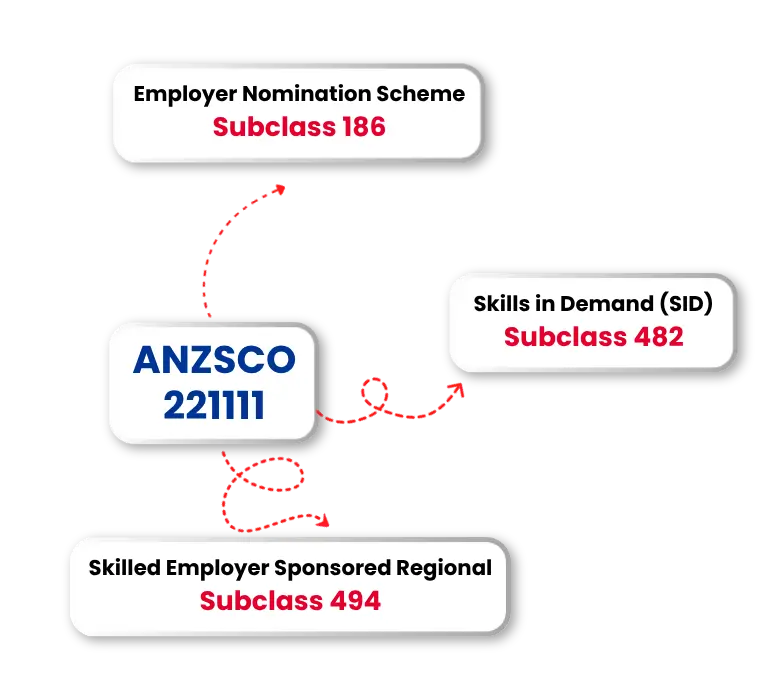
It is a privileged status granted by the Australian Department of Home Affairs (DHA) to employers already holding Standard Business Sponsor (SBS) approval, with a proven compliance track record. It applies to three visa programs:
- Skills in Demand (SID) – Subclass 482: Primary temporary employer-sponsored work visa
- Employer Nomination Scheme – Subclass 186: The permanent residence pathway
- Skilled Employer Sponsored Regional – Subclass 494: The regional visa, also covered under accreditation
Key Duties and Responsibilities of an Accountant (General)
The assessing authorities compare an applicant’s employment history against the standard task list for ANZSCO 221111. Recognised duties typically include:
- Assisting in formulating budgetary and accounting policies for an organisation
- Preparing financial statements for boards of directors, management, shareholders and statutory bodies
- Conducting financial investigations and preparing reports on matters such as mergers, capital financing, suspected fraud, insolvency and taxation
- Examining operating costs, income and expenditure to advise on financial performance
- Providing assurance on the accuracy of financial reports and their compliance with statutory requirements
- Advising on tax structures, tax planning and compliance obligations
- Maintaining and reviewing accounting information systems and internal controls
If your day-to-day role doesn’t clearly reflect several of these tasks, the assessing authority may query whether this is the correct occupation code, or issue a negative skilled employment outcome even where the qualification itself is accepted. Candidates coming from an assistant accountant, accounts payable or bookkeeping background should review this task list carefully, since these roles are often assessed as below the advanced level required.
Not sure where to start?
“Get a CDR written by qualified engineers who know exactly what Engineers Australia looks for.”
Skills Assessment Authorities for General Accountant
Three professional bodies are approved to assess this occupation: CPA Australia, Chartered Accountants Australia and New Zealand (CA ANZ), and the Institute of Public Accountants (IPA). All three check your qualification, English proficiency and, in most cases, relevant work experience against knowledge areas including Accounting Systems and Processes, Business Law, Economics, Financial Accounting and Reporting, Finance and Financial Management, Management Accounting, and Quantitative Methods. If a knowledge area is missing, most authorities allow a bridging subject before issuing a suitable outcome.
CA ANZ places more weight on technical depth, suiting audit or taxation-heavy backgrounds, and stopped offering provisional skills assessments from 1 July 2024. The IPA doesn’t accept diploma-only qualifications on their own; a UK AAT qualification, for instance, is assessed as comparable to an Australian Advanced Diploma and needs an additional bachelor-level qualification to qualify but it’s often chosen by applicants holding membership of an overseas body such as ACCA or CIMA. Standard processing across all three authorities typically runs six to ten weeks, with faster paid options available.
Assessing Authority | Best Suited For | Provisional Assessment (485 visa) |
CPA Australia | Bachelor’s degree holders, general practice roles | Available for eligible graduates |
CA ANZ | Audit, tax and technical accounting specialists | Discontinued from 1 July 2024 |
IPA | Bachelor’s degree holders, including overseas body membership (e.g. ACCA, CIMA) | Available in most cases |
If your degree isn't in accounting:
a non-accounting background doesn’t automatically rule out a positive outcome. If your qualification is missing knowledge areas such as management accounting, business law or financial reporting, all three authorities allow you to close the gap through recognised bridging subjects, completed either before you apply or as part of the assessment itself. Applicants with a business, commerce or economics degree that only partially overlaps should map their transcript against the knowledge list before lodging. Our page on the Australian Qualification Framework covers how bridging study can close AQF-level gaps.
Documents Required for the Skills Assessment
Every applicant needs a consistent evidence package, regardless of which authority handles the assessment:
- Certified copies of academic transcripts and degree certificates
- A detailed CV outlining employment history, job titles and dates
- Employer reference letters on company letterhead describing specific duties performed
- Payslips and employment contracts covering the periods claimed, usually from the start, middle and end of each role
- Proof of identity, such as a passport
- English language test results (IELTS, PTE Academic or an accepted equivalent), where required
Employer references matter more than most applicants expect. A generic letter confirming only a job title is rarely enough; it needs to describe duties in language that maps back to the task list, or the authority may treat the role as unrelated experience. A well-structured CV built around our resume writing service can help your employment history line up cleanly with what the assessor is checking for.
ANZSCO 221111 Compared to Related Accounting Codes
Applicants are sometimes assessed under a neighbouring code once the authority reviews their actual duties. The table below outlines how the general classification differs from its closest relatives.
Occupation | Typical Focus | |
221111 | Accountant (General) | Financial reporting, budgeting, compliance, broad-based accounting duties |
221112 | Management Accountant | Internal reporting, cost control and business decision support |
221113 | Taxation Accountant | Tax planning, structuring and compliance advice |
221213 | External Auditor | Independent audit of financial statements and internal controls |
132211 | Finance Manager | Senior oversight of an organisation’s financial strategy |
If your experience leans toward one of these specialisations, it’s worth discussing the correct nomination with your authority before applying, since a mismatch between code and duties is a common cause of delay. Our overview of professional skilled migration occupations covers how these related codes are treated.
How to Apply for ANZSCO 221111 Accountant
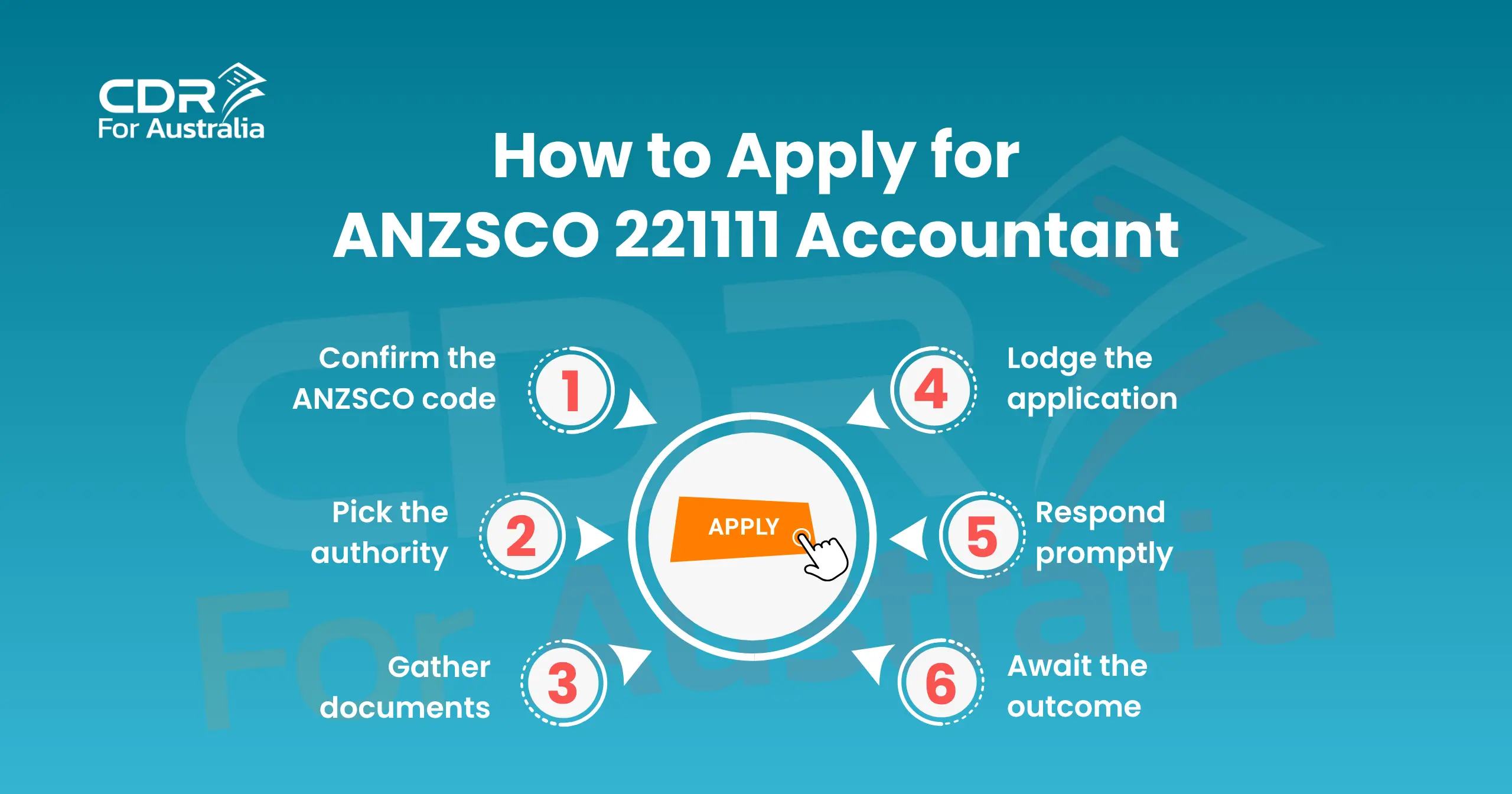
Applying under ANZSCO 221111 comes down to six checkpoints: confirm the code fits your real duties, pick the right assessing authority, and pull together your transcripts, references, payslips and English test results. From there it’s a matter of lodging correctly, responding fast to any follow-up requests, and using the outcome letter to move on to your EOI.
Step 1 →
Confirm ANZSCO 221111 matches your actual job duties, not just your job title
Step 2 →
Choose an assessing authority: CPA Australia, CA ANZ or the IPA
Step 3 →
Gather transcripts, degree certificates, CV and employer reference letters
Step 4 →
Collect payslips, contracts and English test results (IELTS or PTE)
Step 5 →
Lodge the application online with your chosen authority
Step 6 →
Respond promptly to any information requests, then use the outcome for EOI
Visa Pathways for This Occupation
Accountant (General) sits on the Medium and Long-term Strategic Skills List (MLTSSL), keeping it eligible for several points-tested and employer-sponsored pathways. The Subclass 189 Skilled Independent visa needs no state or employer sponsorship, with a minimum score of 65 points, though competitive rounds usually need higher. The Subclass 190 Skilled Nominated visa requires state nomination, which adds points but ties the applicant to that state initially, while the Subclass 491 Skilled Work Regional visa offers additional points for regional areas and a later pathway to permanent residence. Applicants with a job offer may instead pursue the employer-sponsored Subclass 482 Skills in Demand visa.
Because this occupation attracts a high volume of applications, it’s generally treated as oversupplied in skilled migration data, so 189 invitation rounds tend to be competitive. Many applicants improve their prospects through state or regional nomination instead, since those lists tend to be less crowded though criteria change several times a year, so check a state’s current nomination matrix directly. A positive skills assessment is a prerequisite before an Expression of Interest can be submitted, so this step needs completing well ahead of any visa lodgement.
Typical Skills Assessment Timeline
Applicants often underestimate how long the full process takes from document collection to a final outcome letter. Document preparation generally takes two to four weeks, followed by one to two weeks for lodgement and an initial completeness check, then six to ten weeks of standard assessment processing (or two to four weeks fast-tracked). A positive outcome supports an Expression of Interest, while a negative result may call for a review, additional evidence or a different occupation code. Building extra time into this schedule, particularly around employer reference collection, reduces the risk of a rushed application.

Looking for expert CDR Writer for Engineers Australia?

Creating a CDR Report may be difficult due to Engineers Australia’s standards and rules ( EA ). Our experienced engineers have assisted many people in obtaining approval for their report from the EA via the use of powerful projects.
Accountant (General) Salary and Job Outlook in Australia
Salary data varies by source, but SEEK’s 2026 job-ad data puts the average advertised salary for an Accountant in Australia between AUD 80,000 and AUD 95,000, with Sydney and Melbourne typically above the national average. Entry-level roles often start lower, while senior, audit and specialist positions push well past this range. Demand remains steady across accounting, finance and insurance, part of why the occupation has stayed on the MLTSSL for an extended period.
Common Reasons for a Negative Skills Assessment Outcome
A number of recurring issues cause otherwise qualified applicants to receive a negative result: mismatched job duties in references (particularly for candidates whose role was closer to bookkeeping or assistant accounting), incomplete knowledge areas in the transcript without bridging study, weak documentation such as missing payslips, being nominated under the wrong occupation code, or falling short on the English band score required by the chosen authority.
Reviewing these points before submission is far cheaper than appealing an unfavourable result later, since reassessment fees and processing delays can add months to a timeline. Presentation matters as much as substance; a reference set that clearly maps your history to the required duty list, backed by consistent supporting evidence, gives your file the best chance of a clean assessment first time. Our team can help prepare a Statement of Purpose where one is required, and VETASSESS skill assessment services can be a useful reference for comparing how assessments work across different occupation groups.
Frequently Asked Question (FAQs)
What is ANZSCO 221111?
ANZSCO 221111 is the occupation code for Accountant (General), covering professionals who manage financial reporting, budgeting, auditing and taxation-related tasks for organisations or individuals.
Which authority assesses ANZSCO 221111?
CPA Australia, CA ANZ and the IPA are all approved to assess this occupation. Applicants choose the authority that best matches their qualification level and career focus.
Do I need work experience for a positive outcome?
A qualification assessment alone may suffice for a provisional pathway, but most points-tested visas also require a skilled employment assessment checking your work history against the required duties.
Is Accountant (General) on the skilled occupation list?
Yes, it’s listed on the Medium and Long-term Strategic Skills List, making it eligible for the 189, 190, 491 and 482 visa pathways, subject to current program settings.
What is the difference between ANZSCO 221111 and Assistant Accountant?
Assistant Accountant roles typically involve support-level tasks performed under supervision, while ANZSCO 221111 requires duties performed at a more advanced, independent level, such as preparing financial statements or advising on compliance.
How long is a skills assessment under this code valid?
A favourable outcome from CPA Australia, CA ANZ or the IPA is generally valid for three years from the date of issue, though applicants should confirm current validity periods with the relevant authority.
Can I apply with a diploma instead of a degree?
No, not on its own. All three authorities require a qualification comparable to at least an Australian bachelor’s degree, and a diploma alone won’t meet that threshold without an additional bachelor-level qualification.
Why was my ANZSCO 221111 application rejected?
Common reasons include employer references that don’t match the required duty list, missing knowledge areas in the academic transcript, or insufficient documentation such as payslips and contracts.