


ANMAC Skills Assessment: Complete Guide for Nurses and Midwives
If you’re a nurse or midwife trained overseas and hoping to migrate to Australia, you’ll almost certainly run into the ANMAC skills assessment at some point. ANMAC stands for the Australian Nursing and Midwifery Accreditation Council, and it’s the government-approved body that checks whether your qualifications and experience line up with Australian standards. Here’s the part that trips people up: this isn’t the same as AHPRA registration, which actually lets you practise nursing in the country.

ANMAC’s job is narrower: it looks at your education, registration history, and work experience, then decides whether you meet the bar. Once that review is done, you get an outcome letter, and that letter is what the Department of Home Affairs wants to see before considering your skilled visa application. Nurses from India, the Philippines, the UK, and Canada go through this every year, and there’s no exam or interview involved; it’s entirely document based. What follows covers the different pathways, the paperwork you’ll need, what it costs, how long you’re likely to wait, and how long your result holds up once you have it.
What Is an ANMAC Skills Assessment?
At its core, it’s a review of your nursing or midwifery credentials for migration purposes nothing more, nothing less. ANMAC weighs your degree, registration record, and work history against Australian nursing benchmarks, then issues a letter saying whether your profile clears the bar for your nominated occupation.
One thing worth clearing up: a positive ANMAC outcome doesn’t put you on the ward. That’s still AHPRA’s call, through the Nursing and Midwifery Board of Australia. ANMAC just gives you the green light to move forward first with AHPRA registration, then your visa application.
Who Needs This Assessment?
You’ll likely need it if you fit into one of these groups:
- You trained overseas and want to apply for a permanent or provisional skilled visa think 189, 190, 491, 482, or 186.
- You’re already registered with AHPRA or the Nursing Council of New Zealand and you’re applying for a skilled visa anyway.
- You work in aged care or disability support and want your experience assessed under the direct care route.
- You’ve just finished a nursing or midwifery qualification at an accredited Australian institution and applied for AHPRA registration.
Not sure which visa lane fits you? Our skilled migration visa guide breaks down the main options for people working in healthcare.
ANMAC Skills Assessment Pathways and Fees
ANMAC runs several pathways, and which one you land in comes down to where you trained and your current registration status. Get this wrong and you could be looking at weeks of extra delay, so it pays to check carefully before you submit anything.
Pathway | Who It Suits | Fee (AUD) | Typical Processing Time |
Modified Skills Assessment | Nurses and midwives registered with AHPRA or the NZ Nursing Council | $395 | 6 – 8 weeks |
Modified PLUS Skills Assessment | Applicants with an AHPRA in-principle registration approval | $395 | 6 – 8 weeks |
Full Skills Assessment | Overseas-registered nurses from Canada, Hong Kong, Ireland, the UK, or the US | $595 | 6 – 8 weeks |
Direct Care Skills Assessment | Aged care and personal care support workers | $545 | 6 – 8 weeks |
GradReady Skills Assessment | Recent graduates of accredited Australian nursing courses | $395 | Around 5 – 10 business days |
There’s usually a non-refundable admin fee on top of whatever pathway you choose, and if you ever need an outcome letter update or an internal review, those come with their own separate charges. Payment is online, and only Visa or MasterCard work American Express is a no-go.
ANMAC Skills Assessment Checklist
Before you even open the application form, it’s worth pulling your documents together so nothing holds you up later. Here’s what you’ll typically need:
- Passport bio-data page and a recent passport-style photo
- A second and third form of ID a birth certificate or driver’s licence works
- Graduation certificates covering every relevant nursing or midwifery qualification
- Full academic transcripts that break down theory and practical hours
- Current and past registration certificates from wherever you’re registered
- Reference letters from your employer, on official letterhead, signed by your direct supervisor
- English test results, if your pathway requires them
- Certified translations for anything not already in English
Scan everything in colour and keep it sharp blurry copies or documents run through random scanning apps are one of the most common reasons applications bounce back for correction, and that costs you weeks you didn’t need to lose.
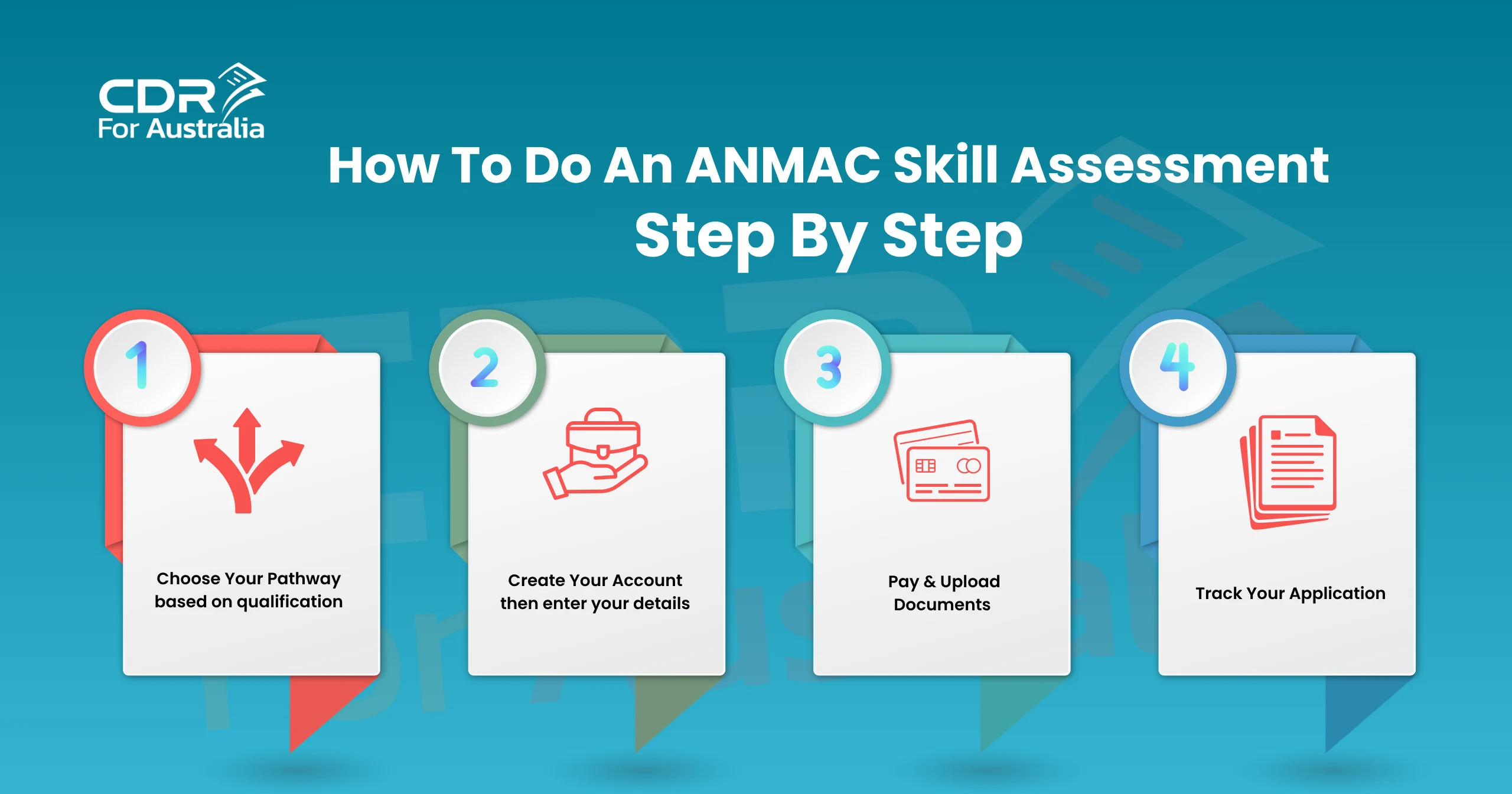
How to Do an ANMAC Skill Assessment: Step by Step
The application itself isn’t complicated once you know the order of operations:
- Work out which pathway actually fits your qualification, country of training, and registration status.
- Set up your account and fill in the online form with your personal, education, and employment details.
- Pay using Visa or MasterCard, then upload your documents once the payment goes through.
- Keep an eye on your account status while ANMAC works through your file.
How Long Does an ANMAC Assessment Take?
This is probably the question people ask most. On average, expect 6 to 8 weeks once ANMAC has every document it needs. GradReady moves faster usually 5 to 10 business days because it’s built for a narrower group of recent graduates with fairly simple files.
That said, timeframes stretch during graduation season or when visa intakes are heavy, sometimes pushing out to 10 or 12 weeks. Most delays come down to missing paperwork or scans that are hard to read, so getting it right the first time really does save you time in the long run.
How Long Is ANMAC Valid For?
A positive ANMAC skills assessment outcome letter holds up for two years from the date it’s issued, and there’s no way to extend that window once it’s set. It’s worth mapping your visa timeline against this from the start. If something changes, say you pick up more work experience you might need an updated letter, which comes with its own fee.
If you’re getting close to that two-year mark and haven’t lodged your visa yet, you’ll probably need to go through the process again.
ANMAC Skills Assessment for International Nurses
For most international nurses, this means the Full Skills Assessment pathway built for people holding a Bachelor of Nursing (or higher) from Canada, Hong Kong, Ireland, the UK, or the US, who are currently or previously registered in that country. The main difference from the Modified route is the need for English test evidence IELTS or OET, typically since you won’t yet be registered with AHPRA or the New Zealand Nursing Council.
If you’re on this pathway, spend real time on your reference letters. ANMAC wants concrete evidence of clinical duties matching your nominated ANZSCO code, not just a job title on a page. Weighing up visa options at the same time? Our general skilled migration overview shows how a positive outcome feeds into your Expression of Interest.
ANMAC Skills Assessment for Aged Care Workers
If you don’t hold a nursing qualification but work in support or personal care, you may still qualify through the Direct Care Skills Assessment you’ll need at least a Certificate III in a relevant area, 120 hours of practical training, and 12 months of full-time paid experience in aged or personal care within the past five years.
This pathway ties into labour agreements like the Aged Care Industry Labour Agreement, aimed at plugging workforce gaps in Australia’s aged care sector. It’s also worth reading up on the Designated Area Migration Agreement, since some regional employers use it to sponsor aged care staff.
ANMAC vs AHPRA Registration
These two get mixed up constantly, so it’s worth spelling out the difference. ANMAC exists purely for migration purposes; its outcome letter is what the Department of Home Affairs looks at. AHPRA, on the other hand, actually authorises you to practise nursing or midwifery in Australia. In practice, you’ll usually need a positive ANMAC outcome before AHPRA moves forward with your registration as an internationally qualified nurse.
Curious how registration and visa steps fit together? Our AHPRA registration process page walks through what typically happens after a positive ANMAC outcome.
Fees, processing windows, and forms all get updated from time to time, so it’s smart to double-check the official ANMAC website before you lock anything in. And if permanent residency without state sponsorship is on your radar, our guide on the Subclass 189 visa points test pairs well with everything covered here.

Looking for expert CDR Writer for Engineers Australia?

Creating a CDR Report may be difficult due to Engineers Australia’s standards and rules ( EA ). Our experienced engineers have assisted many people in obtaining approval for their report from the EA via the use of powerful projects.
Should You Download a Checklist PDF?
A lot of applicants go looking for one neat ANMAC skills assessment checklist PDF to print and tick off. Unfortunately, ANMAC doesn’t publish one requirement sitting across separate pages for each pathway, since Modified, Full, and Direct Care all ask for slightly different evidence. Grabbing an old PDF from a search result is riskier than it sounds, too. ANMAC tightened its identity verification rules in September 2025, adding a requirement for a passport bio-data page, a recent photo, and two extra proof-of-identity documents details an outdated checklist won’t mention.
Your safest bet is to build your own list from the current pathway page on ANMAC’s site, then check each document against the quality standards before uploading. Want a second set of eyes on your paperwork first? A professional document review and proofreading service can pick up on formatting or consistency issues assessors tend to notice.
ANMAC Requirements for Overseas Nurses
Getting through the ANMAC skills assessment as an overseas nurse comes down to a handful of non-negotiables. First, your qualification actually has to lead to registration as a nurse or midwife back in the country where you trained and it needs to line up with an equivalent Australian skill level. ANMAC isn’t going to accept a qualification just because the coursework looks relevant on paper; it has to correspond to a recognised nursing or midwifery credential in your home country.
Here’s what else you’ll need to have sorted:
- Qualification: has to lead to nurse or midwife registration where you studied, and match an equivalent Australian skill level.
- Work experience: only the last ten years counts, and it needs a real reference letter on company letterhead. A scanned note from someone’s personal email won’t cut it. The letter has to spell out your job title, dates, hours, and actual duties not a vague summary.
- Career gaps: if you’ve switched employers a few times or taken time off, be ready to explain it. ANMAC checks your timeline against your registration history, so gaps that don’t add up will get flagged.
- Translations: anything not already in English needs the original document plus a certified translation, and it has to come from a NAATI-accredited translator specifically. A bilingual friend or a general translation company won’t work here.
- English test result: needed if you’re on the Full pathway, which is built for nurses and midwives who don’t already hold AHPRA or New Zealand registration.
On that last point, the required band score isn’t the same across every test, so it’s worth checking which one applies to you:
Test | Notes |
IELTS (Academic) | ANMAC sets its own band requirements here — don’t assume the general migration thresholds apply |
OET | Commonly accepted; grading works differently from IELTS, so compare carefully |
PTE Academic | Has its own separate score threshold |
TOEFL iBT | Accepted less often, but fine if it’s still within its validity period |
One more thing worth flagging: test results expire. If yours has lapsed by the time you lodge, ANMAC treats it the same as if you never sat the test at all, so double-check the date before you submit anything.
ANMAC Skill Assessment Login: Setting Up Your Account
Every pathway starts the same way creating an account through the login page on the Skilled Migrant Application portal. Each person needs their own account and unique email, even if someone else in the family (or an agent) has already applied from the same laptop. A free Gmail or Yahoo address works fine for logging in, but ANMAC won’t accept official verification documents sent from those kinds of accounts.
If the portal won’t load, clearing your browser cache or switching browsers usually sorts it out. Once you get your reference number by email, hang onto it you’ll need it for any phone or email contact with ANMAC.
Frequently Asked Question (FAQs)
How long does an ANMAC assessment take?
Around 6 to 8 weeks in most cases, assuming your documents go in complete and correct. GradReady is the exception that one usually wraps up in 5 to 10 business days.
What is an ANMAC skills assessment?
It’s a document-based review run by the Australian Nursing and Midwifery Accreditation Council to check that an overseas-trained nurse’s or midwife’s qualifications and experience stack up against Australian standards for skilled migration.
How long is ANMAC valid for?
Two years from the date it’s issued, and that period can’t be stretched once it’s locked in.
How much is ANMAC skills assessment?
It depends on the pathway. Modified and GradReady both sit at $395, Direct Care is $545, and Full runs $595 plus a small admin fee on top.
How do I do an ANMAC skill assessment?
Set up an account on the official ANMAC portal, pick the pathway that fits, fill in the form, pay the fee, then upload your documents for review.
What documents are needed for ANMAC assessment?
Proof of identity, your qualification certificates, transcripts, registration history, reference letters, and English test results if your pathway calls for them.
Do international nurses need ANMAC Skills assessment?
Generally, yes nurses trained overseas usually need a positive outcome before AHPRA will move forward with registration, let alone the visa application.
Can aged care workers apply for this ANMAC Skills Assessment?
Yes, through the Direct Care Skills Assessment pathway, as long as the qualification and work experience requirements are met.