


NAATI Test Explained: Types, Format, Fees and Eligibility
If you’re researching skilled migration to Australia or a career as an interpreter or translator, you’ve probably run into the NAATI test somewhere along the way. NAATI stands for the National Accreditation Authority for Translators and Interpreters, and it’s the only body in Australia authorised to certify language professionals. But here’s the thing: there isn’t just one NAATI test. It’s actually a group of separate assessments, each built for a different purpose, ranging from a basic community-level check to advanced professional certification.

Some people sit it purely to pick up extra points for a skilled visa. Others are trying to build an actual career interpreting in hospitals, courts, or government offices. Because the requirements, format, and cost change depending on which version you’re looking at, it helps to know exactly which one applies to you before you book anything.
What Is the NAATI Test?
At its core, the NAATI test measures how well a candidate can interpret or translate between English and another language. Australia is a multicultural country, and government departments, hospitals, courts, and businesses need people who can bridge that language gap accurately. That’s really why this system exists. Depending on which test a person passes, they either walk away with migration points (that’s the Credentialed Community Language route) or a professional credential that lets them work as a certified interpreter or translator.
Broadly speaking, three kinds of people end up sitting this exam. There are skilled migrants chasing extra points under the visa points system. There are people planning to work professionally as interpreters or translators in government agencies, hospitals, legal settings. And there are language professionals already working in the field who need formal Australian certification to keep going. It isn’t mandatory for every skilled visa applicant. It only becomes necessary if you want to claim community language points, or if the occupation you’re targeting requires a NAATI credential to actually work.
Types of NAATI Tests
One of the more confusing parts of researching this exam is figuring out how many versions actually exist and what each one is for. NAATI runs several distinct assessments, and they don’t all sit at the same skill level.
Test | Purpose | Suitable For |
Credentialed Community Language (CCL) | Migration points only, not a professional credential | Skilled migrants seeking bonus visa points |
Certified Provisional Interpreter (CPI) | Entry-level professional interpreting credential | New interpreters starting their career |
Certified Interpreter (CI) | Higher-level generalist interpreting credential | Interpreters with some experience |
Certified Specialist Interpreter (CSI) | Advanced interpreting in health or legal settings | Interpreters specialising in medical or legal work |
Certified Conference Interpreter (CCI) | Highly complex interpreting for conferences and summits | Advanced interpreters working at international events |
Certified Translator (CT) | Professional written translation credential | Translators working with official documents |
Each one comes with its own prerequisites, format, and fees. Picking the right one from the start really does save time and money down the line.
Choosing the Right NAATI Assessment
So which one should you actually take? It comes down to what you’re trying to achieve.
- Want migration points only, with no plan to work as an interpreter? The Credentialed Community Language test was built exactly for this.
- Starting an interpreting career with no NAATI credential yet? The Certified Provisional Interpreter test is typically where you begin.
- Already hold a CPI credential and have some work experience under your belt? The Certified Interpreter test is the next step.
- Aiming for medical or legal interpreting at a higher level? You’ll need the Certified Specialist Interpreter test, and you’ll need the experience and training to back it up first.
- Working toward conference interpreting at international events? That’s what the Certified Conference Interpreter test is designed for.
- Dealing with written documents rather than spoken language? Skip the interpreting tests entirely and go for the Certified Translator test.
Worth flagging: passing the Credentialed Community Language test doesn’t make you a certified interpreter or translator. It’s strictly a points-based assessment, nothing more. NAATI itself doesn’t give migration advice, so before booking anything for visa purposes, it’s worth confirming the requirement with the Department of Home Affairs or a registered migration agent, and checking current details on the official NAATI website.
NAATI Test Format
Format really depends on which skill assessment you’re sitting. The Credentialed Community Language test runs entirely online. Candidates listen to two recorded dialogues, roughly 300 words each, split about half in English and half in the other language. Those dialogues get chopped into short segments about 35 words at a time. A chime plays after each segment, and candidates get around five seconds to start interpreting before the next one begins. The whole thing is expected to wrap up in about 20 minutes, and there’s no pausing or stepping away once it starts.
The professional certification tests work differently. Take the Certified Interpreter test it involves six separate online tasks, including sight translation of documents plus interpreting of both dialogues and monologues. At least two independent NAATI examiners mark each task separately, using a banded scoring system.The Certified Translator test, on the other hand, is all about written translation and revision rather than spoken work.
Across every version, identity verification happens before the session starts, and candidates need to run a system check on their computer, camera, and internet beforehand. It really pays to read the specific candidate instructions for whichever test you’re booked into, since equipment rules and timing details aren’t identical across test types.
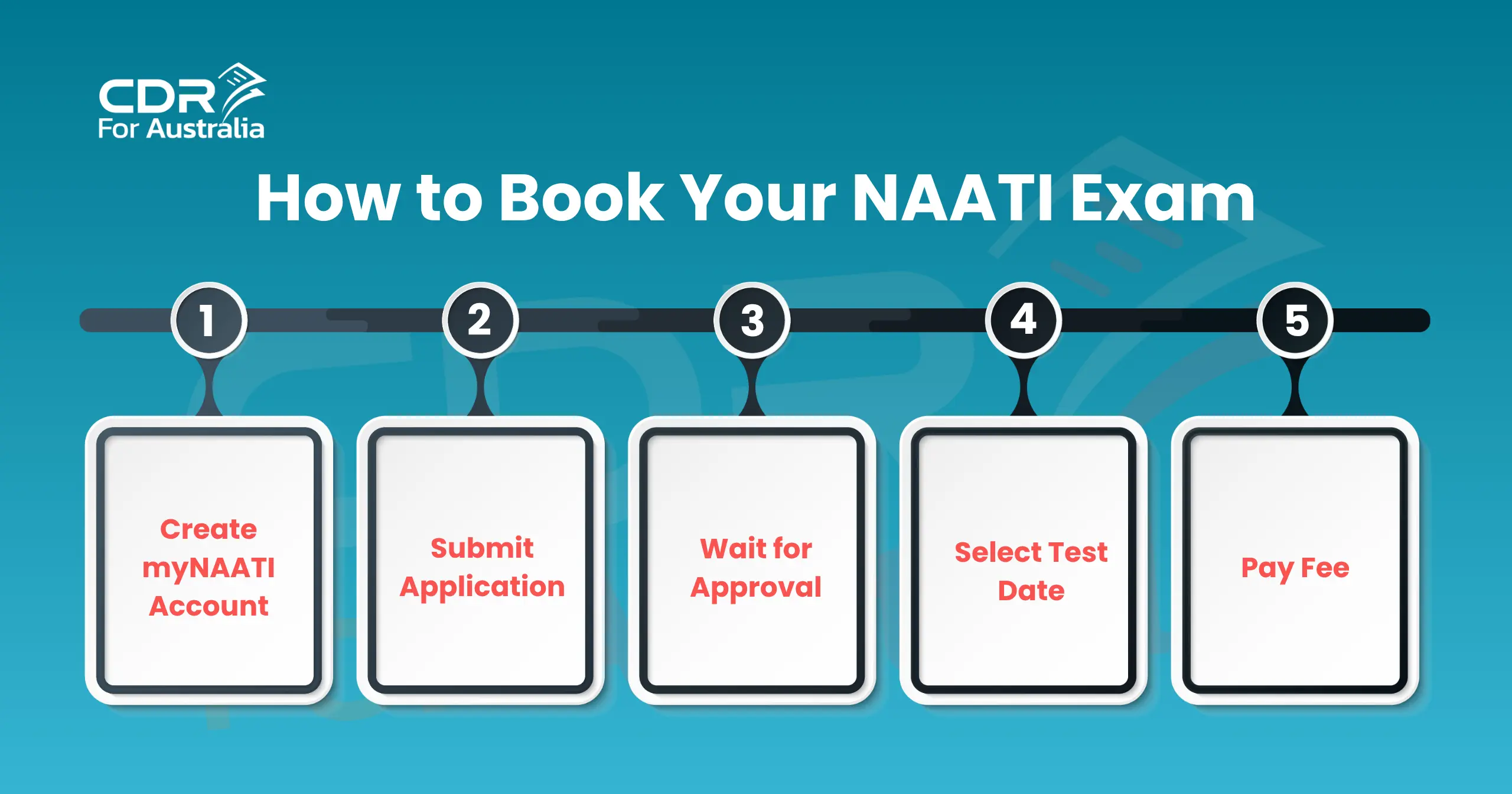
How to Book Your NAATI Exam?
Booking is fairly consistent no matter which assessment you’re going for.
- Create an account on the myNAATI portal with your personal details.
- Select the exam you want to sit, based on your goal and eligibility.
- Choose your language pair from the available options.
- Submit any required documents identification, proof of prerequisites, whatever applies to your test type.
- Pick an available date once your application gets approved.
- Pay the test fee through myNAATI.
- Wait for a confirmation email with instructions for system checks and test day prep.
Migrants juggling several documents at once say, a statement of purpose alongside their language testing often plan this booking around their other application deadlines rather than as an afterthought.
Eligibility for the NAATI Exam
Eligibility rules shift depending on the assessment, and knowing them early saves you from a wasted application.
- The Credentialed Community Language test has no formal training requirement at all. You just need upper-intermediate skills in both languages roughly B2 level under the Common European Framework of Reference for Languages.
- The Certified Provisional Interpreter test usually asks for a relevant qualification, such as an accredited interpreting unit or an approved short course, plus proof of English proficiency and ethical competency training.
- The Certified Interpreter test generally needs an Advanced Diploma-level qualification, or a CPI credential combined with at least two years of interpreting experience.
- The Certified Specialist Interpreter and Certified Conference Interpreter tests target experienced professionals often with a bachelor’s degree or higher, plus substantial work experience in that specialisation.
- The Certified Translator test typically calls for an Advanced Diploma or higher in a related field.
Across every category, candidates need accepted identification, a current passport, or an Australian or New Zealand-issued ID since NAATI can’t issue a result if it can’t confirm who sat the test.
NAATI Test Fees
Fees vary by test type, and they’re reviewed periodically, so it’s worth confirming current pricing on the official NAATI website before you apply. As a rough guide, professional certification tests like the Certified Interpreter or Certified Translator test carry a base fee plus an additional certification test review fee, currently sitting around $275 per application. The Certified Specialist Interpreter assessment has a smaller review fee, around $110, and a supplementary test after a partial result usually costs roughly $220.
The Credentialed Community Language test runs on its own, lower fee structure, which makes sense given its narrower migration-points purpose. Pricing gets updated each financial year, so check the schedule directly on the NAATI site rather than trusting an older figure you found somewhere else.
NAATI Test vs NAATI Certification
People often use “NAATI test” and “NAATI certification” interchangeably, but they’re not quite the same thing. The test is the actual assessment process of the exam itself, where language skills get evaluated under exam conditions. Certification is the credential you’re awarded once you’ve met every requirement, which includes passing the relevant exam and satisfying any prerequisite training or experience conditions.
NAATI Test | NAATI Certification |
The assessment or exam process itself | The credential awarded after meeting all requirements |
Used to evaluate language and interpreting skills | Formally recognises a person’s professional competence |
Includes several exam types, such as CCL, CPI, CI, CSI, CCI, and CT | Includes different certification categories matching each exam passed |
So, in short: passing a NAATI test is the step that leads to NAATI certification, but they describe different stages of the same overall process. That distinction matters more than people think, since some roles specifically ask for certification rather than just evidence of having sat the exam. Migrants working through broader skilled migration documentation alongside language testing should keep this in mind when checking occupation or visa requirements.
Plenty of applicants exploring other point-scoring pathways, like the Skills in Demand visa, end up researching this exam alongside those options during their planning stage. And those tracking invitation rounds for points-tested visas often factor their result straight into their overall points calculation before lodging an expression of interest.
What to Expect on Exam Day
On the day itself, equipment and preparation matter almost as much as language skill. Candidates log in ahead of their scheduled time and go through an identity check with accepted photo ID. A stable internet connection non-negotiable disruptions can invalidate the whole session. Most test versions need a working webcam and microphone, with your face clearly visible throughout; virtual backgrounds aren’t allowed. You’ll also need to run a system check, usually at least 48 hours beforehand, using the exact same computer, location, and internet setup you plan to use on the actual day.
During the assessment, the rules are strict: no mobile phones, no extra screens or notes beyond what’s permitted, and no pausing once things get underway. If a genuine technical issue crops up, candidates should contact NAATI support right away, because unresolved equipment problems can put the validity of the whole result at risk.

Looking for expert CDR Writer for Engineers Australia?

Creating a CDR Report may be difficult due to Engineers Australia’s standards and rules ( EA ). Our experienced engineers have assisted many people in obtaining approval for their report from the EA via the use of powerful projects.
How the NAATI Test Is Marked
Marking criteria shift slightly across test types, but the underlying idea stays the same accuracy, completeness, and appropriate register in the candidate’s interpreting or translation. For the Credentialed Community Language test, marks get deducted for omissions, distortions, or additions that change what the original message actually meant. For the professional certification tests, at least two independent examiners assess each task against banded rubrics, where a lower band reflects stronger performance.
Candidates who don’t pass often share the same handful of issues: mistranslating key details, leaving things out, adding content that wasn’t there, poor time management, or delivery that just isn’t natural or professional enough. Because scoring relies on precise transcripts, small slip-ups can add up fast if you’re not careful with the detail.
Preparation Tips for the NAATI Exam
Good preparation genuinely improves first-attempt results. A few habits tend to make the biggest difference:
- Practise daily with short interpreting or translation exercises instead of cramming right before the date.
- Build subject-specific vocabulary in both languages health, legal, and government topics come up constantly.
- Work on note-taking if you’re preparing for an interpreting-based test, since memory alone rarely holds up over longer segments.
- Get used to Australian-accented English so pronunciation and phrasing don’t throw you off on the day.
- Use official or reputable mock tests that mirror the real format, including timing.
- Record your own attempts and go back over them critically you’ll spot patterns you’d otherwise miss.
- Practise responding within the allowed time window until it feels natural, not rushed.
Steady practice over several weeks tends to beat last-minute cramming, especially for the interpreting-based versions of this exam.
NAATI Test Results and Retesting
Timing depends heavily on the test type. The Credentialed Community Language test generally releases results within 4 to 6 weeks of the test date. Professional certification tests, such as the Certified Interpreter test, can take longer up to 8 to 10 weeks because NAATI issues results individually as each one gets finalised rather than all at once. Results show up through the myNAATI account.
If someone doesn’t pass, NAATI usually offers some feedback on performance, and candidates can apply to sit the same assessment again in a later session. For some professional certification tests, a partial pass might lead to a supplementary test instead of a full retest, depending on which specific tasks weren’t met. Retesting means paying the fee again, so plenty of candidates choose to spend extra time preparing before rebooking rather than jumping straight back in.
Migration applicants often line up their results with other parts of the application resume documentation, for instance to keep the overall visa timeline moving.
Common Mistakes That Affect Exam Scores
A few mistakes come up again and again among candidates who don’t pass on their first try. Translating too literally instead of capturing natural meaning is a big one. So is leaving out details that actually mattered, or adding information that was never in the original message. Disorganised note-taking that can’t keep pace with the dialogue is another common trap.
Speaking too fast under pressure hurts clarity, weak pronunciation can bury an otherwise accurate answer, and not following instructions like speaking during the wrong segment trips people up more often than you’d expect. Knowing these patterns in advance helps candidates prepare with a bit more focus.
Frequently Asked Question (FAQs)
Is NAATI easier than PTE?
Not really comparable, honestly. PTE measures general English proficiency, while the Credentialed Community Language test measures interpreting accuracy between English and another language. Which one feels easier comes down to a candidate’s individual strengths rather than one exam being objectively simpler.
What is the NAATI test for?
It’s used either to award community language points for skilled migration, or to certify someone as a professional interpreter or translator in Australia depending on which version they take.
Is the NAATI exam hard?
Depends on the version and how prepared you are. The Credentialed Community Language test is generally achievable with solid bilingual skills, while the professional certification tests demand a much higher level of trained competence.
How to pass the NAATI test?
You’ll want strong bilingual vocabulary, accurate note-taking, familiarity with the specific format, and regular practice under timed conditions. Avoiding the common errors and omissions, added information makes a real difference too.
What is NAATI CCL?
NAATI CCL is short for the Credentialed Community Language test, an assessment used specifically to award bonus points toward Australia’s skilled migration points test. It’s not a professional interpreting or translation certification.
How much is the NAATI CCL test fee?
Fees change periodically, so it’s best to confirm the current amount on the official NAATI website before booking.
Is the NAATI exam available in all languages?
No. Language availability depends on demand and examiner access, and NAATI regularly reviews and updates which languages are supported for each test type.