


Software Developer Salary in Australia: 2026 Complete Breakdown
There’s no single number for Software Developer Salary. It depends on experience, where you’re based, and honestly, the specific kind of work you do as a junior tester and a senior architect might as well be in different careers, pay-wise. Thinking about a move to Australia, or a shift within the industry? It’s worth knowing what’s realistic before you make any calls. The Australian Bureau of Statistics has full-time software and applications programmers sitting well above the median weekly wage across all occupations.

Junior, mid-level, and senior developers land at very different points, and city matters too: Sydney and Canberra pay more (higher living costs, fiercer demand), regional areas less, though your money often stretches further there. What follows is a breakdown by experience, city, and specialisation, built from government data and the major job platforms, aiming to reflect where things actually stand in 2026.
Average Software Developer Salary in Australia
Different platforms report slightly different numbers here, mostly because of how each one collects its data. Here’s how the main sources line up right now:
Source | Average Salary (AUD/year) |
Jobs and Skills Australia (Government) | ~$114,000 (median, full-time) |
SEEK | $90,000 – $110,000 |
Hays Salary Guide | $90,000 – $150,000 (varies by specialisation) |
Glassdoor | $109,125 (average) |
Payscale | $79,500 – $118,000 (base salary range) |
Government figures back up steady demand for this role software and applications programmers sit comfortably above the national occupation average. The wider spread on recruitment platforms comes down to a few things: they mix junior and senior roles together, and titles like “software engineer” and “programmer” often describe near-identical jobs. Strip out the outliers at either end fresh grads and highly specialised seniors and the software developer salary in Australia actually settles into a fairly tight middle band.
Software Developer Salary in Australia by Experience Level
Experience matters more than almost anything else here. What a junior developer takes home and what a senior engineer earns can look like two completely different careers, and the gap between the two isn’t gradual, it’s a series of jumps. Pulling together data from Hays, SEEK, Payscale, and Glassdoor gives a rough picture:
Experience Level | Typical Salary Range (AUD/year) |
Entry-level / Junior (0–2 years) | $60,000 – $85,000 |
Mid-level (2–5 years) | $85,000 – $120,000 |
Senior (5–8 years) | $120,000 – $160,000 |
Lead / Principal (8+ years) | $150,000 – $190,000+ |
Most graduates start somewhere around $60,000–$65,000, and that climbs fast once the first year or two of commercial experience is under their belt. Once someone takes on technical leadership, mentoring, or architecture work, senior pay routinely clears $150,000. Move into people management or specialist consulting, and it can go higher still, though that really depends on the company and industry.
If you’re coming from overseas and wondering how your existing experience will translate once you land in Australia, getting your work history documented properly matters more than people expect. Services like career episode writing help put technical experience into a format that assessors and employers can actually evaluate which matters both for a skills assessment and for negotiating pay down the line.
Software Developer Salary in Australia by Specialisation
Two broad sectors sit inside the Australian Qualifications Framework: vocational education and training (VET) and higher education. Knowing which sector a qualification comes from, and which level it sits at, helps both job seekers and employers set realistic expectations about what training actually stands behind a certificate or degree.
Front End Developer
Front End Developer builds the parts of an application users see and interact with, mostly working in JavaScript frameworks React, Angular, Vue alongside HTML and CSS. Most roles want at least two years of hands-on framework work and comfort collaborating with designers on UI/UX. Retail, fintech, and consumer-facing product companies hire heavily here.
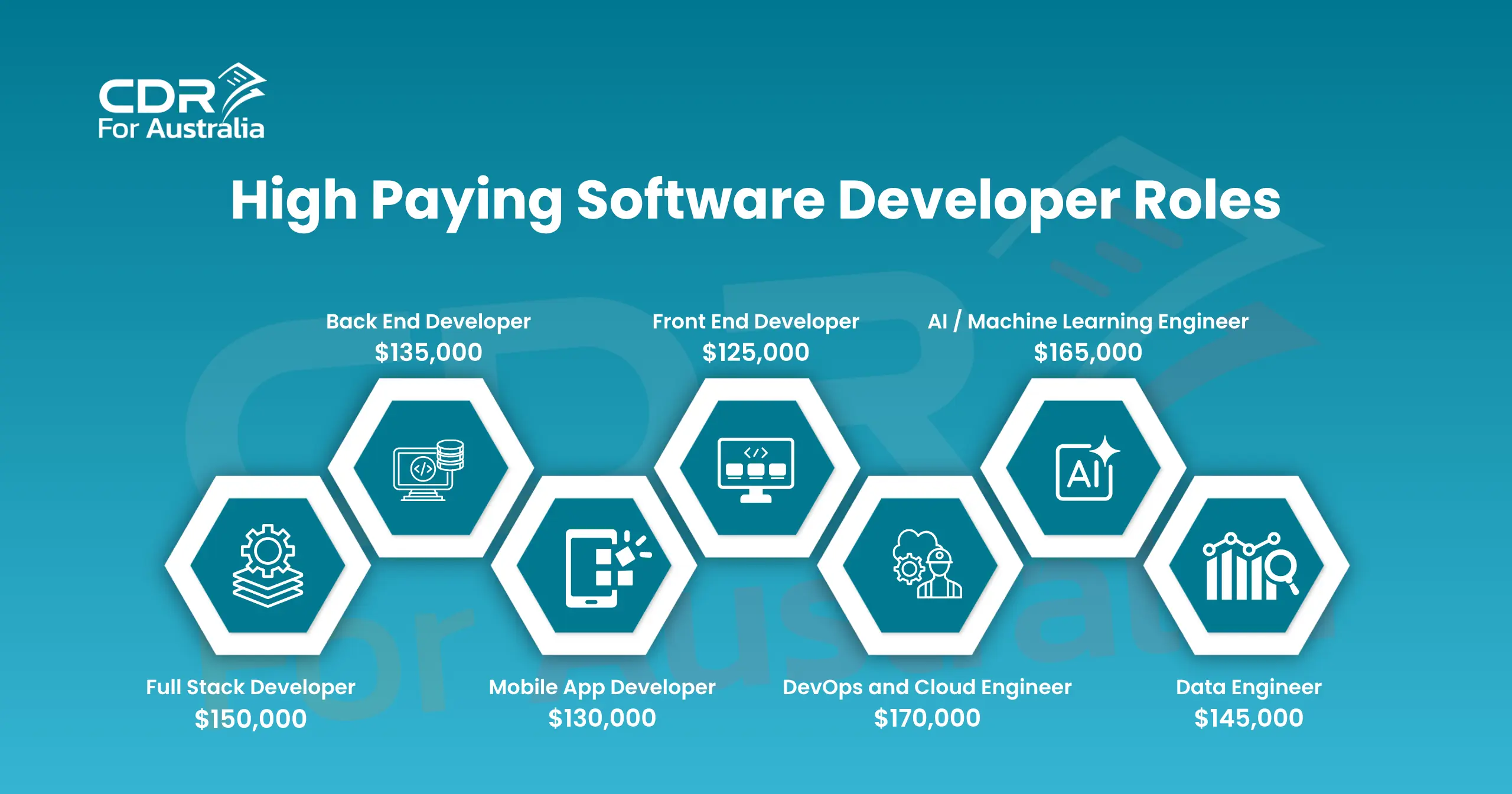
Salary: AUD $90,000–$125,000
Back End Developer
Back End Developer handles the server side databases, APIs, business logic none of which the user ever sees directly. Usually needs solid experience in Java, Python, C#, or Node.js, plus a good grip on database design and system performance. Banking, telecom, and government all lean on this role for secure, high-volume systems.
Salary: AUD $95,000–$135,000
Full Stack Developer
They cover both front end and back end in the same role, which is reflected in the broader pay band. Typically needs three-plus years across multiple languages and frameworks, and the ability to own a feature end to end. Startups and smaller companies especially value this, since it cuts down on how many specialists they need on the team.
Salary: AUD $110,000–$150,000
Mobile App Developer
Builds native or cross-platform apps for iOS and Android using Swift, Kotlin, Flutter, or React Native. Employers generally want to see a portfolio of shipped apps.
Salary: AUD $90,000–$130,000
DevOps and Cloud Engineer
Manages infrastructure, deployment pipelines, and automation that keep software running at scale usually AWS, Azure, or Google Cloud. Typically requires several years of experience plus platform certifications.
Salary: AUD $120,000–$170,000
QA and Test Automation Engineer
Designs and maintains testing frameworks that catch bugs before they reach users, often with Selenium, Cypress, or Playwright. Most roles want a mix of manual testing background and scripting skills in Python or JavaScript. Demand stays steady across nearly every industry that ships software regularly.
Salary: AUD $85,000–$120,000
Data Engineer
Builds and maintains pipelines that move and organise large volumes of data for analytics typically SQL, Python, and cloud warehouses like Snowflake or BigQuery. Demand’s climbing fast as more companies lean on data-driven decisions.
Salary: AUD $100,000–$145,000
Cybersecurity / Security Engineer
Focused on protecting systems and applications from breaches penetration testing, vulnerability assessments, secure code reviews. Often needs formal certification such as CompTIA Security+ or CISSP.
Salary: AUD $110,000–$160,000
AI / Machine Learning Engineer
Builds and deploys models behind recommendation systems, automation tools, and predictive features, usually with Python plus TensorFlow or PyTorch. Generally requires a strong maths or computer science background and real experience training and deploying models in production. Right now, it’s one of the most in-demand specialisations as companies scale up their AI work.
Salary: AUD $115,000–$165,000
For anyone moving to Australia on a skilled visa, these technical skills usually need to be formally documented as part of an ACS RPL report or resume assessment. Getting this right through ACS skill assessment services or a properly formatted resume writing service can genuinely speed up an application and make sure employers see an accurate picture of a candidate’s actual experience.
Software Developer Salary by Major Cities in Australia
Where you work changes the numbers by a fair margin, and it’s one of the things people search for most. Rough ranges by city:
City | Typical Salary Range (AUD/year) | Popular Development Roles |
Sydney | $95,000 – $145,000 | Full stack developer, fintech software engineer, cloud/AI engineer |
Canberra | $95,000 – $135,000 | Cybersecurity engineer, government systems developer, back end developer |
Melbourne | $90,000 – $135,000 | Full stack developer, SaaS/product engineer, data engineer |
Brisbane | $85,000 – $125,000 | Cloud/DevOps engineer, front end developer, AI engineer |
Perth | $85,000 – $125,000 | Back end developer, mining/engineering software developer, automation engineer |
Adelaide | $75,000 – $115,000 | Defence sector software developer, embedded systems developer, full stack developer |
Hobart | $75,000 – $115,000 | Full stack developer, front end developer, QA/test automation engineer |
Sydney and Canberra sit at the top, largely thanks to higher living costs and a heavy concentration of finance, government, and large tech employers. Melbourne isn’t far behind it’s got a mature software scene with both startups and big enterprise players. Brisbane and Perth are catching up as more companies open regional tech hubs outside the two biggest capitals, while Adelaide and Hobart generally pay less, though the lower cost of living softens that gap in real terms.
Remote and hybrid work has also blurred these lines lately; some employers now benchmark pay nationally rather than by city, which has narrowed the gap between metro and regional earnings for experienced developers.
How to Become a Software Developer in Australia
For skilled migrants, the path here is fairly well-trodden. Most roles want a bachelor’s degree in computer science, software engineering, or a related IT field, though some employers will take a diploma paired with several years of relevant experience. A solid portfolio of real projects and current, in-demand skills tends to matter just as much as the degree once you’re actually applying.
For migrants, the process generally looks like this:
- Confirm the right occupation code: Software roles fall under different ANZSCO codes depending on daily duties, and that determines which assessing authority applies.
- Complete a skills assessment: Most applicants need either an ACS RPL report or a Vetassess skill assessment, depending on the occupation and pathway.
- Prepare supporting documents: A well-formatted resume and statement of purpose strengthen both the visa and job applications.
- Apply for a skilled visa: Once the assessment clears, candidates can lodge an expression of interest under the relevant skilled migration stream.
- Start applying for roles: With the assessment and visa sorted, most developers start out in junior or mid-level roles and progress from there.
Getting the skills assessment right the first time saves you from delays that push back both visa approval and your actual start date.
Software Developer Compared to Engineer in Australia
A lot of people wonder whether “software developer” and “software engineer” actually pay differently in Australia. In practice, employers use these titles pretty loosely, and the day-to-day work overlaps a lot between the two. That said, software engineer salaries in Australia tend to run a bit higher on average.
At large tech companies and in engineering-heavy sectors like finance and telecom, where the “engineer” title is often tied to a tougher technical hiring bar. Still, a software developer salary in Australia at a comparable seniority level, doing comparable work, usually lands in the same range once you compare like-for-like experience and company size rather than going off title alone.
For skilled migrants, this title overlap matters for more than just pay comparisons. Visa applications hinge on matching actual job duties to the right occupation code, not whatever’s printed on a business card. Checking the ANZSCO classification for software engineers before lodging a skills assessment helps confirm which category fits daily responsibilities, and that affects both visa eligibility and how you should read salary benchmarks for your specific case.

Looking for expert CDR Writer for Engineers Australia?

Creating a CDR Report may be difficult due to Engineers Australia’s standards and rules ( EA ). Our experienced engineers have assisted many people in obtaining approval for their report from the EA via the use of powerful projects.
How Can You Secure High Paying Software Dev Roles
A few things genuinely move the needle over time:
- Build in-demand skills: Cloud infrastructure, AI integration, and cybersecurity are harder to source and pay a premium.
- Change employers periodically: Switching roles every few years usually brings a bigger pay jump than waiting on internal raises.
- Relocate or go remote: Moving to a higher-paying city, or landing a remote role at a metro-based rate, closes part of the gap.
- Gain certifications: Cloud platform or framework certifications strengthen your case for higher pay.
- Document work history accurately: Accurate, well-documented project history matters as much as raw ability, especially for skilled migrants a properly prepared CDR writing service helps here.
- Build a visible portfolio: Freelance work or open-source contributions give you something concrete to point to in salary discussions.
Career Growth for Software Developers in Australia
Demand for developers in Australia isn’t slowing down, and that’s a big part of why pay keeps climbing over time. Government projections list software and application programming among the occupations expected to grow faster than average, driven by ongoing investment in digital infrastructure, cloud adoption, and automation across banking, healthcare, and government services. That sustained demand is a big reason software development keeps showing up among the in-demand jobs in Australia for skilled migrants going through the points-based visa system.
The usual career arc looks like this: junior developers move into mid-level roles within two to three years, then push toward senior or lead positions as they build technical depth and take on more project ownership. Developers who keep building in-demand skills in cloud architecture, AI integration tend to see their pay grow faster than those who stay narrowly specialised. Jobs and Skills Australia tracks employment trends and wage benchmarks across the ICT sector on an ongoing basis, if you want the official projections and occupation data directly.
Frequently Asked Question (FAQs)
What is the average software developer salary in Australia per month?
On an annual salary of around $100,000, that works out to roughly $8,300 a month before tax though it moves up or down depending on experience and location.
Is $70,000 a good salary in Australia?
Yes it’s a reasonable starting point, especially for graduates or early-career developers. It sits close to the national median income and is fairly typical for juniors in their first year or two.
Is $100,000 a good salary in Australia?
Yes, comfortably above the national median, and a strong income, especially outside Sydney and Canberra. Plenty of mid-level developers reach this within three to five years.
What jobs pay $150,000 a year in Australia?
Senior software developers, engineering managers, specialist doctors, and experienced legal professionals commonly land around here. In tech, it’s typical for senior developers, DevOps engineers, and technical leads.
Is software development hard to learn?
There’s a learning curve, but it’s manageable with consistent practice and structured study. Most developers start with online courses or a degree, then build real skills through actual projects before entering the workforce. The first few months tend to be the hardest building the habit of problem-solving takes longer than picking up syntax or tools.
What jobs earn $500,000 a year in Australia?
Very few salaried roles hit this mark. It’s mostly senior executives, surgeons, and some tech leaders at large multinationals often with significant bonuses or equity folded in. In software, it’s usually reserved for senior engineering directors or specialists at big global firms once equity and bonuses are counted.
What is the monthly salary of a software developer?
It depends on experience and location, but generally ranges from around $5,000 for entry-level roles up to $12,500 or more for senior positions, based on standard annual conversions.