


AACA Portfolio Assessment: Requirements, Documents and Preparation
Planning for the Portfolio Assessment AACA should include an understanding of the assessment pathway, architectural competencies, project documentation, and submission requirements. The Architects Accreditation Council of Australia (AACA) has an Overseas Qualifications Assessment (OQA) pathway to determine if overseas qualifications and competencies are equivalent to those expected of graduates of Australian-accredited architecture programs.
An architectural portfolio is a significant part of the OQA process as it allows the applicants to showcase their design knowledge, technical understanding and application of architectural principles to actual project work. But it is possible that your drawings may not be enough. Applicants are also required to describe their reasons, individual contributions and illustrate their evidence against the appropriate competency criteria.

What Is the AACA Portfolio Assessment?
The Architects Accreditation Council of Australia (AACA) forms the national accrediting body for the development and oversight of assessment programs in the field of architectural qualifications and professional competency in Australia.
The overseas qualifications assessment (OQA) is for applicants who have architectural qualifications from overseas and assesses their qualifications and demonstrated competencies to determine if they are equivalent to an accredited architecture qualification provided by an Australian university or institution.
New applicants are required to undertake the OQA process containing two components: qualification assessment and competency assessment. The competency component includes a project portfolio in architecture, written summary statements to the National Standard of Competency for Architects (NSCA), and a competency assessment interview.
The portfolio allows the applicant to demonstrate how the education and experience they have had in architecture have enabled them to satisfy the competency requirements.
It could involve academic work or professional work, depending on the individual’s experience and the needs of the appropriate pathway. Projects should demonstrate in a meaningful way knowledge of architecture, development of design, technical understanding, and decision-making.
Remember, a portfolio submission is not mandatory for everyone wanting to register or migrate to Australia as an architect. The appropriate route will vary depending on the applicant’s skills, experience and goals.
Who Needs a Portfolio Assessment AACA?
The main focus of AACA portfolio assessment requirements is on applications involving assessment pathways that involve project documentation and evidence of architectural competency.
The OQA pathway may apply to applicants who hold architectural qualifications from another country and wish to apply for an assessment of their qualifications for architectural registration in Australia, or for assessment for a skilled migration visa.
The following situations may need to be taken into account prior to creating a portfolio.
Overseas-qualified architects
For architects trained internationally, qualifications and competencies have to be shown to satisfy OQA pathway requirements.
Selected academic and/or professional projects can be demonstrated in their portfolio as a means of describing their architectural capabilities.
Architecture graduates with overseas qualifications
Architectural graduates from overseas may be required to provide evidence of the knowledge and skills acquired as part of their education.
It can be advantageous to use a final architectural design thesis as it may allow for an opportunity to discuss the design decisions and discuss the relevant competencies during the interview process for evaluating an architectural design thesis.
Applicants with professional architectural experience
The applicant may be able to demonstrate the competencies through work in the field of architecture, if applicable.
They should identify their own role in the work clearly from the work done by other architects, consultants and/or project team members.
Note: There are eligibility criteria specific to each AACA program. Qualification, experience, and English language requirements exist for the OQA pathway. It is necessary that applicants first read the existing official AACA guidelines to determine their suitability to apply.
AACA Portfolio Assessment Requirements
Applicants might be better informed and prepared to present more relevant and complete documentation if they are aware of the assessment requirements prior to choosing projects.
AACA’s published guidance for the OQA pathway calls for a portfolio of three to four architectural projects. Applicants are advised to use the latest OQA Applicants Guide and templates to prepare their applications.
These are some factors you can consider when putting your portfolio together.
Select relevant architectural projects
Select projects that demonstrate your architectural knowledge and skills to a meaningful level.
Projects may be appropriate for:
- Architectural design thesis projects.
- Residential projects or commercial projects for architecture.
- Projects in public buildings or institutional buildings.
- Projects that show technical coordination and integration of design.
- Professional work with significant architectural duties.
Do not take on projects for appearance. Do not undertake projects because they look good.
Include a complex architectural project
The guidance that the OQA committee of AACA recommends for applicants calls for a ‘complex project’ which is normally a medium-scale or larger architectural development.
A complicated project can be an opportunity to discuss the inter-connectivity of architectural design, technical requirements, environmental considerations and other project constraints.
Applicants should refer to the official OQA Applicants Guide for the definition and requirements applicable.
Demonstrate individual contributions
When working on a project for school, let the teacher know what you were doing and why.
For instance, identify design activities that you did yourself from those that were done by others in the team.
Describe what you do in aspects of:
- Initial design development.
- Research and analysis of site and context.
- Spatial planning.
- Design coordination.
- Technical documentation.
- Material selection.
- Environmental considerations.
- Coordination with consultants.
Don’t accept blame for things that you can’t prove.
Address the relevant competency criteria
The portfolio should complement the written summary statements as outlined in the OQA pathway.
AACA applies the following as a framework for evaluating the knowledge and skills that applicants exhibit: National Standard of Competency for Architects.
Your project documentation needs to be evidence-based and must not be based on general descriptions of architectural work, but rather on evidence that addresses the required performance criteria.
Documents Required for AACA Portfolio Assessment
Documents needed for AACA portfolio assessment vary based on assessment pathway and circumstances.
Applicants should refer to the official OQA Applicants Guide, applicants checklist, and template documents for the OQA pathway.
The following checklist provides a list of types of documents to check when preparing.
Academic qualifications and transcripts
Create academic records for the creation of your architectural education.
These may include:
- Architectural degree certificate.
- Academic transcripts.
- Details on the institution that provides the award.
- Providing qualification documents requested by AACA.
Factors taken into account for the assessment of the qualification are the awarding institution, duration and structure of the course, and content of the academic course.
Make sure that the documents reflect your completed qualification.
Architectural project portfolio
Your portfolio is to be presented in an organised and understandable manner and should include the projects you have selected as your architectural projects.
Supporting materials may include (depending on projects):
- Site plans.
- Floor plans.
- Sections and elevations.
- Concept sketches.
- Design development diagrams.
- Three-dimensional views.
- Technical drawings.
- Construction or material information.
- Include pictures of the project, if applicable.
Use documentation that contributes to the explanation of the design process and showcases the required skills.
Avoid adding drawings for the sake of “double pages”. All items should have a specific function.
NSCA summary statements
Written summary statements of performance in the relevant topic areas and National Standard of Competency for Architects performance criteria are needed for the OQA pathway.
The statements should describe how the competencies are being demonstrated in your selected projects.
Use relevant drawings, sketches and other project information to support explanations.
For instance, when talking about design integration, consider the evidence from the project that shows how you met the functional requirements, site conditions, technical constraints, and design objectives.
Professional experience evidence
AACA’s published OQA requirements include evidence of a minimum of 6 months of full-time-equivalent (FTE) work experience in architecture (not course-integrated) after completion of the undergraduate degree.
It is essential that the work experience evidence includes a detailed reference.
Applicants are advised to check the latest requirements for reference letters and employment documents before applying.
English-language evidence
Evidence of English-language proficiency may be required, depending on the language(s) of the architectural program and the requirements of the AACA.
Read the official OQA Applicants Guide to decide on what evidence would be appropriate for your situation.
Declarations and application documents
Other documents may consist of the declaration form, statutory declaration, and checklist of documents.
Depending on whether the applicant is in Australia or not, the appropriate forms may vary.
Document checklist: Academic records, project portfolio in Architecture, summary statements in NSCA, evidence of professional experience, evidence of English-language skills (if applicable), and the appropriate application and declaration forms.
This is a general preparation checklist and is not intended to replace AACA’s submission requirements.
How to Prepare Your Portfolio for AACA Assessment
An effective architecture portfolio should be clear, concise, and complete and demonstrate that you have the skills reflected in your statements.
Please prepare your submission according to the following steps:
Step 1: Confirm your assessment pathway
Make sure the dates, qualification information, experience, project information and your individual responsibilities are consistent.
Identify and resolve discrepancies prior to submission and make sure all documents are submitted.
Lastly, check your submission against the official AACA checklist.
Step 2: Select three to four suitable projects
If it is an OQA application, choose 3-4 architectural projects based on the current instructions of AACA.
Select projects that can be used to demonstrate the competency requirements in a comprehensive way.
Take into account the complexity of the project, your level of involvement, the documentation that is available and the skills you can demonstrate.
It is better to have a few well-documented projects that are not clearly in support of your application than a large number of projects that are not well documented.
Step 3: Organise each project logically
Present each project in a consistent structure.
A useful general framework is:
Project overview: Introduce the project, its purpose, location, building type, and relevant context.
Design objectives: Explain the principal design challenges and requirements.
Design development: Describe how you developed the concept and evaluated different solutions.
Technical documentation: Present relevant drawings, diagrams, and technical information.
Individual contribution: Explain your responsibilities and identify the work you personally completed.
Competency evidence: Connect the project documentation to the relevant assessment criteria.
Adapt this structure to the official templates and instructions applicable to your pathway.
Step 4: Explain your design decisions
Written explanations help the assessors understand your thinking, while drawings help to communicate the physical design.
Describe the design approach used, how it was mitigated, and what factors influenced your decisions.
If applicable, explain functional planning, accessibility, environmental factors, materials and construction techniques, and coordination.
Avoid unsupported claims. Your explanations should be consistent with the project evidence.
Step 5: Reference supporting drawings accurately
Use your summary statements to guide assessors to evidence in your portfolio.
Consistently name projects, reference drawings, and document labels.
If a statement is about a building section, make sure that the section is labeled and has a prominent location.
This will help make the connection between your written explanation and supporting evidence clearer.
Step 6: Review consistency across documents
Make sure the dates, qualification information, experience, project information and your individual responsibilities are consistent.
Identify and resolve discrepancies prior to submission and make sure all documents are submitted.
Lastly, check your submission against the official AACA checklist.
Common AACA Portfolio Assessment Mistakes
By steering clear of some typical pitfalls, you can make your portfolio easier to review and more effective at presenting your experience.
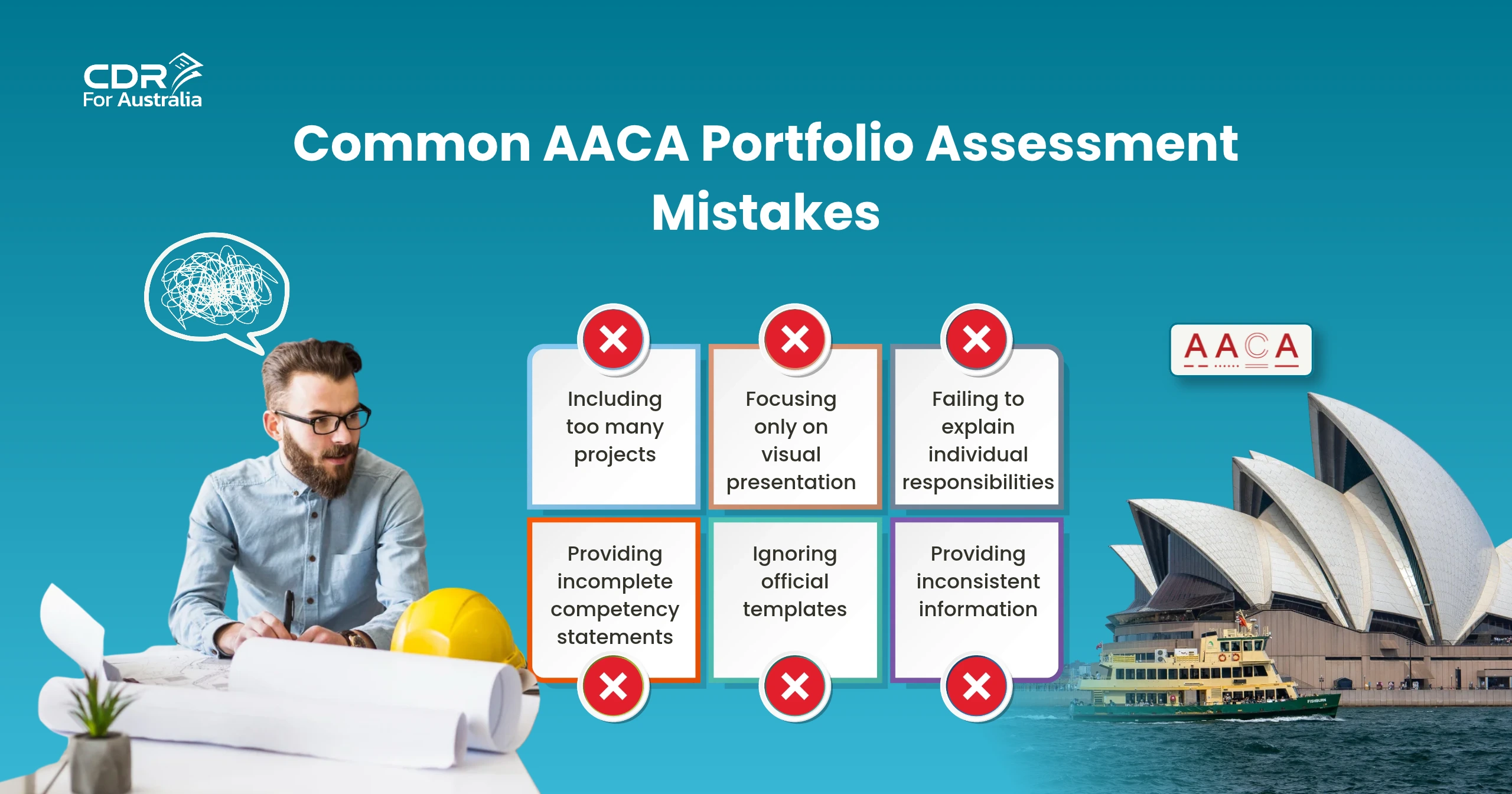
Including too many projects
In the OQA path, AACA lays out a set of three to four architectural projects as a portfolio.
Don’t feel compelled to submit as many projects as you can; it won’t make your application stronger. Choose projects that best illustrate the skills and abilities expected and adhere to the guidelines for the current submission.
Focusing only on visual presentation
An appealing portfolio can facilitate the comprehension of information, but it is not enough to show all of the necessary skills.
Add appropriate explanations, technical evidence, and references to the assessment criteria.
Failing to explain individual responsibilities
The work of a whole architectural team can be included in a portfolio. If you are not given a clear explanation of your role, it can be challenging to know what skills and decisions you actually made.
Accurately describe your contributions and provide supporting evidence.
Providing incomplete competency statements
A statement of general abilities may not fully justify the accomplishment of a specific criterion.
Apply examples from your projects and refer to drawings and documentation.
Ignoring official templates
AACA provides guidance and supporting templates for the OQA pathway for applicants.
An incomplete application can be caused by using an old format or by failing to include necessary documentation.
Always refer to the most up-to-date official instructions before submitting.
Providing inconsistent information
Conflicting information within your portfolio, resume, academic history, and work experience can lead to confusion.
Check the entire application document rather than each separate document.
How Long Does AACA Portfolio Assessment Take?
Assessment timeframe may vary based on the program to which the student is applying, the completeness of the application, and any additional requirements.
According to the published OQA information of the AACA, the applications are generally assessed within a span of seven weeks from their lodgement. Applications that are not complete may take approximately 12 weeks. The published estimates disregard scheduling a competency assessment interview and may be extended during busy periods or during shutdown for holidays.
These are approximate processing times and should not be considered as guaranteed.
Please ensure that you have the necessary documents in your submission and see the latest AACA guidance for current processing information before applying.
A full application may help to prevent delays due to missing information or requesting changes to the application.
AACA Portfolio Assessment vs Other Architecture Assessment Pathways
All applicants do not have to go through the same assessment process.
The right route is determined by your architectural education, experience and goals.
Overseas Qualifications Assessment (OQA)
The OQA pathway evaluates overseas architectural education and competencies that are comparable to Australian-accredited architectural education.
New applicants to the program undergo a qualification assessment, a competency assessment through a portfolio, a written summary statement and a competency assessment interview.
A satisfactory result may prepare for admission to the Architectural Practice Examination, meeting the eligibility requirements that apply.
Experienced Practitioner Assessment (EPA)
There is also an additional pathway, the Experienced Practitioner Assessment, which has different eligibility and professional experience criteria.
It is designed for those who are eligible and experienced practitioners, and can demonstrate competency and professional responsibilities.
Applicants must carefully read EPA requirements and not necessarily rely on the OQA portfolio instructions for their situation.
National Program of Assessment (NPrA)
The National Program of Assessment is a competency-based framework for entry for those who have considerable architectural competence and experience but not a recognised architectural qualification.
Requires a design exercise and its own eligibility and submission requirements.
Candidates must be aware of their own pathway prior to spending any time on assessment documentation.
How Professional Portfolio Preparation Support Can Help
For many, preparing architectural assessment documentation can be a significant amount of work, especially if they are required to present several projects and tie in their evidence with the competence criteria.
Using professional preparation support can assist applicants in structuring the information in their project, ensure that documents are consistent, and facilitate the identification of additional explanations or support that might be required.
The type of support provided can be:
- Reviewing the organisation of architectural project documentation.
- Clarifying the descriptions of projects.
- Organizing project information to allow an easy flow of information.
- Verifying consistency of supporting documents.
- Identifying missing pieces of evidence for applicants.
- Checking against submission guidelines of documents.
Applicants are still accountable for the accuracy of their information, the honest representation of their experience and the final submission meeting the requirements of the assessing authority.
No preparation service can ensure success on an assessment.
If you require assistance in preparing your architectural assessment documents, check the appropriate architecture assessment services available by CDR in Australia that is suitable for your pathway to AACA.

Looking for expert CDR Writer for Engineers Australia?

Creating a CDR Report may be difficult due to Engineers Australia’s standards and rules ( EA ). Our experienced engineers have assisted many people in obtaining approval for their report from the EA via the use of powerful projects.
Final Thoughts on Portfolio Assessment AACA
The Portfolio Assessment AACA process is more than just a collection of architectural drawings. Applicants must be familiar with their assessment path, choice of projects, organisation of supporting documents and how they demonstrate the architectural competencies in their work.
If you are applying for the Overseas Qualifications Assessment, the portfolio should include 3-4 projects that are of an architectural nature, including a complex project, plus the necessary competency statements and other application paperwork.
First, check the existing AACA eligibility requirements and the official AACA guidance. Next, choose appropriate projects, arrange the evidence properly and review the finished work against the appropriate requirements.
If you are struggling to organise your assessment documents for your architecture, consider using the appropriate services that CDR can offer in Australia and ensure that the services provided meet your assessment pathway.
Frequently Asked Question (FAQs)
What is the Portfolio Assessment AACA process?
An AACA assessment pathway is usually referred to as portfolio assessment AACA. The assessment process for the Overseas Qualifications Assessment is to present architectural projects and supporting competency statements, followed by a competency assessment interview.
How many projects should I include in my AACA portfolio?
AACA requires a portfolio of 3-4 architectural projects to be followed for the OQA pathway. Applicants are required to adhere to the current OQA Applicants Guide and should include a complex project accordingly.
Can I include an academic project in my AACA portfolio?
Yes. AACA suggests that a student or academic project is a good starting point to discuss during the competency assessment interview, such as a final architectural design thesis. The requirements vary depending on the context of the professional projects; they may also be accepted.
What documents are required for AACA portfolio assessment?
The documents may be academic qualifications and/or transcripts, an architectural project portfolio, NSCA summary statements, evidence of professional experience, evidence of English language proficiency if applicable, and relevant declarations depending upon the pathway applied.
The full list is available in the official AACA guidance – applicants should check this.
Do I need professional experience for the AACA OQA pathway?
Published eligibility for OQA requires a minimum of six months of postgraduate full-time equivalent architectural experience (excluding course-integrated practical experience) at AACA. Eligibility requirements and supporting evidence requirements should be reviewed prior to submitting an application.