


NSCA Summary Statement for AACA Stage 2 Assessment Australia
An NSCA Summary Statement is a structured document that architects submit as part of the Architects Accreditation Council of Australia (AACA) Overseas Qualifications Assessment. It connects an applicant’s Portfolio projects to the Performance Criteria set out in the National Standard of Competency for Architects, so assessors can confirm an applicant’s education. Work experience matches the level expected of a graduate architect in Australia.
Overseas-trained architects, and applicants without an accredited Australian qualification, are the ones who typically need to prepare this document before they can move ahead with their skills assessment. It is not a narrative essay. It works more like an index, pointing the assessor to the exact project and page where a specific competency is demonstrated.

What Is the NSCA Summary Statement?
The NSCA Summary Statement lists each required Performance Criterion from the National Standard of Competency for Architects and explains, in a few words, how the applicant has demonstrated it through a specific project in their Portfolio.
Every applicant applying through the Overseas Qualifications Assessment pathway must submit this statement alongside their Portfolio and attend a Competency Assessment Interview.
Assessors read it first, then check the referenced project to confirm the claim. Without a clear, well-structured statement, the Portfolio alone does not give assessors enough information to verify how a specific skill was applied.
NSCA Summary Statement vs Project Proforma
Applicants often confuse this document with the Project Proforma, since both are submitted alongside the Portfolio. Understanding the difference early helps avoid duplicating content between the two.
NSCA Summary Statement | Project Proforma | |
Scope | Covers all submitted projects at once | Written per individual project |
Purpose | Maps each Performance Criterion to the exact point it was demonstrated | Describes the project’s scope, the applicant’s role, and the delivery process |
Focus | Which competency the work proves | What was actually done on the project |
Not sure where to start?
“Get a CDR written by qualified engineers who know exactly what Engineers Australia looks for.”
Who Needs to Submit an NSCA Summary Statement?
Not every applicant to the architecture profession in Australia needs this document, so it helps to understand who it applies to before starting one.
Architects with Overseas Qualifications
Whose qualification is not accredited by the AACA and who are completing the Overseas Qualifications Assessment.
Applicants without an Australian degree
Applicants without an recognised Australian degree, in architecture who need to prove equivalent competency through project evidence.
Candidates who have passed Stage 1
Candidates who have passed Stage 1, eligibility and are moving into Stage 2, where this statement becomes a required document.
Architects applying for skilled migration
Architects applying for skilled migration, who need a positive skills assessment outcome to support their visa application.
Applicants who already hold an AACA-accredited qualification from Australia, New Zealand, Hong Kong, or Singapore generally do not need to prepare one. Instead, they can apply for a Skilled Migration Assessment through a Verification application, which does not require the Overseas Qualifications Assessment. Architects registered in a small number of other countries, including the United Kingdom, may also have a separate mutual recognition pathway available, though this works differently from the Verification route.
It is worth checking eligibility directly with the AACA before assuming this document is required, since preparing one unnecessarily adds time to an application that may not need it at all.
When Is the NSCA Summary Statement Required?
Most new applicants now complete the Overseas Qualifications Assessment as a single, combined process rather than as two separate stages. Since March 2022, the AACA has run Stage 1 and Stage 2 competency assessment concurrently for first-time applicants, so this document is generally prepared and submitted together with the academic qualification review, rather than only after a separate Stage 1 outcome. Applicants who already hold a successful Stage 1 outcome from before this change can still apply for Stage 2 on its own, in which case it is required at that later stage.
Either way, it must be prepared and submitted together with the Portfolio and Project Proformas, ahead of the Competency Assessment Interview. Applicants should not leave this document until the last stage of preparation. Since it depends on matching real project evidence to each Performance Criterion, it is easier to prepare once the Portfolio projects have already been selected and organised.
Many applicants prepare their summary statement writing alongside their Portfolio, rather than after it, so both documents stay consistent in referencing and terminology.
Complete Format of the NSCA Summary Statement
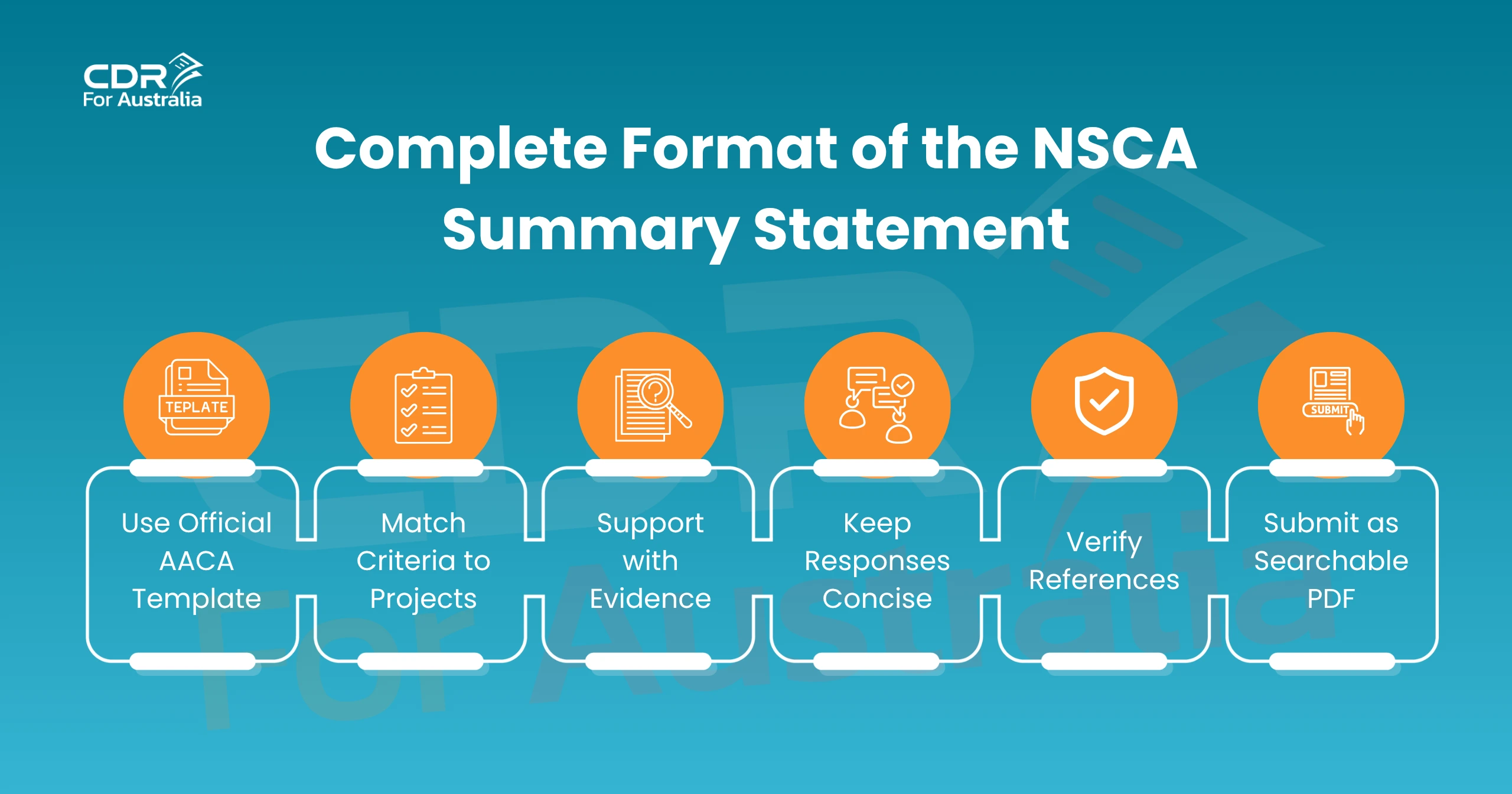
The AACA provides an official template for this document as part of its OQA application documents, and applicants are expected to use it rather than build their own layout from scratch. Getting the format right means following these steps:
- Start from the official template. Do not recreate the layout independently, since assessors are reviewing against the AACA’s own structure.
- Map each Performance Criterion to a specific Portfolio project. Every criterion addressed must point to the exact project where it was demonstrated, not to the Portfolio in general.
- Support each mapping with real evidence. The reference must be backed by the drawings, sketches, or other documentation actually contained in that project.
- Keep statements short and direct. Assessors are scanning for proof, not reading a narrative, so long paragraphs slow down the review rather than strengthen it.
- Keep referencing consistent throughout. The same referencing style should be used from the first Topic Area to the last.
- Match page and project references exactly. Any reference listed here must correspond precisely to what appears in the submitted Portfolio, since even a small mismatch can delay the review.
- Submit as a colour PDF at a minimum of 300 dpi, without password protection. Certified copies, photocopies, or black-and-white scans are not accepted for supporting documents.
- Stay within file size limits. Files should be kept as compact as possible across the application without losing legibility.
How is the NSCA Summary Statement Structured?
Structuring it correctly means organising it around the thirteen Topic Areas defined by the AACA. Here is how the structure works:
Where the Topic Areas Come From
The thirteen Topic Areas group the required Performance Criteria drawn from across the NSCA’s four Units of Competency: Practice Management and Professional Conduct; Project Initiation and Conceptual Design; Detailed Design and Construction Documentation; and Design Delivery and Construction Phase Services.
Use the Official Wording
Always use the official Topic Area titles and wording provided in the AACA Summary Statement template. Avoid renaming, rephrasing, or simplifying the headings, as assessors evaluate submissions against the prescribed format. Following the official wording helps maintain consistency and reduces unnecessary review issues.
Address Every Relevant Topic Area
Each Topic Area contains specific Performance Criteria that must be addressed with concise explanations supported by evidence. For every criterion, reference the relevant project, drawing, document, or portfolio section so assessors can quickly verify how your experience demonstrates the required competency.
Check for Gaps Before Submitting
Before submitting your NSCA Summary Statement, review every Topic Area to confirm that no required Performance Criteria have been overlooked. Verify that each claim is supported by portfolio evidence and accurate references, helping minimise requests for clarification or additional information during assessment.
You can review the complete list of Units and criteria on the official National Standard of Competency for Architects page before structuring your own statement.
Levels of Competency in the NSCA Summary Statement
The NSCA describes competency as developing in three stages, corresponding to three Competency Profiles: Graduate of Architecture, Candidate for Registration, and Architect Post-Registration. The active language used across the Performance Criteria reflects this progression:
Awareness
Performance Criteria using phrases such as “be aware of” or “have knowledge of” indicate that the applicant should demonstrate familiarity with a concept, principle, process, or professional requirement.
Understanding
Criteria containing terms like “understand” or “demonstrate understanding” require the applicant to explain how a concept, process, or principle applies within architectural practice.
Application
Criteria using phrases such as “be able to apply,” “be able to prepare,” require the applicant to demonstrate the practical use of their knowledge and skills through relevant project experience and supporting evidence.
Since the Overseas Qualifications Assessment benchmarks applicants against the Graduate of Architecture profile, most Performance Criteria at this stage call for Awareness or Understanding rather than full independent Application.
Visa Pathways After a Positive AACA Stage 2 Assessment
A positive AACA Stage 2 OQA outcome opens the following skilled migration visa pathways for Architect ANZSCO 232111.
Visa | Type | Key Requirement |
189 Skilled Independent | Permanent, no sponsor | MLTSSL occupation, Architect 232111 is on MLTSSL, points invitation |
Permanent, state sponsor | Occupation on state list, positive AACA outcome, nomination | |
491 Skilled Work Regional | Provisional, regional sponsor | Regional nomination, positive AACA outcome |
186 ENS Direct Entry | Permanent, employer sponsored | Employer nomination, positive AACA outcome |
482 Skills in Demand | Temporary, employer sponsored | CSOL occupation, sponsor required |

Looking for expert CDR Writer for Engineers Australia?

Creating a CDR Report may be difficult due to Engineers Australia’s standards and rules ( EA ). Our experienced engineers have assisted many people in obtaining approval for their report from the EA via the use of powerful projects.
What Happens After You Submit It?
Once the Portfolio, Project Proformas, and the NSCA Summary Statement are lodged, the application is reviewed for completeness, and the AACA generally sends one feedback email requesting revisions, if needed, before the Competency Assessment Interview is scheduled.
During the interview, assessors commonly ask questions that trace directly back to claims made in the statement, so applicants should be ready to explain any project or criterion they have listed.
If the interview outcome is Not Suitable, the applicant receives written advice on where they were considered deficient, and may then submit further evidence to address it, apply for a second Competency Assessment Interview, or lodge an appeal.
A clear, accurate, and well-referenced NSCA Summary Statement reduces the chance of this outcome and keeps the assessment process moving without unnecessary delays.
Preparing an Accurate NSCA Summary Statement
- Review the full list of Performance Criteria before selecting Portfolio projects, so the projects chosen can realistically cover most Topic Areas.
- Choose 3 to 4 strong projects, combining academic and professional work where possible, rather than relying on a single project to prove every criterion.
- Match each Performance Criterion to genuine project evidence, not just a project title or a general project description.
- Note the exact page, drawing, or section where each criterion is demonstrated, and double-check that this matches the Portfolio before submission.
- Review the level of competency claimed against what the evidence actually shows, rather than defaulting to the highest level for every criterion.
- Check the finished document for originality, since the AACA expects applicant-written content across the Portfolio, Project Proformas, and this statement itself. Many applicants use plagiarism checking and removal before submission for this reason.
Applicants preparing this document alongside other Stage 2 documents often review Stage 2 competency assessment services and sample submissions to understand how referencing is typically presented, though every statement must reflect the applicant’s own projects rather than copied content. Keeping supporting documents such as resume writing consistent in tone and terminology also helps the overall submission read as one coherent application.
Frequently Asked Question (FAQs)
What is the NSCA Summary Statement?
It is a structured document that lists each required Performance Criterion from the National Standard of Competency for Architects and explains how it is demonstrated through a Portfolio project.
Who needs to submit an NSCA Summary Statement?
Overseas-trained architects and applicants without an AACA-accredited Australian qualification need to submit this document as part of the Overseas Qualifications Assessment.
When should it be prepared for the NSCA Summary Statement?
It should be prepared during Stage 2 of the assessment, alongside the Portfolio, and before the Competency Assessment Interview.
Is there a fixed format to follow for NSCA Summary Statement?
Yes, the AACA provides an official template. It must map each Performance Criterion to the specific Portfolio project where it is demonstrated, supported by the relevant drawings, sketches, or documentation.
How many Topic Areas does the NSCA cover?
It covers thirteen Topic Areas, each linked to a group of related Performance Criteria from the National Standard of Competency for Architects.