


AACA Overseas Qualification Assessment (OQA) Australia
An architectural qualification achieved overseas may require registration, or a pathway to a skilled migration visa, in Australia, and an Overseas Qualification Assessment (OQA) may be required through the Architects Accreditation Council of Australia (AACA).
AACA Overseas Qualifications Assessment assesses overseas architecture qualifications to see if they are equivalent to an existing Australian accredited qualification in architecture. It also assesses the skills and knowledge that applicants must demonstrate to meet the requirements of the 2021 National Standard of Competency for Architects (NSCA).
A successful OQA may be used to assist in the pathway to the Architectural Practice Examination (APE) for eligible applicants, and may also be used for eligible applicants to apply for the AACA Skilled Migration Assessment for the occupation of Architect.

What Is an Overseas Qualification Assessment?
The Overseas Qualification Assessment, provided by the Architectural Accreditation Council of Australia (AACA), is the assessment of an applicant’s eligible overseas architecture qualification(s).
AACA determines if an overseas academic qualification is equivalent to an existing accredited Australian qualification in architecture. The assessment takes into account the education system, the institution, the length of qualification, the structure of the course, the topics covered, and the structure used to grade the work.
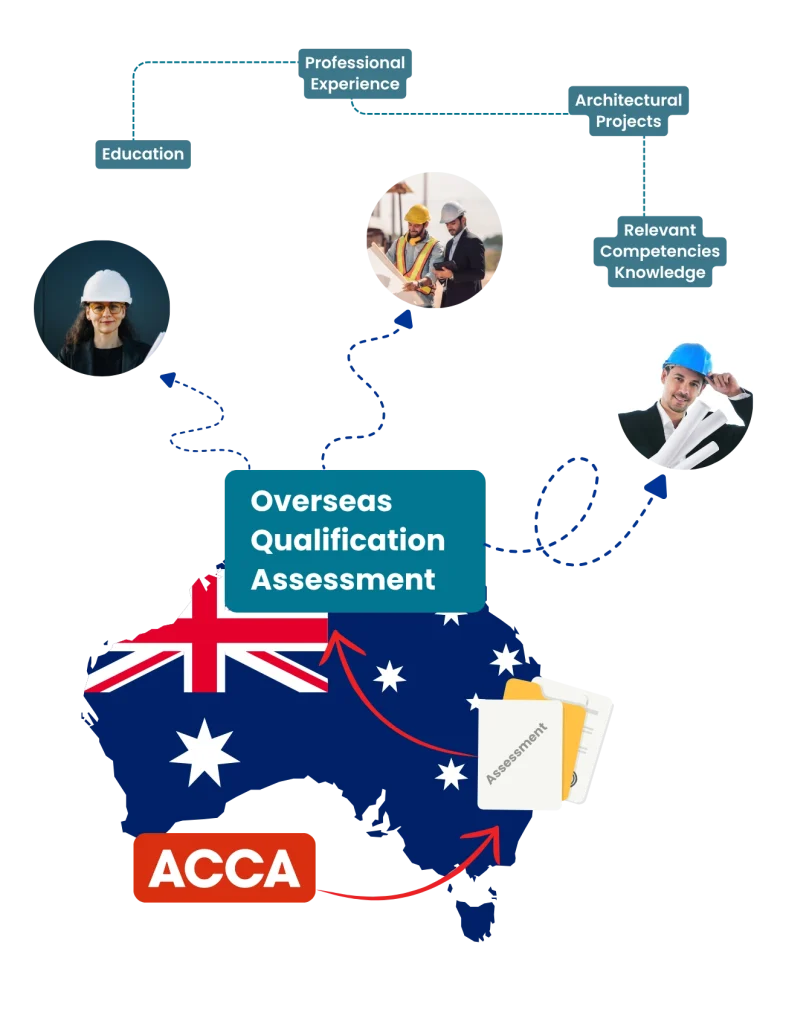
In addition to the competency assessment, there is also an OQA. Applicants will be assessed on their education, professional experience, architectural projects and knowledge against the relevant competencies of the 2021 National Standard of Competency for Architects.
AACA says applications are considered on a case-by-case basis. Thus, it is not guaranteed that an overseas architecture qualification would be assessed as appropriate.
Who Needs an AACA Overseas Qualification Assessment?
If you have gained an architecture qualification in another country but wish to register as an architect in Australia, or to be assessed for Skilled Migration in the role of architect, the OQA may be relevant.
Applicants may live either in Australia or overseas when applying.
In general, applicants are required to have successfully completed a tertiary course of study in architecture which would enable a successful completion of a course leading to the qualification of an architect in the country of origin of the qualification. Five years is the expected standard for qualification, according to AACA.
Applicants should also have the necessary post-graduate architectural experience as well as English language skills as applicable.
You might need a different assessment process than OQA if you already have an AACA-accredited architecture qualification from Australia, New Zealand, Hong Kong or an assessment jurisdiction recognised by AACA’s relevant recognition process. Before choosing an assessment pathway, your circumstances should be checked.
AACA Overseas Qualification Assessment for Migration
The AACA has also included an occupation with Skilled Migration Assessments, namely Architect.
If a Skilled Migration Assessment is requested for Australian immigration purposes, a successful OQA can lead to a Skilled Migration Assessment. The occupation is currently classified by AACA as 241131 – Architect, prior to that as 232111.
It is important to note that applicants should not expect the same assessment as overseas graduates in architecture.
For instance, if the applicant has an accredited architecture qualification from Australia, New Zealand, Hong Kong or Singapore, they may be eligible for alternative assessment or verification pathways depending on their qualification. Candidates with other overseas architectural qualifications may need to undertake the OQA or, if eligible, may wish to consider the Experienced Practitioner Assessment.
It can make sense to understand what steps there are to take before you begin making an application to help avoid unnecessary delays and costs.
AACA OQA Eligibility Requirements
It is important to read AACA’s eligibility criteria carefully before preparing an application.
In general, the requirements for OQA applicants are as follows:
- A suitable tertiary architecture qualification
- The validity of a qualification in the country earned
- Architectural education and prescribed areas of study
- Experience in postgraduate architectural work.
- Communication skills in English, as applicable
- The purpose of this project is to determine the requirements for a project portfolio for architects.
- The 2021 NSCA is well understood. There is a clear understanding of the 2021 NSCA.
- Required supporting documentation
Currently, AACA requires at least six months of full-time equivalent post-graduate architectural work experience (excluding course-integrated practical experience). Evidence such as a detailed reference letter is required.
The program must also be eligible for the architecture program in accordance with the requirements of the AACA. AACA does not offer a pre-assessment of individual qualifications, but rather evaluates each qualification on an individual basis.
How Does the AACA OQA Process Work?
The OQA for new applicants is no longer broken into two stages but is a fully integrated assessment.
AACA describes how new applicants are completing both the qualification and competency parts in one application.
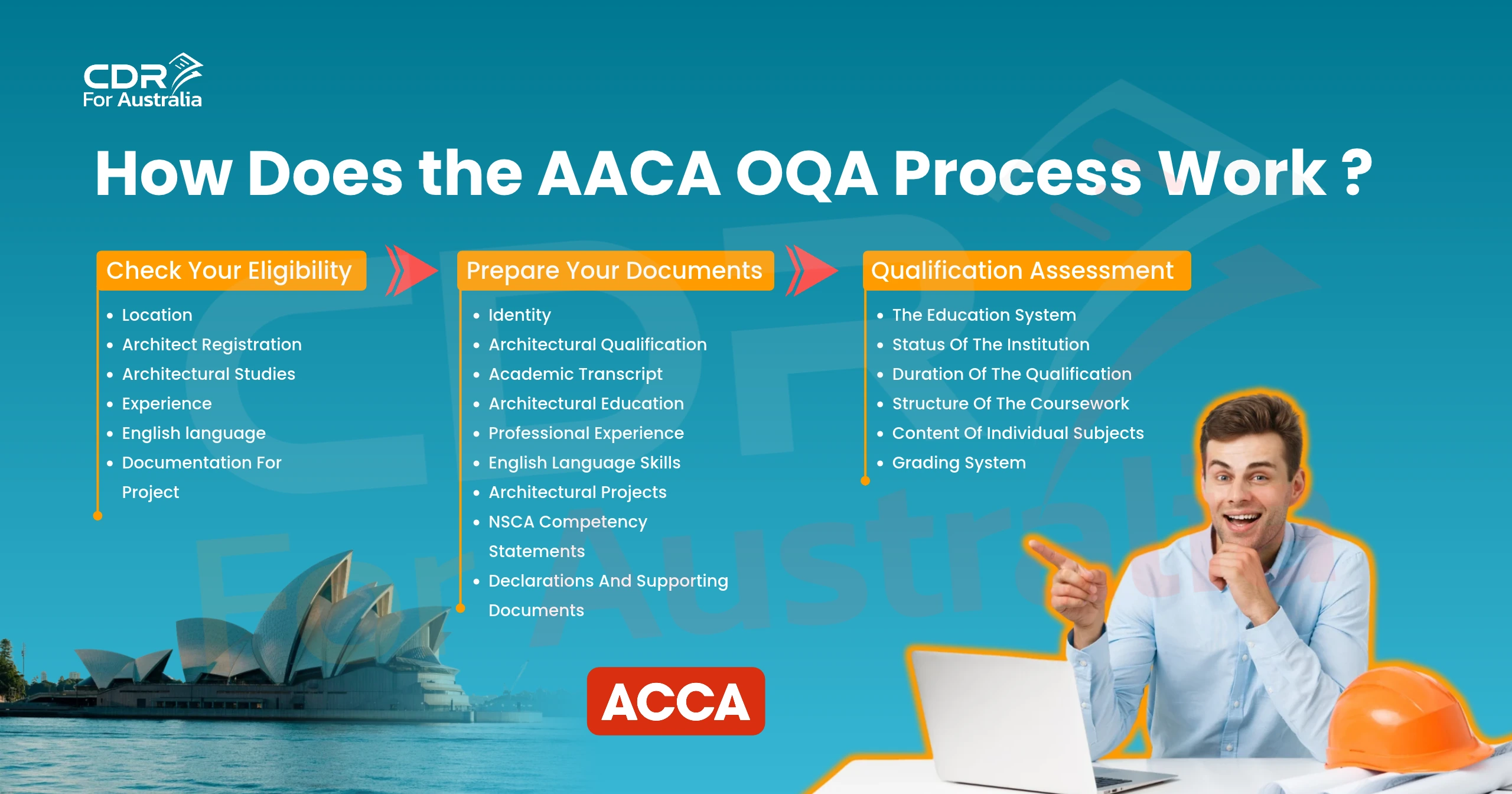
Step 1: Check Your Eligibility
When preparing your application, check that you are eligible for your overseas qualification in architecture with AACA.
You should consider:
- Location of the awarded qualification
- Whether the qualification allows for progression towards architect registration in that country
- The length and format of your architectural studies
- Your architectural post-graduate experience
- English language requirements
- The documentation you have on hand for the project.
Step 2: Prepare Your Documents
Applications will be submitted as complete applications.
Common documentation consists of documents that show information about your:
- Identity
- Architectural qualification
- Academic transcript
- Architectural education
- Professional experience
- English language skills (where necessary)
- Architectural projects
- NSCA competency statements
- Required declarations and supporting documents
AACA reports that the application may be delayed if it is not completed, and the required information must be provided in the format listed.
Step 3: Qualification Assessment
AACA compares your overseas qualification in architecture with an Australian accredited qualification in architecture.
The assessment considers:
- The education system in which the qualification was completed
- Status of the awarding institution
- Duration of the qualification
- Structure of the coursework
- Content of individual subjects
- Grading system
Your qualification should demonstrate the appropriate coverage of the prescribed areas of architectural study.
These include:
- Design Studies and Design Integration
- Documentation and Technical Studies
- History and Theory Studies
- Practice and Project Management, Implementation and User Studies
- Environmental Studies
- Communication Studies
AACA OQA Portfolio Requirements
The portfolio is an important part of the competency assessment.
All applicants are required to include a portfolio that includes three to four architectural projects according to the AACA requirements.
According to AACA, applicants are allowed to submit up to four projects.
Must include at least one complex project. AACA also suggests that the candidate include a copy of his/her final architectural design project, as it can be used as a foundation for discussions during the Competency Assessment Interview.
You cannot just show what makes the architecture pretty in your portfolio. It should include evidence that will assist in demonstrating the competencies needed to meet the applicable NSCA performance criteria.
Projects should be chosen strategically, therefore.
Projects may be used to illustrate aspects like:
- Design development
- Technical documentation
- Construction knowledge
- Environmental considerations
- Project management
- Communication
- Professional practice
- Problem solving
- The development of this component was integrated with architectural needs.
NSCA Summary Statements
Applicants will also need to create written NSCA Summary Statements.
The following statements cover the topic areas and performance criteria from the 2021 National standard of competency for architects.
The statements need to be supported by relevant evidence from the projects presented in the portfolio. Drawings, sketches and other documentation of the project can be used to support evidence.
Some good signs of a strong submission include the applicant relating their experience and project evidence to the competency requirements, and not just a project.
Therefore, it is important to be familiar with the NSCA criteria before choosing and documenting your project.
Competency Assessment Interview
Another part of the AACA OQA is the Competency Assessment Interview.
AACA will review the documentation, give feedback, and ask for revisions or more information. Applicants then move towards the Competency Assessment Interview, following the appropriate process.
In the interview, applicants may be asked to explain, defend, and expound upon the evidence included in their portfolio and to show competence in the appropriate architectural skills.
You should, therefore, be ready to talk about:
- Your role in each project
- Design decisions
- Technical solutions
- Documentation
- Construction considerations
- Environmental factors
- Project management
- Professional responsibilities
- Communication with stakeholders
- Lessons learned from your architectural experience
Simply submitting a visually strong portfolio is not enough. One must be able to articulate how education and work experience prove one has the competencies.
English Language Requirements
Applicants for an OQA can be asked to provide evidence in English.
In the case of an architectural program taught in a language other than English, AACA states that evidence of English proficiency must be provided, as specified in the OQA Applicants Guide.
Applicants should therefore check the current AACA requirements before choosing an English test or relying on previous study or employment as evidence.
English requirements for an AACA assessment should also be differentiated from English requirements that are set by the Australian immigration system for a specific visa.
AACA Overseas Qualification Assessment Fees
The program fees might change, so please consult the current program fee schedule before applying.
AACA announced fee changes from 1 July 2026, after its fee review. The present OQA page has the following new applicant fees:
|
OQA Application |
Australian Card |
Overseas Card |
|
New applicant |
AUD $4,973.01 |
AUD $5,042.10 |
|
OQA Stage 2 only* |
AUD $3,044.70 |
AUD $3,087.00 |
|
Second Competency Assessment Interview |
AUD $1,217.88 |
AUD $1,234.80 |
|
Skilled Migration Assessment renewal |
AUD $446.56 |
AUD $452.76 |
Stage 2 only is available to those who have successfully completed Stage 1 before 1 March 2022.
These fees may change at any time, and applicants should double-check the appropriate fee with AACA prior to submitting an application.
How Long Does AACA OQA Take?
Generally, OQA applications are finalised within around seven weeks from lodgement, once the application and the documentation are completed, AACA states.
The assessment is likely to be completed within about 12 weeks after lodgement if there is an incomplete documentation.
These timeframes do not include scheduling of the Competency Assessment Interview and could be extended during times of shutdown or peak periods.
The applicant is therefore advised to not make migration plans or career choices based on the shortest advertised processing time only.
What Happens After a Successful OQA?
There are two important avenues available if an appropriate OQA outcome is achieved.
Pathway 1: Australian Architect Registration
Where an applicant is successful in obtaining an appropriate OQA result, they may be eligible to apply for the Australian state or territory Architects Registration Board’s Architectural Practice Examination (APE) based on the requirements that apply to them.
Practical experience is required, as is the experience logbook.
This successful pathway to registration can contribute to becoming an architect in Australia.
Pathway 2: Skilled Migration
Applicants who achieve an appropriate OQA result could also be asked to sit an AACA Skilled Migration Evaluation for migration purposes.
A Skilled Migration Assessment is suitable for inclusion in an Australian visa application for a skilled occupation, Architect, depending on the visa program.
The visa or permanent residency is not guaranteed by the general results of the AACA assessment. Applicants are required to meet the requirements of the Australian Department of Home Affairs and the applicable visa subclass on their own.
Common AACA OQA Mistakes
When applicants do not clearly show their qualifications or competencies in their documentation, they may have problems.
Common issues include:
- Selecting unsuitable portfolio projects
- Submitting more than the permitted number of projects
- Providing insufficient project evidence
- Failing to explain the applicant’s individual role
- Writing generic NSCA Summary Statements
- Failing to connect evidence with performance criteria
- Providing incomplete academic documentation
- Not demonstrating the required post-graduate experience
- Ignoring English language requirements
- Preparing for the interview too late
- Using outdated AACA requirements or templates
Ensure that AACA requirements are updated and applicants are advised to always use the most recent versions of the AACA Applicant’s Guide and templates when preparing their submission.
How CDRForAustralia Can Help With AACA OQA
Collecting an architecture degree certificate is just the beginning of preparing for an AACA Overseas Qualification Assessment.
All your competency evidence, work experience, and project portfolio should be in a cohesive professional profile.
CDRForAustralia can help overseas applicants who are eligible to apply for a CDR to compile the documentation and arrange the file for their OQA, such as:
- OQA application guidance
- Academic document organisation
- Architectural project portfolio preparation
- NSCA Summary Statement guidance
- Project evidence organisation
- Professional experience documentation
- Competency-focused content development
- OQA submission review
- Competency Assessment Interview preparation
Our goal is to ensure that you are able to communicate your architectural education and experience succinctly and effectively in response to the requirements of the AACA.
AACA is the assessing authority; however, they will make the final assessment decision. There are no consultants or service providers who can absolutely guarantee success.

Looking for expert CDR Writer for Engineers Australia?

Creating a CDR Report may be difficult due to Engineers Australia’s standards and rules ( EA ). Our experienced engineers have assisted many people in obtaining approval for their report from the EA via the use of powerful projects.
Start Your AACA Overseas Qualification Assessment
The AACA Overseas Qualification Assessment process is important if you are planning to obtain registration as an architect in Australia or skilled migration and have an overseas qualification in architecture.
Your architectural education, professional experience and competency should be evident throughout each element of your application, from the assessment of your qualifications to the preparation of your portfolio, through to NSCA Summary Statements and the Competency Assessment Interview.
Please always reference the most up-to-date AACA requirements, Applicants Guide, fees and templates, as assessment requirements and fees may change.
CDRForAustralia can assist you in creating and presenting your documentation within the guidelines and requirements provided by the AACA Overseas Qualification Assessment.
Frequently Asked Question (FAQs)
What is an Overseas Qualification Assessment?
An Overseas Qualification Assessment is an AACA assessment of an overseas accredited qualification to determine if it is similar to an existing accredited architecture qualification in Australia and if the applicant has the architectural competencies required to be a registered architect in Australia.
Is AACA OQA required for overseas architects?
Depending on their circumstances and qualification, an Applicant whose qualifications are in another country may require completion of the AACA OQA for architect registration in Australia or an AACA Skilled Migration Assessment to register as an Architect in Australia.
Can I apply for AACA OQA from outside Australia?
Yes. AACA is an opportunity for eligible applicants to apply from overseas.
How many projects are required for the AACA portfolio?
The competency assessment requires a portfolio of 3-4 architectural projects for AACA. A maximum of 4 projects will be submitted.
Does the AACA OQA include an interview?
Yes. Competency is a component that contains a competency assessment interview.