


Competency Assessment for Engineers Australia
If you’re an engineer trained outside Australia, chances are you’ve come across the term “competency assessment” while researching skilled migration. In simple terms, it’s how Engineers Australia checks that your qualifications, skills and hands-on work experience stack up against what’s expected of engineers practising in Australia. It’s used for skilled migration visas, but also comes up later for engineers chasing EA membership or Chartered status.
What makes this process different from a typical qualification check is that EA doesn’t just glance at your degree certificate and move on. Assessors want to see real engineering work career episodes, a summary statement, a CV. Every part of that report needs to demonstrate actual engineering knowledge, technical judgement.
The rules for how this all gets put together sit in the Engineers Australia Migration Skills Assessment booklet, and skipping past them is one of the fastest ways to slow your own application down.

What Is a Competency Assessment?
At its core, a competency assessment measures whether you can perform at a defined professional level. EA sets specific standards for each occupational category knowledge, skills, professional attributes and an assessor checks your career episodes and summary statement against them line by line.
Pass, and it confirms your background is on par with an Australian-trained engineer at the same level. You can find EA’s own assessment information on their website, and it’s worth treating that as the primary source when rules or fees change.
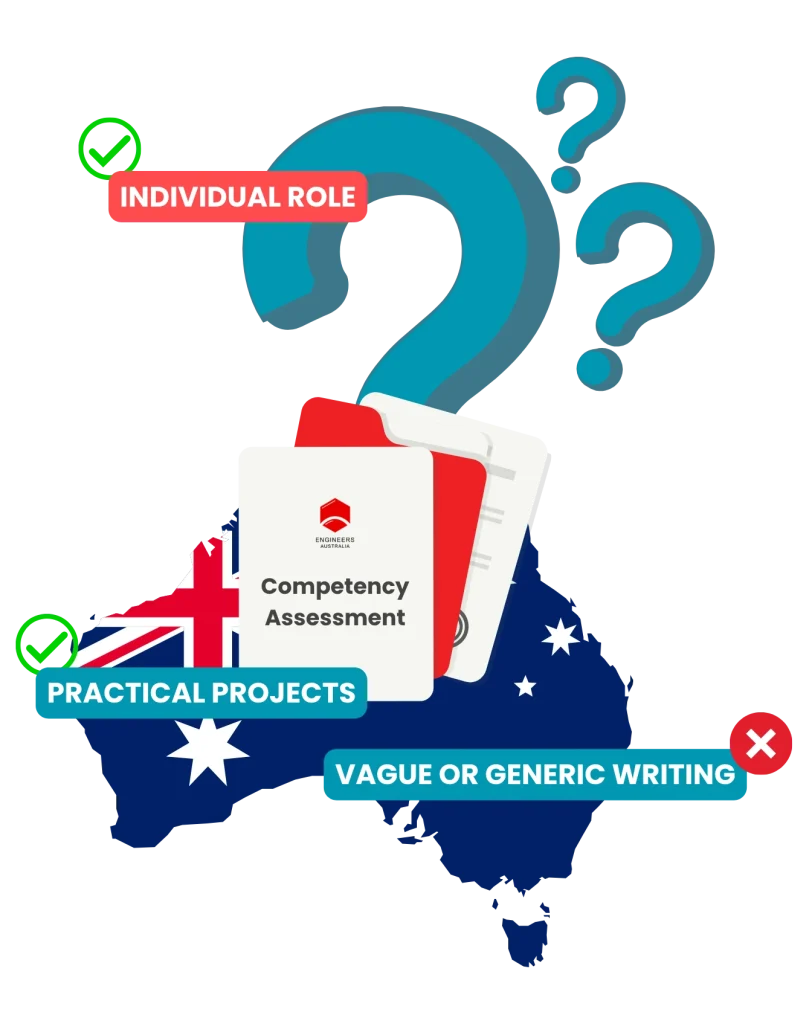
This isn’t a one-off academic test you cram for. Assessors want your full engineering story education through to real project work and they specifically want to hear about your role, not the team’s. Because the people reviewing applications are engineers themselves, vague or generic writing tends to stand out immediately, and rarely in a good way.
Who Needs a Competency Assessment?
Broadly, most overseas-qualified engineers need one before they can even apply for a skilled migration visa. That includes anyone whose degree wasn’t accredited under the Washington Accord, Sydney Accord, or Dublin Accord. It’s also required for general EA membership, since the organisation needs proof you meet the entry-level standard before it will let you in.
A few groups where this comes up a lot:
- Engineers with a degree from a university that isn’t accredited
- Engineers whose training mixes academic study with vocational or on-the-job learning
- Engineers with strong practical experience but no formal engineering degree
- Graduates chasing EA membership before they’ve clocked up much work experience
Types of Competency Assessment: Stage 1 and Stage 2
Engineers Australia splits this into two stages, and they’re not interchangeable, each one is answering a different question.
Stage 1 Competency Assessment
Think of Stage 1 Assessment as entry-to-practice. It’s asking: does this person have the knowledge and skill of a fresh engineering graduate in Australia? Most skilled migration applicants go through the Stage 1 assessment service because it’s the level checked in a Competency Demonstration Report (CDR). This stage looks at your academic background alongside career episodes and a summary statement mapping your experience to the required elements. If you want more detail on eligibility, fees and timing, our Stage 1 assessment guide breaks it down further.
Stage 2 Assessment
Stage 2 Assessment is a different animal; it’s built for engineers who already hold Stage 1 status and are going after Chartered membership or professional registration. Instead of graduate-level knowledge, it’s testing independent judgement, leadership, and accountability built up over years of actual practice. The Stage 2 assessment service is measured against 16 elements of competency tied to your occupational category. To even be eligible, you generally need to already be an EA member with five or more years of engineering experience under your belt.
Here’s how the two stages stack up against each other:
Feature | Stage 1 Assesment | Stage 2 Assessment |
Purpose | Entry-to-practice assessment | Independent-practice assessment |
Typical applicant | Skilled migration and general EA membership | Engineers seeking Chartered status or NER |
Standard checked | Entry-to-practice competency elements | 16 elements of competency |
Core documents | Career episodes, summary statement, CV | Structured practice reports, referee statements |
Experience level | Recent graduate level | Several years of engineering practice |
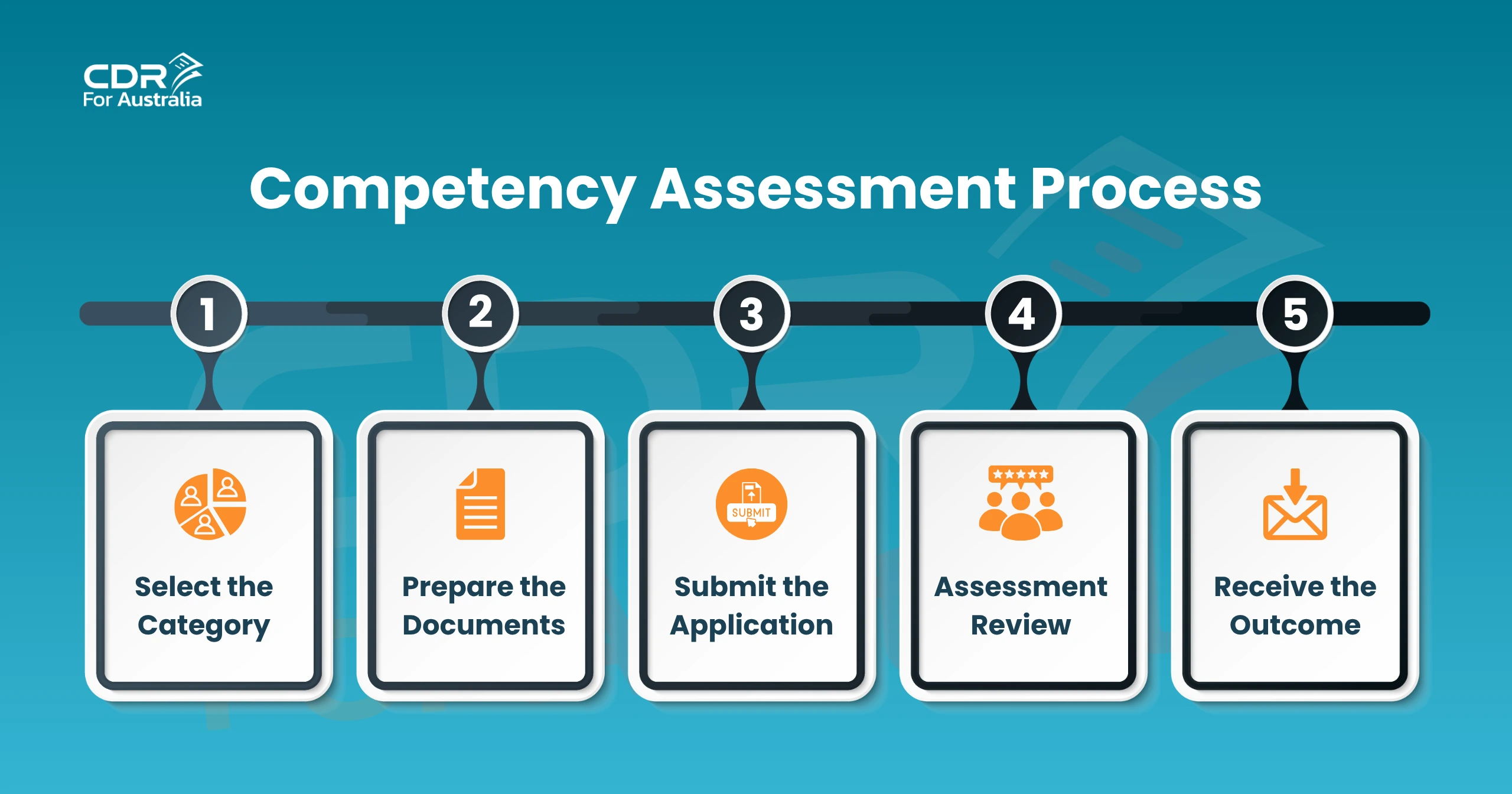
Competency Assessment Process
Most applicants move through roughly the same sequence, from picking a category through to getting a result.
- Select the occupational category. You identify the correct occupational category and ANZSCO code for your discipline; this decision determines which competency standard you’re measured against.
- Prepare the core documents. You write your career episodes and summary statement, making sure every claim is backed by a real project example rather than a general statement.
- Submit the application. The full application, along with supporting evidence, goes through EA’s online portal.
- Assessment review. An EA assessor checks the application against the relevant standard. Timeframes vary quite a bit depending on the pathway: a membership entry-to-practice assessment typically takes around four weeks, while a Migration Skills Assessment under the CDR pathway generally takes around 15 weeks just to be assigned to an assessor and total processing can run longer still, depending on document quality and whether EA needs to come back for more information.
- Receive the outcome. A pass supports your visa or membership application. A negative outcome usually comes with feedback, which you can act on before resubmitting.
For skilled migration, this whole process typically gets referred to as a Competency Demonstration Report, or CDR since the career episodes and summary statement together are what actually proves your competence.
Competency Mapping and Your Assessment
If there’s one thing that trips up applications more than anything else, it’s weak competency mapping. This is the process of linking each paragraph of your career episodes to a specific competency element EA has defined. You’ll usually see this laid out in the summary statement, which basically works as a reference table for the assessor, a shortcut so they don’t have to hunt through your whole report to find evidence of a particular skill. Get the mapping wrong or leave gaps, and the assessor simply can’t confirm you’ve covered everything required, which is a fast track to a negative outcome.
A few things worth aiming for:
- Point to a specific paragraph number and career episode for each competency element
- Write short, direct sentences that show a concrete action not a vague description of what a project “involved”
- Don’t recycle the same paragraph across multiple, unrelated competency elements
- Make sure you’re mapping against the right standard, since Professional Engineer, Engineering Technologist and Engineering Associate applicants are all judged differently
Our Engineers Australia MSA Booklet guide goes into more depth on mapping and the other formatting rules EA expects.
Documents Required for the Assessment
Every application needs a complete, consistent set of supporting documents and missing or unclear paperwork is genuinely one of the most common reasons applications stall. Here’s what a standard application usually includes:
Document | Purpose |
Curriculum Vitae (CV) | Shows education, work history, and technical skills in order |
Three Career Episodes | Describe real engineering projects and personal contribution |
Summary Statement | Maps career episode paragraphs to competency elements |
Continuing Professional Development (CPD) | Shows ongoing learning after graduation (optional supporting evidence for the entry-to-practice assessment) |
Academic transcripts and certificates | Confirm formal qualifications |
Identity and English language documents | Confirm identity and language ability where required |
Content aside, formatting matters more than people expect. EA lays out expected structure, headings, page limits, and cross-referencing between your career episodes and summary statement and applicants who ignore that structure, or skip a section, often end up waiting while EA comes back asking for what’s missing.
CDR vs Competency Assessment
People throw these two terms around interchangeably, but they’re not quite the same thing. A competency assessment is the full evaluation EA runs to confirm your engineering standard meets the bar. A CDR is the specific bundle of documents most skilled migration applicants prepare as the evidence for that evaluation. Put simply: the CDR is what you submit, the assessment is what comes back.
Aspect | CDR | Overall Assessment |
What it is | A set of documents: career episodes, summary statement, and CPD | The full evaluation process carried out by Engineers Australia |
Main purpose | Provides evidence for a skilled migration application | Confirms whether an applicant meets the required standard |
Who prepares it | Applicants without an accredited engineering degree | All applicants, regardless of assessment pathway |
Where it sits | Used as part of a Stage 1 application | Covers both Stage 1 and Stage 2 |
End result | A completed report submitted to Engineers Australia | A formal positive or negative outcome from Engineers Australia |

Looking for expert CDR Writer for Engineers Australia?

Creating a CDR Report may be difficult due to Engineers Australia’s standards and rules ( EA ). Our experienced engineers have assisted many people in obtaining approval for their report from the EA via the use of powerful projects.
How to Prepare Apply for Competency Assessment?
Good preparation starts long before you touch the application form. First, nail down your occupational category and ANZSCO code gets that wrong and everything downstream is measured against the wrong standard. From there, try to pick three career episodes that each cover different technical ground, so between them you’re demonstrating the full spread of required skills rather than repeating yourself. Write each one in your own words, grounded in real details, actual dates, calculations, tools used, decisions you made on site or at the drawing board.
Once your episodes are drafted, go back through them against the competency elements one at a time and check that each has genuine supporting evidence. A career episode that reads like a job description rather than something you personally did is a red flag assessors pick up on quickly. Build the summary statement last, after the career episodes are locked in, so your paragraph references actually line up. Applicants who work in this order tend to end up with cleaner, more consistent applications. It’s a lot harder to retrofit a mapping table onto episodes you haven’t finished writing.
Common Mistakes to Avoid in Competency Assessment
A lot of applicants lose time and money repeating the same handful of errors. Some are just formatting slip-ups; others chip away at how credible the whole application looks. Watch out for:
- Weak or missing competency mapping between career episodes and required elements
- Generic project descriptions that don’t show your personal contribution
- Copied or closely paraphrased content this gets checked closely for plagiarism
- Picking the wrong occupational category or ANZSCO code
- Leaving the CPD section blank or half-finished
- A summary statement that doesn’t actually match the detail in your career episodes
A careful pass before you hit submit goes a long way toward avoiding a negative outcome and the resubmission that follows.
Frequently Asked Question (FAQs)
What is a competency assessment?
It’s a formal review by Engineers Australia checking whether your qualifications, skills, and work experience meet the standard required for migration, membership, or Chartered status in Australia.
What are the types of competencies Engineers Australia assesses?
EA groups competencies into three key areas: knowledge base (your engineering foundation knowledge), engineering ability (applying that knowledge to real problems within your occupational category), and professional attributes. The specific elements within each area shift depending on your occupational category.
What is an example of a competency assessment?
A common one: a civil engineer’s Competency Demonstration Report, where three career episodes describe real projects, and a summary statement maps specific paragraphs to each required competency element for the Professional Engineer category.
What are the 4 types of assessment used by Engineers Australia?
Applicants are generally assessed under four occupational categories Professional Engineer, Engineering Technologist, Engineering Associate, and Engineering Manager each with its own competency standard.
What is the difference between Stage 1 and Stage 2?
Stage 1 checks entry-level, graduate engineering knowledge and covers most skilled migration applications. Stage 2 checks the higher, independent-practice level needed for Chartered status and professional registration.
How long does this assessment take to process?
It depends which pathway you’re on. A membership entry-to-practice assessment usually takes around four weeks. A Migration Skills Assessment under the CDR pathway, the one most skilled migration applicants use, generally takes around 15 weeks just to be assigned to an assessor, and total processing time can stretch further depending on document quality and application volume.
Why does competency mapping matter?
Because it links specific career episode paragraphs to specific competency elements, which makes it far easier for an assessor to confirm your real experience actually covers everything required. Clear mapping lowers your chances of a negative outcome, sloppy mapping raises them.