


National Innovation Visa (Subclass 858) Australia
If you’ve already made a name for yourself in your field internationally, the National Innovation Visa is the permanent residency route built with you in mind. Known officially as Subclass 858, it took over from the Global Talent Visa on 6 December 2024 and now sits as Australia’s main option for migrants whose achievements put them ahead of a typical points-based application. There’s no points test here, and no fixed occupation list to match against. What matters is what you’ve actually done.
The visa is built for people in academia and research, entrepreneurship, sport, and the arts, as well as professionals working in priority sectors like critical technologies, health, and renewable energy. You’ll need to back your case with independent evidence awards, patents, publications, business results rather than a general summary of your career.
The process starts with an Expression of Interest. Only those who get shortlisted move on to an invitation to apply. Once the visa is granted, permanent residency kicks in immediately for the main applicant and any eligible family members, along with full work rights and Medicare from day one.

What Is the National Innovation Visa?
This is a permanent category built for migrants with an internationally recognised record of exceptional achievement. It isn’t tied to a job offer or a named occupation, so people come into it from research institutions, start-ups, sporting organisations, and creative industries alike. The Department of Home Affairs looks at each case on its own merits, your track record, and what impact you’re likely to have once you’re in Australia.
Age, English ability, and qualifications still come into it, but they aren’t scored the way they would be under skilled migration streams like Subclass 189 or 190. The focus here stays on what you’ve proven you can do and what you’re likely to contribute next, which makes the whole assessment feel quite different from a standard skilled visa.
Who Can Apply For a National Innovation Visa?
Three things really drive eligibility. First, you need an internationally recognised record of outstanding achievement in one of the eligible fields. Second, you need to still be active in that field past success alone, without current momentum, won’t carry an application. Third, you have to show you can genuinely benefit the Australian community, whether that’s through ongoing employment, business activity, or continuing research.
Most people who succeed under this visa fall into one of these groups:
- Researchers and academics with published work, patents, or recognised standing in their subject
- Entrepreneurs who’ve built or scaled a business with results you can point to
- Athletes with national or international-level achievement
- Artists and creatives with an established professional reputation
- Professionals working in critical technologies, health industries, or renewable energy
You’ll also need a nominator, someone with genuine standing in your field, whether that’s an Australian citizen, a permanent resident, or a well-known Australian organisation. Because the nomination and supporting statement carry real weight in the assessment, it’s worth taking the time to get your Statement of Purpose right when you’re pulling your documents together.
Not sure where to start?
“Get a CDR written by qualified engineers who know exactly what Engineers Australia looks for.”
Priority Categories for National Innovation Visa
The visa runs on a four-tier priority system. Applicants in a higher tier are generally invited sooner, so it’s worth knowing where you’re likely to sit before you plan your timeline.
Priority Tier | Category | Who It Covers |
Tier 1 | Global Experts | Recipients of top international honours, such as a Nobel Prize or Olympic gold medal |
Tier 2 | Government Nominated | Applicants nominated by an Australian government agency |
Tier 3 | Priority Sector Experts | Achievers in critical technologies, health industries, and renewable energy |
Tier 4 | Other Eligible Applicants | Achievers in broader sectors not listed under Tier 3 |
There’s no set occupation list attached to this visa, one of the clearest differences from standard skilled migration. Within Tier 3, applicants working in artificial intelligence, quantum computing, robotics, biotechnology, and medical research tend to carry extra weight, since these areas line up closely with current national priorities.
Application Process for National Innovation Visa
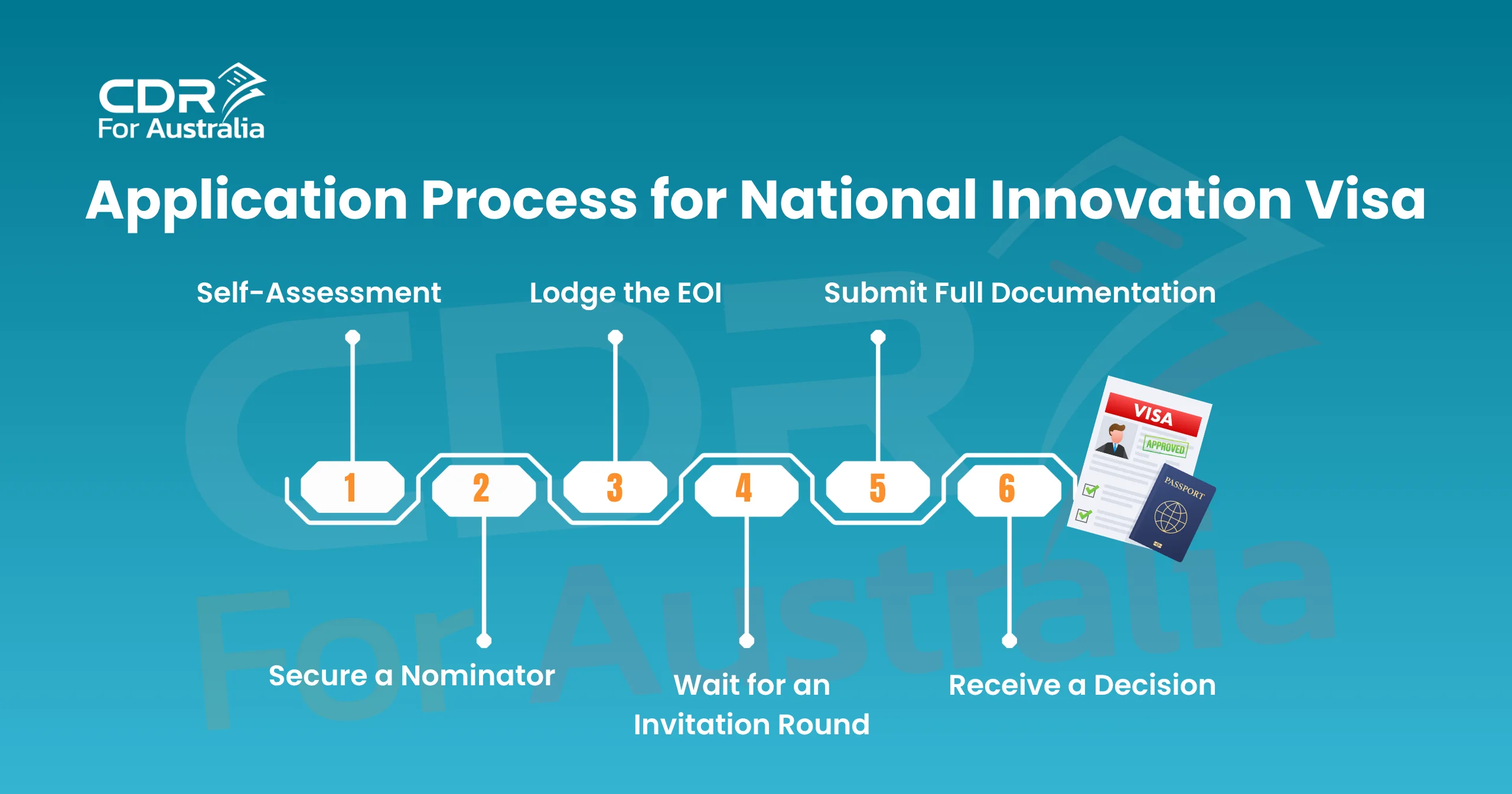
The application follows a set order, and the groundwork starts well before you actually lodge anything. Skipping ahead or rushing a step to save time is one of the more common reasons applications stall.
- Self-Assessment: Look honestly at how your achievements measure up against the priority tiers above. This decides how strong your position is before you approach anyone else.
- Secure a Nominator: Find someone with real standing in your industry: an Australian citizen, permanent resident, or recognised organisation. A weak or unfamiliar nominator can undercut an otherwise solid submission.
- Lodge the EOI: Submit an Expression of Interest through ImmiAccount. It stays valid for two years. Vague or generic entries rarely go anywhere, so every claim needs independent proof behind it, not just a statement about your capability.
- Wait for an Invitation Round: The Department of Home Affairs runs periodic invitation rounds, somewhat similar in structure to other skilled visa categories, though there’s no points cut-off deciding who gets invited here.
- Submit Full Documentation: Once invited, you have 60 days to provide identity documents, health checks, police clearances, and evidence of your achievements. It’s a tight window, so most applicants start gathering paperwork well before an invitation ever arrives.
- Receive a Decision: The Department reviews the full application and issues an outcome. Approval goes straight to permanent residency; there’s no provisional stage in between.
Fees and Processing Time for National Innovation Visa
Government charges apply per applicant, and family members are billed separately from the main applicant.
Applicant Type | Fee (AUD) |
Main applicant | 4,985 |
Dependent applicant (18 and over) | 2,495 |
Dependent applicant (under 18) | 1,250 |
Submitting an EOI | No charge |
Processing time depends on which priority tier you’re in and how complete your documentation is at lodgement. Roughly half of all applications clear within four months, and most wrap up within seven. That timeframe only covers processing itself; it doesn’t include the wait for an invitation, which can run anywhere from a few weeks to well over a year depending on your tier and how strong your EOI is.
A well-structured resume that reflects migration and assessment standards can genuinely help here, since assessors are working through a large volume of supporting evidence for every case that crosses their desk.
State Nomination Pathways
Several Australian states run their own nomination pathways that connect into this visa under the Government Nominated priority tier. South Australia, New South Wales, Victoria, and Queensland each run a Registration of Interest process with their own criteria and priority sectors. A state nomination can push an applicant into a higher priority tier, which often means a faster invitation than applying without one.
If you’re weighing up South Australia specifically, it’s worth comparing the South Australia state nomination process which runs alongside standard skilled visa categories against this pathway, depending on your overall profile. A state nomination supports the EOI, but it doesn’t guarantee an invitation; that decision always sits with the Department of Home Affairs.

Looking for expert CDR Writer for Engineers Australia?

Creating a CDR Report may be difficult due to Engineers Australia’s standards and rules ( EA ). Our experienced engineers have assisted many people in obtaining approval for their report from the EA via the use of powerful projects.
How Subclass 858 Visa Differs from Other Options
This visa works quite differently from points-tested options like Subclass 189 and 190, which score applicants on age, English level, and work experience, and which require an eligible occupation from a fixed list. Here, none of that applies the focus stays purely on proven achievement and what benefit you’d bring to Australia. It also replaced the Business Innovation and Investment Program, which closed to new applications on 31 July 2024 and had judged applicants mainly on investment size and business turnover rather than personal or professional achievement.
Engineers who don’t quite meet the high achievement bar for this visa often go the standard points-tested route instead, which calls for a Competency Demonstration Report prepared to Engineers Australia standards.
Professionals from other fields management, health, trades typically use the VETASSESS skilled migration route. Both of those pathways sit apart from the National Innovation Visa and suit people at different career stages, so the right choice really comes down to how your achievements measure up against each program’s criteria.
Additional Things to Know About the NIV
- Age limit: There’s no fixed age limit. Applicants under 18 or 55 and over need to show they’d bring exceptional benefit to Australia beyond their field achievements alone.
- English requirement: Functional English is expected of the main applicant and any accompanying partner. Falling short of this doesn’t mean automatic refusal; it triggers an additional charge at lodgement instead.
- Competition level: Recent quarterly figures from the Department show invitation rates sitting below 10 percent of submitted Expressions of Interest, so a strong, independently backed EOI matters far more than a broad career history.
- Family inclusion: Eligible partners and dependent children can be added to the same application and get permanent residency alongside the main applicant on grant.
- Citizenship pathway: Time spent in Australia on this visa counts toward the standard residence requirements for citizenship.
Frequently Asked Question (FAQs)
Who is eligible for the National Innovation Visa?
Applicants with an internationally recognised record of exceptional achievement in a profession, sport, the arts, or academia and research. You’ll also need a credible nominator and evidence of continued activity in your field, not just past accomplishments.
How hard is it to get a National Innovation Visa?
Genuinely competitive. Invitation numbers stay limited against the volume of expressions of interest submitted each round, so you need strong, independently verifiable evidence rather than a general track record or self-description.
What is the salary for National Innovation Visa applicants?
There’s no fixed salary requirement written into the rules, but applicants are generally expected to show earning capacity around the Fair Work High Income Threshold. Think of it as a benchmark rather than a strict cut-off, particularly for early-career researchers.
How much is the National Innovation Visa application fee?
The main applicant fee is AUD 4,985. Dependents aged 18 and over pay AUD 2,495 each, and dependents under 18 pay AUD 1,250 each. Submitting an Expression of Interest is free.
What is the National Innovation Visa (Subclass 858)?
It’s the official name for Australia’s permanent, merit-based visa for globally recognised talent. It replaced the Global Talent Visa on 6 December 2024 and keeps a similar focus on exceptional individual achievement.
How is the NIV EOI different from a normal visa application?
The Expression of Interest isn’t a visa application in itself. It’s a preliminary step that lets the Department review your profile before deciding whether to issue an invitation to apply for the visa.
Can I apply for state nomination under this visa?
Yes. South Australia, New South Wales, Victoria, and Queensland all offer nomination pathways that fall under the Government Nominated priority tier.
Does the National Innovation Visa require a points test?
No, one of the biggest differences from standard skilled migration options. Age, qualifications, and English level are considered, but none of them are scored on a points scale.