


Engineering Profession in Australia: Demand & Career
Roads, bridges, power grids, water systems, factories. Almost none of it exists without engineers, and the engineering profession in Australia is what holds that work together. Australia treats engineering as a regulated profession. That word matters. It means a person’s qualifications and work history get checked against national standards before they can call themselves an engineer here, whether they trained locally or overseas. Engineers Australia runs most of that checking, and government occupation lists track which disciplines the country actually needs right now.

If you’re an overseas-qualified engineer looking at Australia, the first thing worth understanding is how the profession is put together. Not just the paperwork, but the categories your qualification might fall under, the disciplines with real demand behind them, and what a skills assessment actually involves.
That’s what this article covers, drawing on figures published by Engineers Australia and the Australian Government. Whether you’re chasing a job offer, a permanent visa, or just trying to work out where you’d fit in, the sections below give you something concrete to start from.
What Is the Engineering Profession in Australia?
At its core, the engineering profession in Australia covers the regulated technical work behind designing, building, maintaining and managing infrastructure and systems. That spans civil, mechanical, electrical, structural, mining and chemical engineering, along with a growing list of newer specialisations.
Engineers Australia has represented the profession since 1919. It now has more than 100,000 members spread across nine divisions and several international chapters, and it’s the body responsible for setting competency standards, accrediting university programs, and assessing overseas qualifications for anyone applying to migrate.
Engineering Education and Accredited Qualifications
Most engineers practising in Australia hold a degree accredited by Engineers Australia. Accreditation is really a stamp on the program itself, confirming it teaches the competencies the profession expects.
Sydney, Melbourne, Monash, Queensland, UNSW most of the well-known Australian universities offer accredited engineering degrees, usually four years for the professional engineer track and three years for engineering technologist programs.
When an overseas qualification comes into the picture, it gets measured against these same accreditation benchmarks during a skills assessment. Degrees from institutions covered by the Washington Accord, Sydney Accord, or Dublin Accord are usually recognised without needing a full CDR. Everything else generally goes through the standard CDR assessment pathway instead.
National Engineering Register and Chartered Status
Some engineers want recognition that goes beyond a basic skills assessment. Two options exist for that: the National Engineering Register (NER) and Chartered status.
NER Registration
Confirms an engineer meets a nationally consistent competency benchmark, something that’s becoming close to a requirement for government and infrastructure work.
Chartered Status
Sometimes called Stage 2 assessment, sits a level above that, aimed at experienced engineers who can show advanced technical judgement and genuine leadership within their field.
Both routes ask for documented evidence of real projects, responsibilities, professional development not unlike what goes into the original CDR.
Migration Pathways for the Engineering Profession in Australia
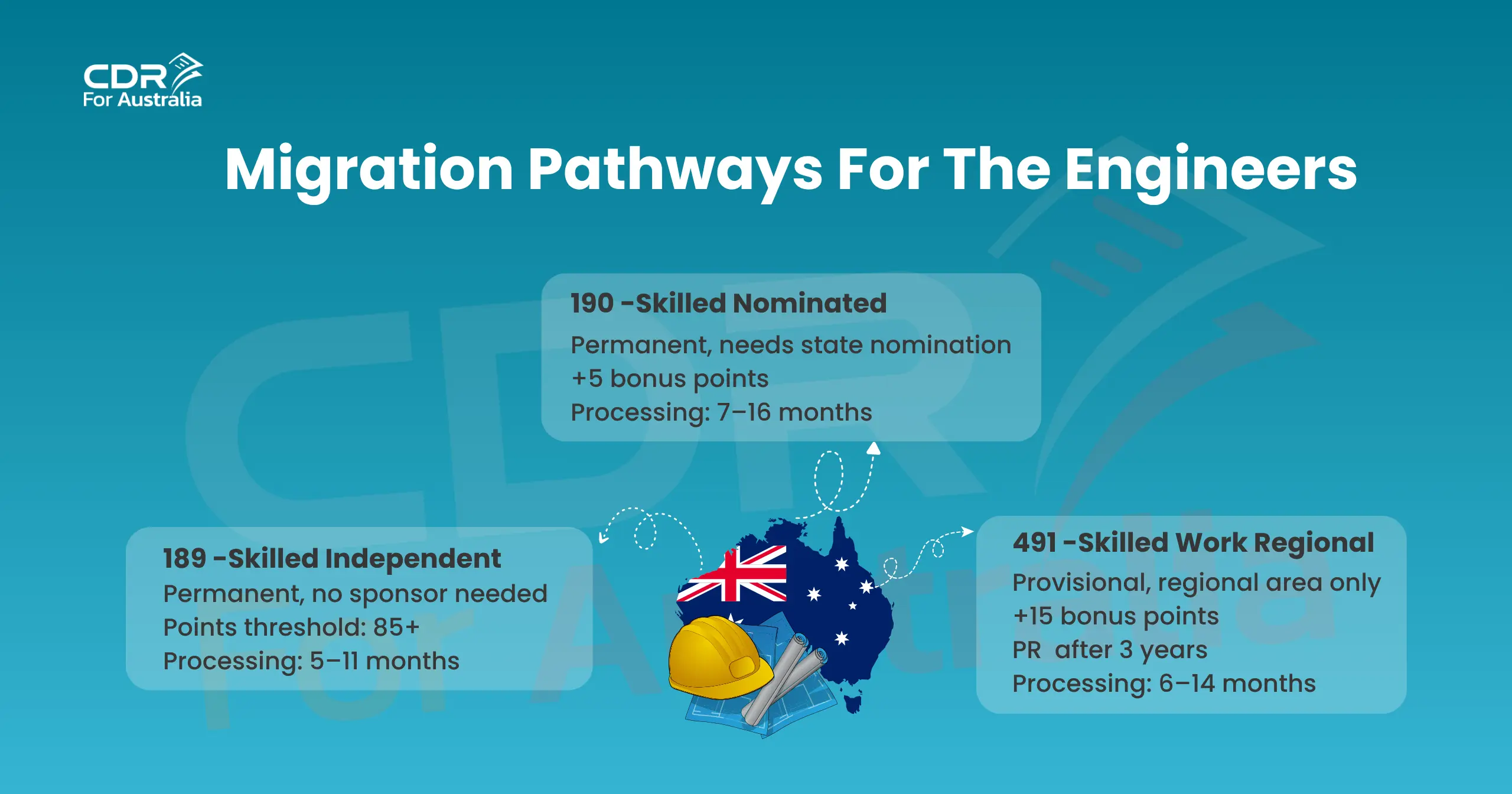
Most overseas engineers come into Australia through the General Skilled Migration program that’s the Skilled Independent visa (189), Skilled Nominated visa (190), and Skilled Work Regional visa (491). Employer-sponsored routes exist too, under the Skills in Demand visa program.
Here’s a quick comparison of the three main skilled visa options:
Visa Subclass | Sponsorship Type | Suits |
189 (Skilled Independent) | No sponsor needed | High-scoring applicants on the MLTSSL |
190 (Skilled Nominated) | State nomination | Applicants targeting a specific state |
491 (Skilled Work Regional) | State or family sponsorship | Applicants willing to live in regional areas |
Whichever pathway someone chooses, the basics stay the same: a positive skills assessment from Engineers Australia, a valid Expression of Interest through SkillSelect, a minimum of 65 points, and proof of English proficiency.
For occupations that sit outside what Engineers Australia assesses, VETASSESS skill assessment services are worth looking into instead. And for the full, current list of recognised engineering occupations, Engineers Australia’s own migration skills assessment page is the most reliable place to check.
Categories of Engineers in Australia (ANZSCO)
Australia sorts engineering roles under the Australian and New Zealand Standard Classification of Occupations, or ANZSCO. Each category in the engineering profession in Australia carries a different scope of responsibility.
Occupational Category | Typical Role | Assessment Level |
Professional Engineer | Designs, manages, and takes responsibility for complex engineering projects | Bachelor’s degree or higher (4-year accredited) |
Engineering Technologist | Applies engineering principles in a more applied, practical capacity | 3-year engineering technology degree |
Engineering Associate | Supports engineering teams with technical and drafting work | Advanced diploma or associate degree |
Engineering Manager | Oversees engineering functions, budgets, and project delivery | Degree plus significant management experience |
Each of these carries its own set of competency standards. Right now, Engineers Australia recognises 31 distinct engineering occupations spread across these four categories.
Types of Engineers in Australia
Under that broader umbrella sit the individual disciplines. These are the ones you’ll most commonly see referenced for skilled migration and hiring:
- Civil Engineer: roads, bridges, water systems, and general infrastructure
- Structural Engineer : building frameworks and load-bearing design
- Mechanical Engineer : machinery, HVAC systems, and manufacturing equipment
- Electrical Engineer : power generation, distribution, and control systems
- Electronics Engineer : circuit design, communication devices, and automation
- Chemical Engineer : processing plants, materials, and industrial chemistry
- Mining Engineer : extraction planning and resource operations
- Industrial Engineer : process efficiency and systems optimisation
- Environmental Engineer : waste management, water treatment, and sustainability projects
- Telecommunications Engineer : network infrastructure and communication systems
Civil, mechanical and electrical still make up the bulk of engineering employment in Australia. Mining and resources engineering hasn’t slowed down either, given how much the economy still leans on exports. Mechatronics and renewable energy engineering are the ones to watch, though both are growing fast as industries modernise.
Skills Shortage in the Engineering Profession in Australia
Australia has been short of qualified engineers for a long time, and it’s not a small gap. Engineers Australia’s own data shows only around 8.5 percent of Australian graduates come out with an engineering qualification, one of the lowest rates in the OECD.
Because of that, migration does a lot of the heavy lifting in keeping the workforce staffed. Overseas-trained engineers make up a large share of people working in infrastructure, energy and mining, particularly in states like Western Australia and Queensland where project volumes are high.
Jobs and Skills Australia, the government’s own workforce data agency, reviews this regularly. Engineering keeps showing up on their list of occupations that are genuinely hard to fill locally, which is why it tends to stay on national skill priority lists year after year. Given the amount of infrastructure and energy work moving through construction over the next several years, that pattern isn’t likely to change soon.
Skills Assessment for the Engineering Profession
If you want to work as an engineer in Australia, homegrown or overseas-trained, you’ll almost certainly need a positive skills assessment first. Engineers Australia is the body authorised to carry that out.
There are two main routes:
- Washington Accord Pathway : for graduates of accredited programs from countries with mutual recognition agreements.
- Competency Demonstration Report (CDR) Pathway : for engineers whose qualifications aren’t automatically recognised.
The CDR route asks for three things: three career episodes describing real projects and your individual role in each, a summary statement cross-referencing those episodes against the required competency elements, and a one-page CPD record covering your ongoing professional learning.
All of it needs to follow the MSA Booklet guidelines, and every submission gets screened for plagiarism before it’s assessed. A lot of applicants turn to a professional CDR writing service at this stage, mostly to make sure the career episodes are structured correctly and actually map onto the competency elements assessors are looking for.
There’s also help available with career episode writing specifically, since that’s really the evidence backbone of the whole CDR. According to Engineers Australia, standard applications generally take around 15 weeks just to be assigned to an assessor and the total time to an outcome depends heavily on how complete and well-documented the submission is.
Demand for Engineers in Australia (Skilled Occupation List)
The Australian Government keeps track of labour shortages through lists like the Medium and Long-Term Strategic Skills List (MLTSSL) and the Core Skills Occupation List (CSOL). Most engineering occupations sit on these lists, and that’s what opens the door to visa subclasses 189, 190 and 491.
A few occupations stand out right now for strong, sustained demand:
Engineering Occupation | ANZSCO Code | Demand Driver |
Civil Engineer | 233211 | Infrastructure and housing projects |
Structural Engineer | 233214 | Construction and building safety compliance |
Electrical Engineer | 233311 | Renewable energy and grid upgrades |
Mechanical Engineer | 233512 | Manufacturing and equipment maintenance |
Mining Engineer | 233611 | Resources and export industries |
For a wider picture of which occupations are short-staffed right now, this breakdown of in-demand jobs in Australia covers more than just engineering.

Looking for expert CDR Writer for Engineers Australia?

Creating a CDR Report may be difficult due to Engineers Australia’s standards and rules ( EA ). Our experienced engineers have assisted many people in obtaining approval for their report from the EA via the use of powerful projects.
Engineering Technologist Role in Australia
Engineering Technologist is its own ANZSCO occupation within the engineering profession in Australia, and it’s a good fit for anyone with a three-year engineering technology qualification rather than the full four-year degree.
The work itself tends to be hands-on and applied technologists usually operate under the direction of Professional Engineers rather than leading complex design work independently. Demand for this category has picked up noticeably, especially in electrical, mechanical and civil support roles. Assessment still runs through the CDR pathway, and quite a few applicants get help with Stage 1 competency assessment services to make sure their submission actually meets what Engineers Australia is looking for.
State-Based Registration Requirements
National recognition through Engineers Australia is one thing. Some states go further and legally require engineers to register before they can carry out certain work, a separate process from the migration skills assessment.
State | Registration Scheme | Applies To |
Queensland | Registered Professional Engineer Queensland (RPEQ) | Engineers signing off on regulated work |
Victoria | Professional Engineers Registration | Structural, civil, electrical, mechanical, and fire safety engineers |
New South Wales | Design and Building Practitioners scheme | Engineers involved in building design |
Western Australia | Building engineering registration (BSR Act) | Mandatory for structural, fire safety, and fire systems engineers from 1 July 2026; civil and mechanical engineers from 1 July 2027 |
Rules differ quite a bit from state to state, so anyone planning to work on regulated infrastructure or building projects should double-check the specific requirements for wherever they intend to be based.
Salary Trends in the Engineering Profession in Australia
Pay within the engineering profession in Australia shifts depending on discipline, experience and, quite a lot, on location.
Graduate Engineer
Fresh out of an accredited degree, most graduate engineers start somewhere between AUD 65,000 and 80,000 a year, depending on the discipline and employer.
Mid-Career Engineer (5–10 years)
Once someone has five to ten years behind them, salaries typically climb into the AUD 100,000 to 130,000 range, with resources and infrastructure roles often sitting at the higher end.
Senior Engineer or Engineering Manager
At the senior end, particularly in engineering management, salaries frequently pass AUD 150,000, especially for engineers overseeing large-scale mining, energy, or infrastructure projects.
Engineers based in Western Australia and Queensland, particularly in mining and resources, tend to sit above the national average remote site allowances and the sheer scale of some projects push earnings up. If you want a closer look at one specific discipline, this guide to civil engineer salary in Australia breaks it down further.
Future Outlook for the Engineering Profession in Australia
Demand for engineers doesn’t look like it’s easing off anytime soon. Infrastructure spending, the push toward renewable energy, and ongoing housing construction all point in the same direction: sustained need for civil, electrical and mechanical engineers in particular.
At the same time, domestic graduate numbers remain low, so skilled migration is likely to keep carrying a big part of the load for the engineering profession in Australia. That makes getting the skills assessment and documentation right more important than it’s ever been for engineers planning to work here.
Engineers who get their qualifications, competency evidence and registration paperwork sorted early tend to move through assessment and visa stages with far fewer hold-ups, regardless of discipline or which state they’re heading to.
Frequently Asked Question (FAQs)
Which engineers are in demand in Australia?
Structural, electrical, mechanical, and mining engineers are among the most in-demand disciplines, driven by infrastructure, housing, and energy projects across the country.
Can engineers get PR in Australia?
Yes. Engineers can apply for permanent residency through skilled visas such as subclass 189 and 190, provided they hold a positive skills assessment from Engineers Australia and meet the points test requirements.
What are the 7 types of engineers?
Common categories include civil, mechanical, electrical, chemical, structural, mining, and industrial engineers, though many additional specialisations exist within these fields.
What are the top 5 engineering fields?
Civil, mechanical, electrical, structural, and mining engineering are generally considered the top fields by employment numbers and ongoing demand.
What is an Engineering Technologist (ANZSCO)?
An Engineering Technologist is a recognised ANZSCO occupation for applicants with a three-year engineering technology qualification, working in an applied technical capacity under Professional Engineers.
What is the MSA Booklet for engineers in Australia?
The Migration Skills Assessment (MSA) Booklet is published by Engineers Australia. It sets out the required format, competency standards, and documentation needed for a valid CDR submission.
Is the engineering profession in Australia still growing in 2026?
Yes. Continued infrastructure investment and a shortage of local graduates mean the engineering profession in Australia is expected to stay in demand across most disciplines through 2026 and beyond.
Do overseas engineers need a CDR to work in Australia?
Not always. Engineers with qualifications from institutions covered under agreements like the Washington Accord may skip the CDR. Others generally need to submit a CDR to Engineers Australia to have their skills formally recognised.