


Civil Engineer Salary in Australia: How Much Engineers Actually Earn
Australia keeps building. New highways, rail links, tunnels, water networks and the infrastructure pipeline here is one of the largest in the country’s history. Civil engineers sit at the centre of all of it, and the pay reflects that. The civil engineer salary in Australia has risen steadily over the past few years, with SEEK reporting an average range of AUD $95,000 to $115,000 per year. In 2024, Engineers Australia recorded a 3.9% wage increase across the engineering sector well above the national average.

Jobs and Skills Australia classifies civil engineering under ANZSCO 233211 as a shortage occupation at both the national and regional level. That classification matters. It means employers in many parts of the country are actively competing for engineers, and salaries move accordingly. The demand is not limited to major cities either. Transport, energy, water, and urban development projects are running across every state.
Both local graduates and overseas professionals are entering this market. A fresh graduate wants to know what the civil engineering salary in Australia looks like at entry level. A mid-career engineer wants to know whether a move is worth it. An overseas professional wants to understand what they can realistically earn once they arrive. The civil engineer salary in Australia shifts depending on experience, location, sector, and specialisation. Each of those variables is covered below with real numbers.
What Is the Average Civil Engineer Salary in Australia?
Each job platform calculates salaries differently, so the numbers vary. Some factor in superannuation, others pull from self-reported submissions, and some only look at active job listings. That is why the figures below do not all match.
Source | Average Annual Salary (AUD) | Basis |
SEEK | $95,000 – $115,000 | Employer-disclosed job ads |
Indeed | $99,899 | Job postings (past 36 months) |
Glassdoor | $88,600 (median) | 1,300+ anonymous submissions |
PayScale | $85,010 | Self-reported salaries |
RealPay | $96,250 | Industry reports and job postings |
Across those sources, a realistic working average for a practising civil engineer in Australia falls between AUD $95,000 and $110,000 per year before tax. That is the number most engineers with a few years of experience land in.
Jobs and Skills Australia’s Civil Engineer occupation profile puts total employment at over 76,600 professionals, with roughly 4,000 new positions opening each year. The civil engineer salary in Australia is not dropping anytime soon.
Civil Engineer Salary in Australia by Experience Level
Years of experience move the needle more than almost anything else. A graduate and a chartered engineer can be working on the same project and earning vastly different amounts. Here is how pay breaks down across career stages:
Experience Level | Annual Salary (AUD) | Typical Role |
Graduate / Fresher (0–2 yrs) | $62,000 – $80,000 | Site assistant, design support |
Junior Engineer (2–4 yrs) | $80,000 – $95,000 | Project engineer, structural review |
Mid-Level Engineer (4–7 yrs) | $95,000 – $120,000 | Project lead, drainage, transport |
Senior Engineer (10+ yrs) | $130,000 – $165,000 | Senior PM, infrastructure delivery |
Chartered / Principal Engineer | $150,000 – $180,000+ | Principal engineer, technical lead |
Graduate roles involve working under supervision site checks, design support, documentation. Pay is modest at this stage, but it moves quickly once engineers start running their own project work. The jump from junior to mid-level is largely about accountability. Engineers who own project outcomes, not just assist on them, get paid accordingly.
At the senior end, what pushes pay higher is not just time served. Geotechnical, structural, and water engineering specialisations are in short supply. An engineer with ten years of experience in one of those areas, holding chartered status through Engineers Australia, is in a strong position to negotiate well above the base senior range.
Overseas engineers planning to migrate should start with the ANZSCO 233211 Civil Engineer classification. It defines the occupation for visa purposes and sets the benchmarks used during the skills assessment.
Civil Engineering Salary in Australia by City
Where someone works changes the number significantly. Cities driving large infrastructure programs or sitting near resource sectors tend to pay more.
City / State | Average Annual Salary (AUD) | Key Driver |
Sydney, NSW | $110,000 | Transport, tunnelling, urban growth |
Canberra, ACT | $108,000 | Federal infrastructure, public sector |
Melbourne, VIC | $105,000 | Rail, road, water infrastructure |
Darwin, NT | $105,000 | Remote demand, smaller talent pool |
Perth, WA | $102,000 | Mining, resources, FIFO projects |
Brisbane, QLD | $95,000 | Record 2025–26 infrastructure budget |
Adelaide, SA | $90,000 | Lower cost of living offset |
Hobart, TAS | $85,000 | Smaller market, lower cost base |
Sydney sits at the top, largely because of the scale of tunnelling and transport work running through New South Wales right now. Perth looks lower on paper but FIFO arrangements change that calculation engineers on remote resource sites often receive location loadings of 10 to 25% on top of base salary, which pushes real earnings well past the average. Adelaide and Hobart pay less, but cost of living in both cities is considerably lower than Sydney or Melbourne, so take-home buying power is closer than the numbers suggest.
Civil engineering is listed as a shortage occupation across most states on the Skilled Occupation List Australia. Engineers in shortage occupations generally have more room to negotiate starting salary, especially when relocating.
What Factors Push the Civil Engineer Salary in Australia Higher?
Not every engineer at the same experience level earns the same amount. Several things separate the higher earners from the average:
- Project type and complexity: Engineers who have delivered major rail, highway, or renewable energy projects are in a different bracket from those who have not.
- Specialisation: Geotechnical, structural, and BIM-capable design engineers are consistently sought after and paid above average.
- FIFO and remote work: Taking on remote or fly-in fly-out roles adds 10 to 25% on top of base in most cases.
- Sector: Tier 1 private contractors generally pay more than government roles. Government work trades some salary for stability and leave entitlements.
- CPEng status: Chartered Professional Engineer accreditation through Engineers Australia is a clear pathway into higher salary bands.
- Renewables: Solar farms, wind, and hydropower work have added a new premium category. Clean energy infrastructure is growing fast and the specialist civil engineering talent pool is still catching up.
For overseas engineers, a well-prepared CDR for Engineers Australia can affect which salary band they enter at. Engineers whose CDR clearly demonstrates mid or senior-level competency do not have to start at graduate pay.
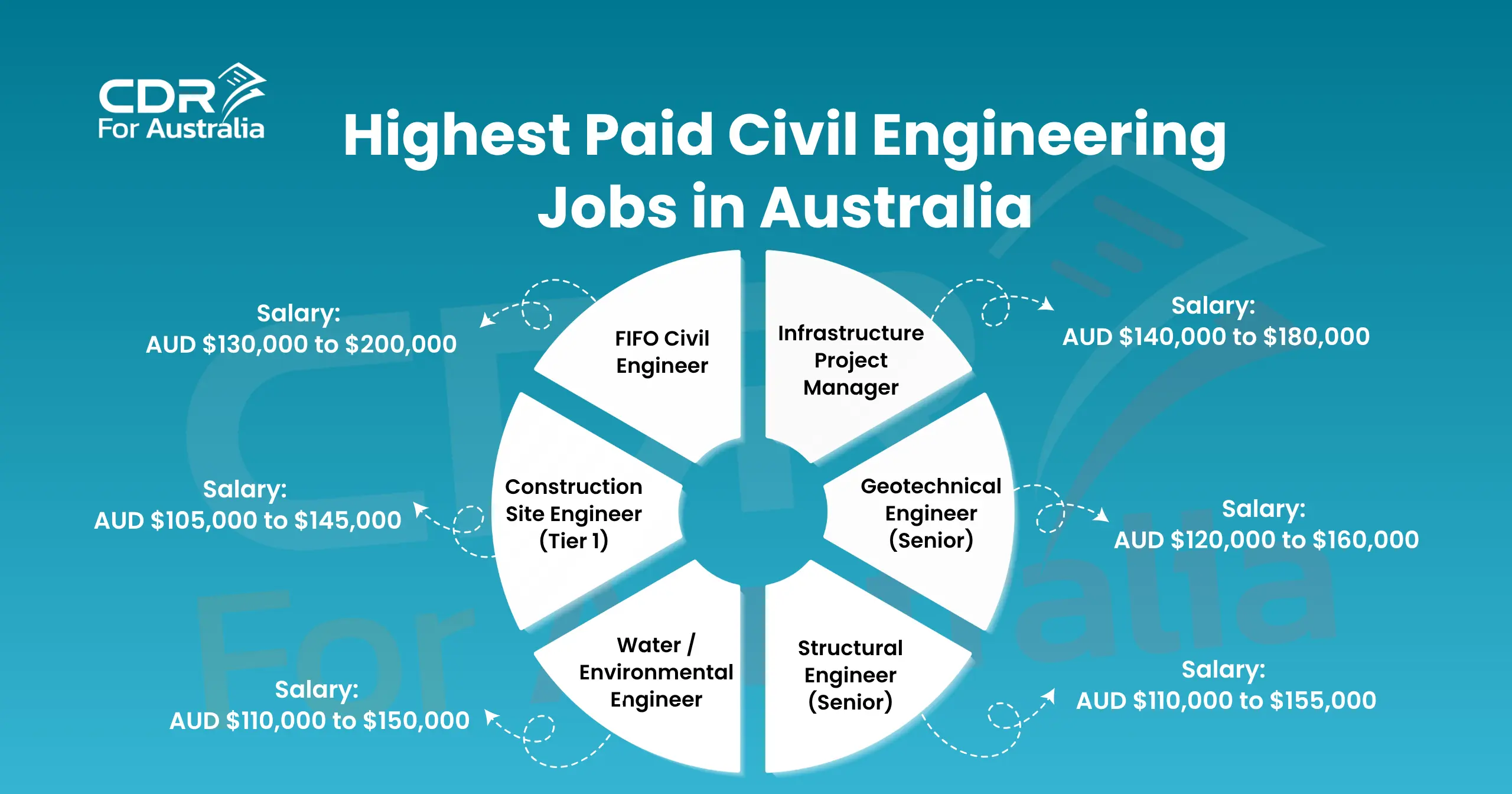
Highest Paid Civil Engineering Jobs in Australia
Some roles within the civil engineer salary in Australia range sit well above the average. These are the positions where total earnings are highest in the current market:
FIFO Civil Engineer:
The top earner in the field. Allowances, rosters, and remote loadings on top of base salary push packages into a range that office-based roles rarely reach. Most of these positions are in Western Australia and the Northern Territory.
Salary: AUD $130,000 to $200,000+
Infrastructure Project Manager:
Senior project delivery on major rail, tunnelling, and highway work. Both state governments and Tier 1 contractors are hiring at this level, and demand is high across New South Wales, Victoria, and Queensland.
Salary: AUD $140,000 to $180,000
Geotechnical Engineer (Senior):
Deep foundations, piling, ground risk this specialisation is short-supplied relative to demand. Senior geotechs rarely struggle to find well-paid work.
Salary: AUD $120,000 to $160,000
Structural Engineer (Senior):
Bridges, high-rise structures, complex civil works. Structural engineers with a strong project portfolio earn consistently above the field average.
Salary: AUD $110,000 to $155,000
Water / Environmental Engineer:
Desalination, flood mitigation, water supply infrastructure. Climate-related spending has lifted demand for this specialisation noticeably over the past two years.
Salary: AUD $110,000 to $150,000
Construction Site Engineer (Tier 1):
On-site roles with major contractors pay more than equivalent positions at smaller firms. Site engineers managing large delivery teams or complex subcontractor arrangements earn at the higher end.
Salary: AUD $105,000 to $145,000
A CDR that accurately captures experience in any of these areas is worth getting right. Engineers who document their role precisely not just what the project was, but what they personally decided and delivered tend to get assessed at a higher competency level.
Civil Engineer Salary in Australia vs USD
At an exchange rate of approximately 0.66 USD per AUD, here is how the civil engineer salary Australia compares globally:
Level | AUD | USD (approx.) |
Graduate / Entry | $80,000 | ~$52,000 |
Average Mid-Career | $105,000 | ~$68,250 |
Experienced Engineer | $130,000 | ~$84,500 |
Senior Civil Engineer | $150,000 | ~$97,500 |
Chartered / Principal | $180,000 | ~$117,000 |
Beyond base salary, Australia’s package includes Medicare, 11.5% superannuation on top of base pay, and a minimum of four weeks annual leave. When the full remuneration is considered, the Australian civil engineer salary is highly competitive internationally particularly for engineers migrating from South Asia, the Middle East, or Southeast Asia.
Qualifications and Eligibility to Work as a Civil Engineer in Australia
Civil engineering sits under ANZSCO Skill Level 1 the top tier of the Australian occupational classification framework. A four-year bachelor degree in civil engineering is the standard minimum. Employers typically want coverage across structural design, geotechnics, hydraulics, construction management, and project delivery.
Australian graduates from accredited programs satisfy this requirement without any additional steps. A Master of Engineering or higher qualification can accelerate access to senior roles.
For engineers trained overseas, recognition depends on whether their qualification falls under one of the international engineering accords. Engineers Australia, as the assessing authority for ANZSCO 233211, checks international qualifications against Australian standards. A positive assessment allows the engineer to apply for a skilled migration visa and work at the professional engineering level in Australia. Engineers Australia also runs the National Engineering Register (NER), and registration on the NER is becoming a practical requirement for work with larger employers and government contractors.

Looking for expert CDR Writer for Engineers Australia?

Creating a CDR Report may be difficult due to Engineers Australia’s standards and rules ( EA ). Our experienced engineers have assisted many people in obtaining approval for their report from the EA via the use of powerful projects.
The CDR Assessment Process for Civil Engineers
The Competency Demonstration Report is what Engineers Australia uses to determine whether an overseas engineer’s real-world experience meets the Stage 1 Competency Standards for a Professional Engineer.
A CDR submission for Civil Engineer (ANZSCO 233211) has four parts. The CPD list covers any training, courses, technical reading, or professional development completed since graduating. Three Career Episodes follow each one describing a specific project or work situation in 1,000 to 2,500 words, with the focus on what the applicant personally contributed, decided, and solved. This is not a project description; it is an account of the engineer’s own thinking and actions. Copied or generic content is flagged and leads to rejection. The Summary Statement then cross-references each episode to the specific competency elements Engineers Australia uses. Supporting documents, degree certificates, transcripts, reference letters on company letterhead, and passport complete the submission.
Applications fail most often because of three things: content that reads as copied or AI-generated, an ANZSCO code that does not match what the engineer actually does, and Career Episodes that describe a team’s work rather than the individual’s contribution.
Career Episode Writing that is specific, personal, and tied to real decisions made on real projects is what gets a positive outcome.
Civil Engineering and Permanent Residency in Australia
A successful Migration Skills Assessment from Engineers Australia is the entry point to skilled migration. Civil Engineer (ANZSCO 233211) appears on both the Core Skills Occupation List (CSOL) and the Medium and Long-Term Strategic Skills List (MLTSSL), which means it qualifies for several visa pathways.
Subclass 189 (Skilled Independent) gives permanent residency without needing an employer or state sponsor. The minimum points score is 65, but civil engineers typically need 85 to 90 or above to receive an invitation, given current competition. Subclass 190 (Skilled Nominated) requires a state or territory nomination New South Wales, Victoria, Western Australia, and Queensland are all actively nominating civil engineers. Subclass 491 (Skilled Work Regional) is a five-year provisional visa for engineers prepared to live and work in a regional area. It leads to permanent residency through Subclass 191 after three years of regional work.
The CDR submission needs three Career Episodes, a Summary Statement, and a Continuing Professional Development (CPD) list. The Summary Statement links the episodes to Engineers Australia’s competency criteria and is what the assessor spends the most time reviewing.
Civil engineer demand across New South Wales, Victoria, and Western Australia remains strong. A well-assessed CDR opens the door to both residency and the salary levels the Australian market is currently offering.
Frequently Asked Question (FAQs)
How much is a 1-month salary in Australia for a civil engineer?
Most civil engineers take home AUD $7,900 to $9,600 a month before tax. After tax, expect around AUD $5,900 to $7,100 in hand each month.
Which engineering discipline is highest paid in Australia?
Mining and petroleum engineers top the list averaging above AUD $130,000, with senior FIFO roles crossing AUD $200,000. In civil engineering, project management and geotechnical work pay the most.
Can a civil engineer get PR in Australia?
Yes. Civil engineering sits on Australia’s MLTSSL and CSOL. That opens the Subclass 189, 190, and 491 visa pathways. Engineers Australia handles the skills assessment via a CDR.
What is the lowest salary for a civil engineer in Australia?
Fresh graduates start somewhere between AUD $59,500 and $62,000 a year. With a couple of years in the workforce, that moves closer to AUD $76,000.
What is the civil engineer salary in Australia per hour?
Around AUD $49 an hour on average. Junior roles sit near AUD $30. Senior and chartered engineers earn AUD $65 to $92 an hour.
Is civil engineering a good career in Australia in 2026?
Shortage listed occupation. Record infrastructure budgets. Wages up 8.1% in 2024. The short answer is yes.
What is the average civil engineer salary in Australia after tax?
At AUD $96,250 a year, take-home is roughly AUD $73,700 annually, about AUD $6,142 a month after tax.
How does the civil engineer salary in Australia compare in USD?
AUD $105,000 converts to roughly USD $72,450. AUD $150,000 is around USD $103,500 as of current exchange rate of 2026. Add super, Medicare, and four weeks leave the full package holds up well globally.