


Statutory Declaration for VETASSESS: Process & Requirements Guide
If you’ve ever been asked to sign something “under statutory declaration,” you probably had a few questions before you got started. Who’s allowed to witness it? Does it need a lawyer? What happens if a detail turns out to be wrong later? These are the exact questions most applicants ask, especially when the document is going towards a visa file or a skills assessment rather than something everyday like a bank form.
A statutory declaration is a written statement where you set out facts and sign to say they’re true, in front of someone qualified to witness it. It sits somewhere between a normal letter and a court affidavit: legally binding, but without the formality of swearing an oath before a judge.
Government departments, banks, insurers, and migration assessing bodies all rely on this kind of document when the usual paperwork isn’t available or doesn’t tell the full story. For anyone preparing a VETASSESS application, this distinction actually matters, because assessing bodies expect the Commonwealth form specifically, not a state one substituted in its place.

What Is a Statutory Declaration?
Put simply, it’s a formal written statement, made under legislation, in which you declare certain facts to be accurate. That last part is what separates it from an ordinary letter or reference. Once you sign one in front of an authorised witness, you’re on the record. If something in it later turns out to be false and you knew that at the time, there are real legal consequences, including a possible prison sentence under the Act.
The Commonwealth version uses the format set out in the 1959 Act. States like New South Wales, Victoria, Queensland, and South Australia each have their own equivalent laws for matters that don’t fall under federal jurisdiction. Either way, the basic rule doesn’t change: it has to be signed in front of an approved witness, and you need to genuinely understand what you’re putting your name to before you sign.
What Is a Statutory Declaration Used For?
People turn to this document whenever they need to put something in writing but can’t produce the usual paper trail. A few common scenarios:
- Confirming your identity, address, or a relationship when the standard records are missing or don’t quite line up
- Backing up a name change or explaining why your name appears differently across documents
- Verifying employment history when a reference letter simply isn’t obtainable
- Explaining self-employment or freelance work for a visa or skills assessment application
- Supporting an insurance, superannuation, or bank claim when documentation is incomplete
- Providing evidence for a government or legal process that calls for a formal written statement
For skilled migration applicants specifically, this comes up a lot around employment history. Maybe a former employer has closed down, gone quiet, or simply won’t cooperate. In that case, a properly written declaration can stand in for the reference letter that assessing bodies would normally expect.
Not sure where to start?
“Get a CDR written by qualified engineers who know exactly what Engineers Australia looks for.”
Stat Dec vs Affidavit
People mix these two up constantly, and it’s easy to see why. Both are written statements confirming facts, and both carry legal weight. The difference comes down to how they’re made. A stat dec is signed before an authorised witness, no oath required. An affidavit involves swearing or affirming under oath, and it’s generally reserved for court matters.
For visa applications, VETASSESS submissions, and most everyday personal declarations, a standard stat dec is all you need. Courts and tribunals are really the only place an affidavit gets specifically requested.
If your degree isn't in accounting:
a non-accounting background doesn’t automatically rule out a positive outcome. If your qualification is missing knowledge areas such as management accounting, business law or financial reporting, all three authorities allow you to close the gap through recognised bridging subjects, completed either before you apply or as part of the assessment itself. Applicants with a business, commerce or economics degree that only partially overlaps should map their transcript against the knowledge list before lodging. Our page on the Australian Qualification Framework covers how bridging study can close AQF-level gaps.
Who Can Witness a Statutory Declaration?
This is where a lot of applications actually go wrong. The witness has to be someone other than yourself, and they need to currently hold an approved role or registration, not just have held one at some point. For a Commonwealth declaration, that list includes:
- Legal practitioners on the roll of a Supreme Court or the High Court of Australia
- Justices of the Peace
- Notaries public, including those registered overseas
- Medical practitioners, pharmacists, dentists, and other registered health professionals
- Police officers, with no minimum service period required
- APS employees, bank officers, and building society or credit union officers, each with five or more years of continuous service
State versions run a broadly similar list, though the exact categories shift slightly by jurisdiction. If you’re not sure whether someone qualifies, don’t guess, ask the organisation that requested the declaration, or check the relevant government site before you book an appointment.
Statutory Declaration Wording and Format
Every valid version follows roughly the same structure:
Heading
Identifies the document as a formal declaration made under the Commonwealth Statutory Declarations Act 1959.
Declarant details
Your full name, current address, and occupation, written exactly as they appear on your official identification.
Statement of facts
Numbered points that clearly lay out exactly what you’re declaring, one specific fact per paragraph.
Declaration and penalty clause
The formal wording, paired with the statement confirming you understand a false declaration has legal consequences.
Signature and date
You sign and date the declaration only in front of the witness, never beforehand, as pre-signing can make the whole document invalid.
Witness certification
The section where the approved witness signs, dates, and formally confirms they personally observed everything occur.
Getting this wording right isn’t just a formality. Incomplete or incorrectly worded forms get bounced back by the requesting authority more often than you’d think. Grab the official form from the Attorney-General’s Department to make sure you’re working from the current version, not an outdated template someone’s forwarded you.
How to Write and Sign a Statutory Declaration
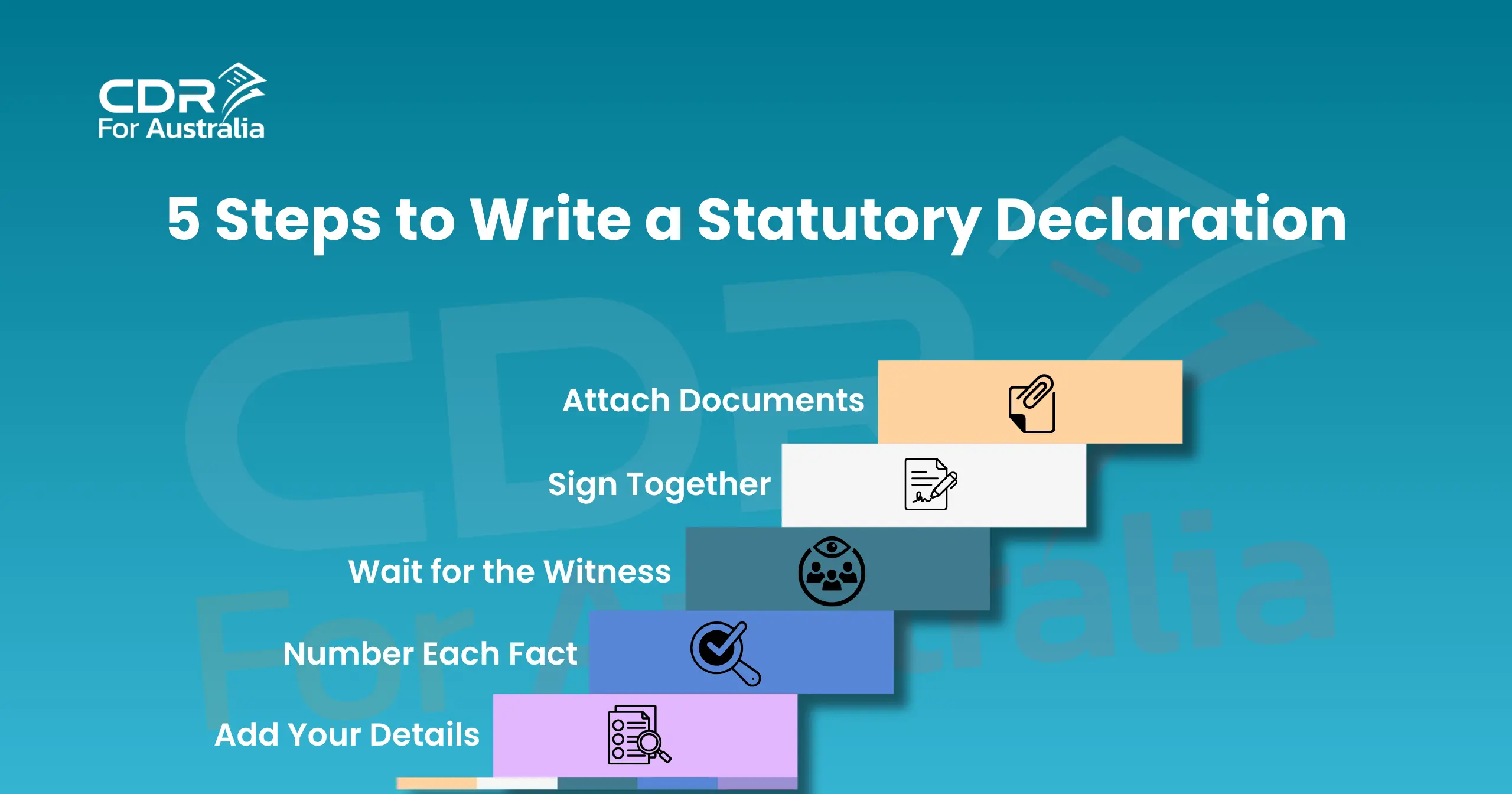
There’s no trick to it, but getting the details right matters more than people expect. Start with the correct approved form for your jurisdiction, Commonwealth or state, and work through it methodically:
- Fill in your personal details: full name, address, occupation
- Set out the facts in clear, numbered paragraphs, one point per number
- Skip the vague language. Stick to things you can actually back up
- Leave the signature blank until you’re in front of the witness, don’t pre-sign
- Sign it in person or remotely over video, whichever the witness can arrange
- Attach any annexures you’ve referred to in the text
Only include what you genuinely know to be true. Padding it out with assumptions or exaggerated claims is a fast way to get a declaration rejected, and in more serious cases, it opens you up to penalties under the Act.
One thing people underestimate is how much clarity matters over polish. A declaration written in plain, direct sentences tends to hold up better than one dressed up with legal-sounding phrases borrowed from a template. If you’re describing a job role, for instance, name the actual tasks you performed rather than copying generic duty statements. Assessors and witnesses alike are looking for something they can verify, not something that sounds impressive.
Digital statutory declaration in Australia
Since January 2024, you don’t necessarily need a witness at all for the Commonwealth version, it can be done through myGov instead. That does require a Digital Identity linked to your account, verified to at least standard strength.
The digital version comes with a QR code baked in to confirm it hasn’t been tampered with, and the platform itself can’t retain or edit a copy once you’ve made it. It’s a genuinely faster option if getting to an in-person witness is difficult, though the traditional route hasn’t gone anywhere and carries exactly the same legal weight.
Requirements and Common Mistakes to Avoid
Requirement | Common Mistake |
Use the correct approved form for the jurisdiction | Downloading an outdated or state-specific form for a Commonwealth matter |
Leave it unsigned until the witness is present | Signing before the witness has actually seen you do it |
Stick to clear, verifiable facts | Throwing in vague or unrelated statements |
Use a genuinely approved witness | Getting a friend or relative to sign who isn’t authorised |
Attach every annexure you mention | Forgetting the supporting documents referenced in the text |
Getting these right the first time saves a round trip. Nobody wants to redo a declaration because a witness wasn’t properly qualified.

Looking for expert CDR Writer for Engineers Australia?

Creating a CDR Report may be difficult due to Engineers Australia’s standards and rules ( EA ). Our experienced engineers have assisted many people in obtaining approval for their report from the EA via the use of powerful projects.
Statutory Declaration and Skilled Migration Documents
For engineers and other professionals working through Australian skilled migration, this document can help explain gaps in employment evidence, but it isn’t a stand-in for official records. VETASSESS is explicit about this: a stat dec cannot be accepted as proof of employment dates, hours, or payment on its own, and assessments are never based on a declaration alone. Those specific details still need to come from official documentation, such as tax records, signed contracts, or payslips.
For VETASSESS purposes specifically
- Describing tasks and duties you can’t obtain through official channels, particularly when an employer has closed down or gone unreachable
- Explaining self-employment activity where formal HR records don’t exist
- Filling in context around a role that a reference letter doesn’t fully cover
It is not accepted as evidence of following
- Exact employment dates or hours worked
- Salary, wages, or other payment details
- Sole proof of experience, without any supporting third-party documentation
There’s also a witnessing detail specific to VETASSESS worth knowing. The declaration needs to be properly executed by an appropriate legal professional in the applicant’s country of residence, rather than any generic Commonwealth-approved witness.
For trade occupation assessments specifically, VETASSESS won’t accept one covering employment experience unless it’s backed by separate third-party evidence, such as an employer reference or financial records. The same rule applies to anyone preparing a Competency Demonstration Report alongside their assessment.
A well-prepared declaration, matched against the required supporting documents for your occupation, still cuts down the risk of delays. Assessors cross-check it against everything else in the file, so if the duties described don’t line up with your other paperwork, it tends to raise more questions than it answers. Generic templates rarely work well here either; a declaration copied from a random website often reads as vague or disconnected from the applicant’s actual ANZSCO occupation, and assessors notice that fairly quickly.
Frequently Asked Question (FAQs)
What is the meaning of a statutory declaration?
It’s a written statement where someone declares certain facts to be true, signed in front of an approved witness. People use it when there’s no standard document available to confirm something.
How do I get a statutory declaration form in Australia?
Commonwealth forms are free to download from the Attorney-General’s Department, or you can complete one digitally through myGov. State and territory versions are on the relevant state government website.
What is a statutory declaration used for?
Mostly to confirm facts like identity, employment history, or a name change when you can’t provide the usual supporting documents.
How much does a statutory declaration cost?
The form itself is free. Some witnesses charge a small fee for their time, though a Justice of the Peace is not permitted to charge a fee under the Act.
What are the requirements for a statutory declaration?
Use the correct approved form, include only facts you can verify, and sign it in front of an authorised witness who confirms your identity.
Who can witness a statutory declaration?
Justices of the Peace, legal practitioners, notaries public, police officers, and various other licensed professionals listed under the current regulations.
What is an example of a statutory declaration?
A common one is an employment declaration, where someone sets out their job title, duties, and dates of employment because a reference letter from a past employer isn’t available.
Is a NSW statutory declaration different from a Commonwealth one?
Yes. NSW declarations follow the Oaths Act 1900 and apply to state matters, while Commonwealth declarations follow the Statutory Declarations Act 1959 and cover federal matters like visa and migration applications.