


Project Summary Proformas AACA: Requirements and Preparation Guide
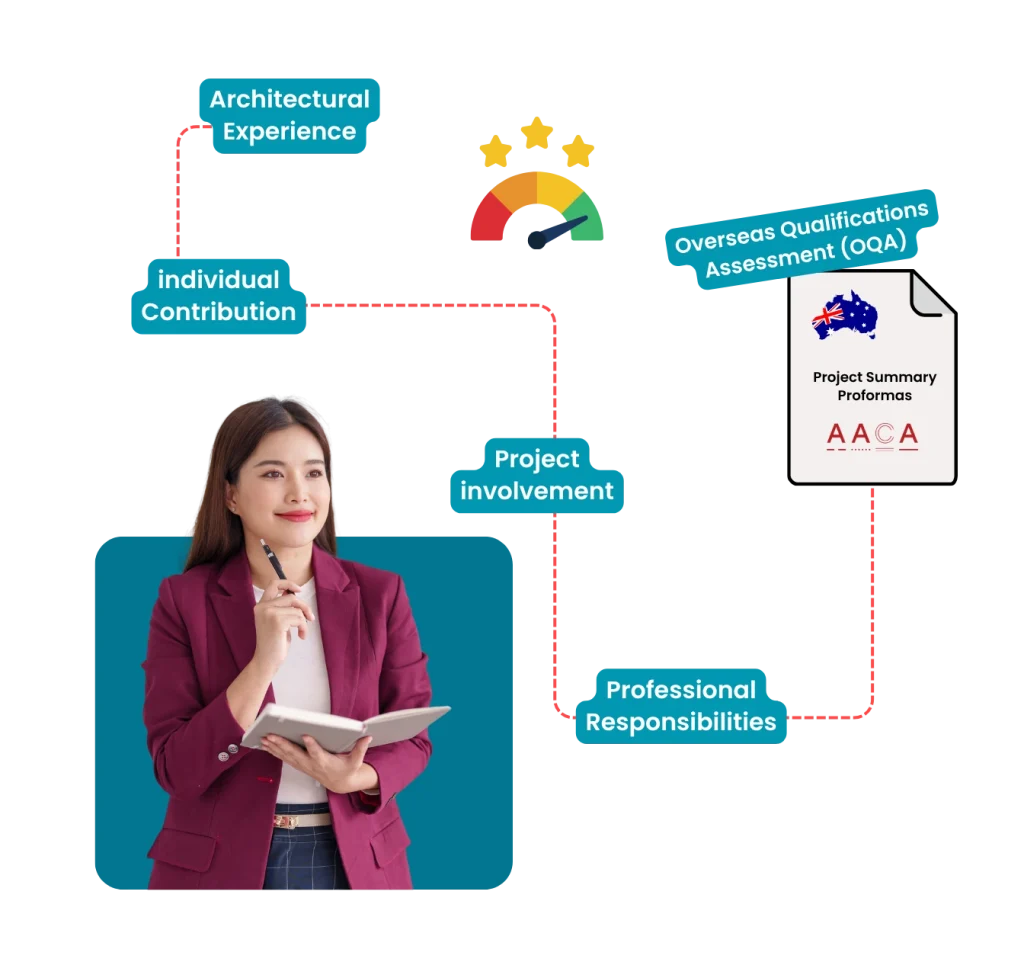
Creating an architectural portfolio for the Architects Accreditation Council of Australia (AACA) involves more than just gathering together drawings and completed projects. The architectural experience, individual contribution, project involvement, and professional responsibilities must also be explained in the supporting documents.
A key document of the Overseas Qualifications Assessment (OQA) is the Project Summary Proformas AACA. Gives an overview of each architectural project in the applicant’s portfolio and an understanding of the applicant’s academic and professional involvement.
What Are Project Summary Proformas for AACA?
Project Summary Proformas are documents that are official AACA documents that give a general overview of the architectural projects that are included in an applicant’s portfolio.
They provide a context for the assessor to form a picture of the background, type, location, scope, and nature of each project, and the applicant’s personal involvement.
These proformas are part of the competency assessment documentation when applying for the Overseas Qualifications Assessment with:
- Architectural project portfolio
- NSCA Summary Statements
- Curriculum vitae (CV)
- Academic qualification documents
- Knowledge of the field or industry and its practical requirements
The portfolio includes supporting architectural work such as drawings, design development, and other pertinent documentation, while the proformas contain project-specific information.
Candidates are required to fill out the most recent official AACA form and not a document of their own design.
Why Are AACA Project Summary Proformas Important?
Project Summary Proformas are useful for helping assessors determine the relationship of the applicant’s academic and professional background to architectural competency.
The following are some of the reasons why they are important:
Providing Project Background
A project summary provides a brief introduction to an architectural project, such as its location, building type, scale, and general purpose. This provides context for assessors to consider before reading the drawings and supporting evidence.
Demonstrating Individual Involvement
There are several cases where several architects, designers, engineers, and other professionals are involved in a professional architectural project. The proforma assists in determining if the applicant was an observer, participant or executive in the project.
Supporting Portfolio Assessment
Each project summary should correspond with the relevant project in the architectural portfolio. The use of consistent project names and information improves the ease of assessing the supporting evidence.
Preparing for the Competency Assessment Interview
Selected projects can be discussed in the Competency Assessment Interview. Developing clear project summaries allows them to structure their experience and to communicate about their participation.
Connecting Academic and Professional Experience
The applicant may showcase their architectural education, design knowledge, and experience with relevant academic and professional projects.
AACA Project Summary Proforma Requirements
Applicants are required to complete a number of fields in the official AACA Project Summary Proforma. Always refer to the latest template and OQA Applicant’s Guide for the exact instructions.
The applicant should be familiar with the following information:
Applicant and Project Identification
Start with the applicant and project being documented.
Generally, the information that is provided is:
- Applicant’s full name
- Project number
- Project name as it is listed in your portfolio
- Team member(s) (students or professionals)
Consistently use the same name and numbering for the project in the portfolio and supporting materials.
Project Type and Building Type
Applicants need to identify the type of architectural project and the building classification.
Examples include:
- Residential buildings
- Commercial developments
- Educational institutions
- Healthcare facilities
- Mixed-use developments
- Open space and public areas
The building type must be more specific than a generic architectural classification, describing the project itself.
Project Location
Provide the project’s geographical location, including:
- Town or city
- State or province
- Country
Make sure you verify the location, matching the information presented in the portfolio and other supporting materials.
Project Floor Area
The official proforma has a space for the square metre (m²) of the project.
The applicant must ensure that his/her figure is accurate and based on the available project documentation. Do not make estimates without supporting information.
Project Description
The project description is an important part of the proforma.
It should provide a brief statement about the architecture project, its context, type of development, and relevant aspects of the applicant’s engagement in professional projects.
Consider including:
- Project background and purpose
- New construction or alteration
- Building scale and general configuration
- Main architectural objectives
- Relevant design considerations
- Your involvement in the project
Do not include opinions or exaggerations; stick to the facts and be brief and concise, matching the actual project documentation.
Your Role in Professional Projects
For professional projects, applicants must indicate their level of involvement.
The official template identifies three categories:
Observer: Experience gained through careful observation of procedures and practices carried out by others.
Participant: Experience gained as a team member or operative working under the supervision of a responsible person.
Executive: Experience gained as the principal decision-maker on a project.
Applicants should select the category or categories that accurately reflect their involvement.
Do not claim an executive role simply because you contributed to an important part of the project. Your selection must reflect your actual responsibilities and authority.
Academic Project Information
In the case of student projects, the proforma asks for further academic information, such as:
- Year of the architectural course when the project was completed
- Whether the project was individual or group work
This information is useful to the assessors to get an idea of the academic environment of the chosen project.
As per the AACA Applicant’s Guide, applicants can submit their last year architectural thesis or design project.
Professional Project Information and Referee Details
Applicants are required to prepare information with regard to their employment and project involvement for professional projects.
The official template has spaces for the following fields:
- Calendar year(s) of involvement
- Firm or company worked for
- Project referee’s name
- A project referee’s contact information.Contact details of the project referee.
- Mobile number
- Email address
Be sure to have accurate referee information and that someone can confirm if they are contacted that you are a referee.
Project Image
The proforma also has the space to include a picture of the project.
Select an image that is indicative of the project and matches the content of the portfolio.
This can vary by project and may be an architectural drawing, photo of a building or other suitable graphic.
How to Prepare Project Summary Proformas AACA Step by Step
The proforma must be prepared carefully and should be consistent throughout the application documents.
Follow these steps:
Step 1: Download the Official AACA Template
Go to the AACA Overseas Qualifications Assessment page and download AACA Project Summary Proformas.
Read the OQA Applicant’s Guide prior to filling out the document. This will give you an idea of the criteria for the evaluation and why each supporting document is needed.
Step 2: Select Your Architectural Projects
New OQA will include 3-4 architectural projects in the portfolio.
Choose projects to illustrate various facets of architectural learning and practice.
At least one project should satisfy AACA’s definition of a complex project.
Step 3: Collect Project Information
Fill in each proforma after collecting the information.
Useful materials include:
- Architectural project drawings
- Describe and present a design brief for a project.
- Academic project documentation
- Accounts and financial records
- Include photographs or drawings of the project.
- Referee contact information
Make sure to use professional project materials, if required.
Step 4: Write Clear Project Descriptions
Explain each project in such a way as to make assessors understand the background and architectural purpose of the project.
Don’t use too technical language when it’s not needed.
If there are professional projects, describe what you did and not what you and the entire project team accomplished.
Step 5: Identify Your Level of Involvement
Identify if you were an Observer, Participant, or Executive.
Choose the category that is relevant to your work in the real project.
If the project had multiple phases, explain which phases you were involved in.
Step 6: Complete the Academic or Professional Details
Share the other information relevant to the project classification.
If the project is a student project, specify the academic year and if it is an individual or group project.
If a student is doing a professional project, fill out the calendar years, company, and referee information.
Step 7: Cross-Check With Your Portfolio
Compare each proforma with its respective portfolio project.
Check that:
- Project names match.
- The locations of the projects are standardized.
- Dates are accurate.
- The types of buildings are properly identified.
- You’re described in a consistent manner.
- Project images correspond to the correct projects.
Step 8: Review Before Submission
Review all information, spelling, contact information, and supporting information.
Follow the most recent AACA submission guidelines and checklist to verify all submissions are correct.
How Many Projects Are Required for AACA Portfolio Assessment?
The October 2025 AACA OQA Applicant’s Guide specifies that new applicants will have to submit a portfolio with at least three projects and a maximum of four architectural projects.
A minimum of one project should be considered a complex project.
A complex project is generally a medium- or larger-sized project that incorporates a variety of complex architectural requirements, including:
- Site planning and building configuration
- Structural systems
- Building services
- Materials and construction
- Cultural and social factors are a consideration.
- Environmental and technical conditions
Single-dwelling residential projects and interior fit-out projects are not classified as complex projects.
It would also be important for the applicant to bring his/her final-year architectural thesis, as this could form a point of reference for a discussion of education competencies that will take place during the interview.
Note: There should be a Project Summary Proforma for each project in the portfolio.
Project Summary Proforma vs NSCA Summary Statement
These are often confused with one another by applicants, as they are both submitted as part of the AACA competency assessment.
They are used for different purposes, though.
Comparison | Project Summary Proforma | NSCA Summary Statement |
Main purpose | Provides an overview of a project | Demonstrates architectural competencies |
Coverage | Individual project | 13 NSCA Topic Areas |
Main focus | Project background and applicant involvement | Performance Criteria and supporting evidence |
Information | Project type, location, role and description | Competency explanations and project references |
Preparation | One for each selected project | Across the required competency areas |
The Project Summary Proforma describes the project and the applicant’s role in the project.
The NSCA Summary Statement provides an explanation of how the evidence the applicant has chosen for the project demonstrates the applicable competencies required by the National Standard of Competency for Architects.
The project name and references on both documents should be consistent.
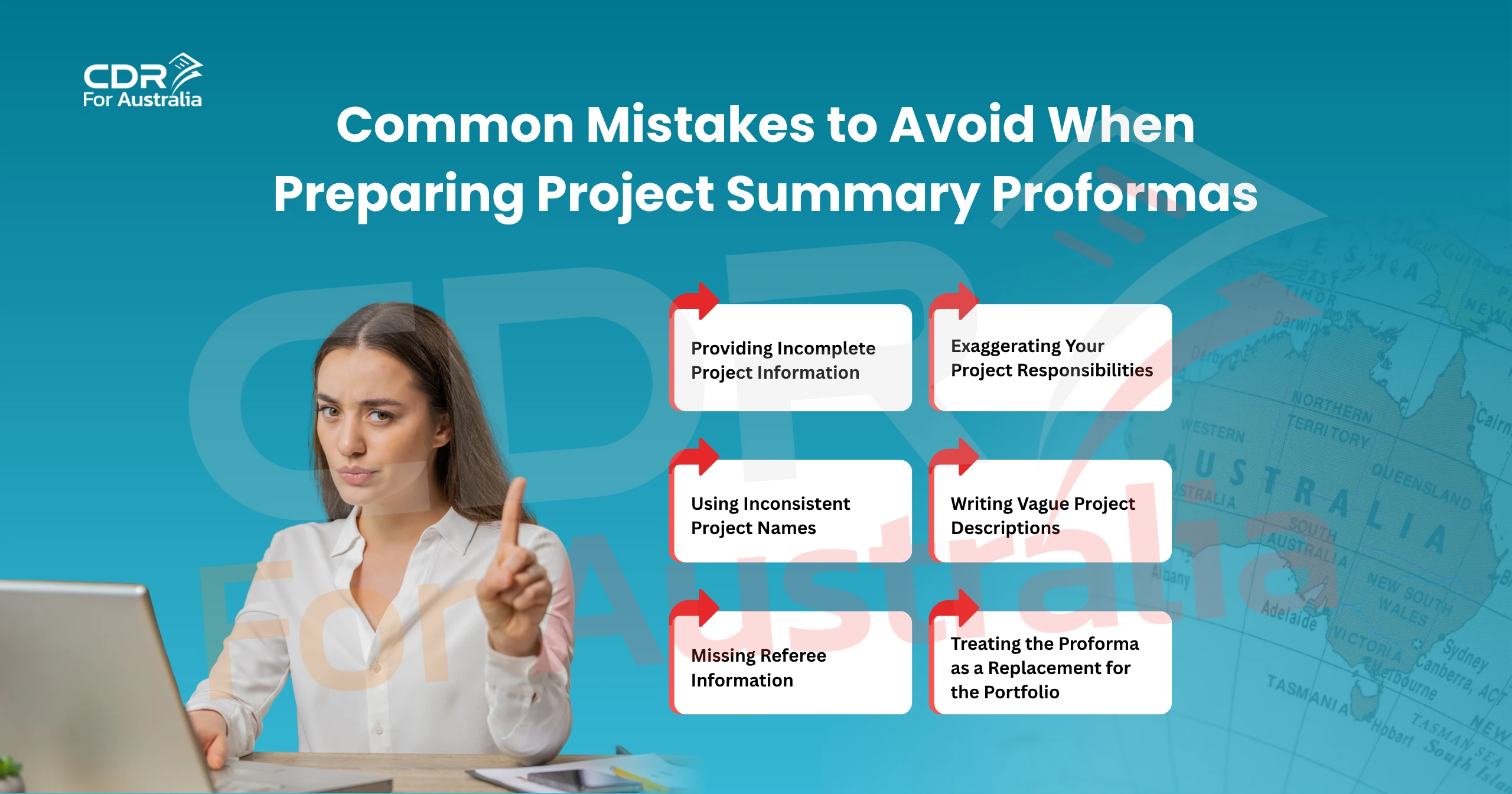
Common Mistakes to Avoid When Preparing Project Summary Proformas
When the applicant has suitable architectural experience, but the documentation in the project involvement is inadequate, it can be difficult to understand.
These are some things to steer clear of.
Providing Incomplete Project Information
Access to project locations, building types, dates, or referee information may be unavailable, making documentation incomplete.
Make sure to check all the relevant fields before completing the proforma.
Exaggerating Your Project Responsibilities
Don’t take ownership of design choices and project work done by other team members.
Make clear the difference between your own roles and those of the other members of the project team.
Using Inconsistent Project Names
Having multiple project titles in the portfolio, CV, and proforma can be confusing.
Use a consistent project name and continue to use it in all parts of your project.
Writing Vague Project Descriptions
The context provided in the descriptions is not sufficient.
Using accurate and relevant information, explain the purpose of the project, building type, and your involvement.
Missing Referee Information
Assessment criteria and templates for documents may change.
Always download the most current forms directly from AACA and not from other forms or examples which may have been downloaded previously.
Treating the Proforma as a Replacement for the Portfolio
The proforma is not a substitute for the architectural portfolio or NSCA Summary Statements.
Each document is for a specific purpose and must be prepared as specified by AACA.
Final Checklist Before Submitting Your Project Summary Proformas AACA
As a checklist before you submit your documents:
- Downloaded the latest official AACA template.
- Completed a separate proforma for each selected project.
- Provided accurate applicant and project details.
- Identified the correct building type and location.
- Entered the available floor area information.
- Wrote a clear project description.
- Correctly identified professional involvement.
- Completed academic project details where applicable.
- Provided professional referee details where applicable.
- Added an appropriate project image.
- Checked consistency with the architectural portfolio.
- Reviewed the latest OQA Applicant’s Guide and submission checklist.

Looking for expert CDR Writer for Engineers Australia?

Creating a CDR Report may be difficult due to Engineers Australia’s standards and rules ( EA ). Our experienced engineers have assisted many people in obtaining approval for their report from the EA via the use of powerful projects.
How CDR For Australia Can Help With AACA Portfolio Preparation
A proper selection of projects, structuring of documents and presentation of architectural experience is required to prepare an AACA architectural portfolio.
CDR For Australia can help applicants prepare a portfolio to organise their architectural work and supporting materials.
This help can be provided in the form of:
- Reviewing and organising architectural project information.
- Organizing descriptions and other materials for projects.
- Identifying and locating appropriate project evidence.
- Auditing consistency of project summaries to portfolio documents.
- Assisting in the development of NSCA Summary Statements.
- Checking relevant documentation prior to submission.
From academic projects to professional project records and even your old architectural portfolio, our team can help you organize your documents and present yourself clearly.
Looking for help with your AACA Portfolio Assessment? Speak with CDRForAustralia about your project documentation and portfolio needs.
Frequently Asked Question (FAQs)
What are Project Summary Proformas for AACA?
Project Summary Proformas are official documents that are created to give the AACA Overseas Qualifications Assessment an overview of each architectural project in the applicant’s portfolio. They provide project information and the applicant’s participation.
Is a Project Summary Proforma required for every project?
Yes. Applicants must submit a Project Summary Proforma for each architectural project in the portfolio (according to the existing AACA instructions).
How many projects are required for AACA Portfolio Assessment?
Each applicant new to the OQA must submit 3 – 4 architectural projects. There must be at least one of them that is a complex project as defined by AACA.
Do academic projects need referee details?
There is an official template that separates student projects from professional projects. For academic projects, information is needed regarding year of study and individual or group-based work. Professional project referee information for professional projects.
What information should a Project Summary Proforma contain?
The official template asks for identification of the applicant, building type, project type, location, floor area, project description, and image. It also features separate areas for student projects and professional projects (if relevant) with role and referee details.