


Highest Paying IT Jobs in Australia in 2026
Technology has quietly become one of the best-paying fields in Australia. Banks are rebuilding core systems. Hospitals are digitising patient records. Retailers are moving everything to the cloud, and government departments are trying to keep up with all of it at once, usually with fewer people than they’d like. Every one of those projects needs staff, and there aren’t enough to go around. That’s really the short version of why IT jobs in Australia now sit near the top of the pay scale, right behind medicine and senior executive roles.

Sydney still leads on salary. Melbourne and Canberra aren’t far behind, especially for anyone working in architecture or cybersecurity. Even graduates walking into their first tech job tend to out-earn peers in most other industries, which says something about where this market is headed.
So what follows looks at which roles pay the most in Australia’s IT sector, what’s actually pushing wages up, which positions employers can’t fill fast enough, how pay shifts as you gain experience, and how the visa process works for skilled migrants trying to get in. All of it is based on current recruitment data and figures from Australian government labour sources.
Why Do IT Jobs Pay So Well in Australia?
Jobs and Skills Australia updates its shortage list every year, and software engineers, cybersecurity specialists, and ICT business analysts keep turning up on it. When a company can’t fill a role fast enough, the usual response is to offer more money. It’s not complicated.
Digital transformation hasn’t slowed down. Old systems are being torn out, cloud migrations are happening across almost every sector, and cyber defence has turned into a board-level concern rather than something buried inside an IT budget somewhere. That keeps demand fairly constant, from junior developers right up to senior architects.
There’s a numbers problem underneath all of this too. Australia’s population is small compared with the size of its economy, so the domestic supply of trained tech workers doesn’t always keep up. Cloud engineering and AI roles feel this the hardest, and it’s a big part of why so many employers now look overseas for talent. Local universities and TAFEs just can’t turn out enough graduates each year to fill every open technical role.
Then there’s the roles that sit at the intersection of deep technical skill and business or security responsibility. Enterprise architects, cybersecurity managers, that kind of thing. These tend to command the biggest pay packets in the whole sector. And Australian employers aren’t only competing with each other anymore, they’re competing with fully remote overseas jobs too, which has pushed a lot of local businesses to sweeten base pay, throw in equity, or add more flexibility just to hold onto their better staff.
Highest Paying IT Jobs in Australia by Role
Pay shifts a lot depending on seniority, specialisation, and where you’re based. Here’s a rundown of some of the highest paying IT jobs in Australia right now, drawn from current figures published by recruitment firms including Hays, SEEK, and Robert Half.
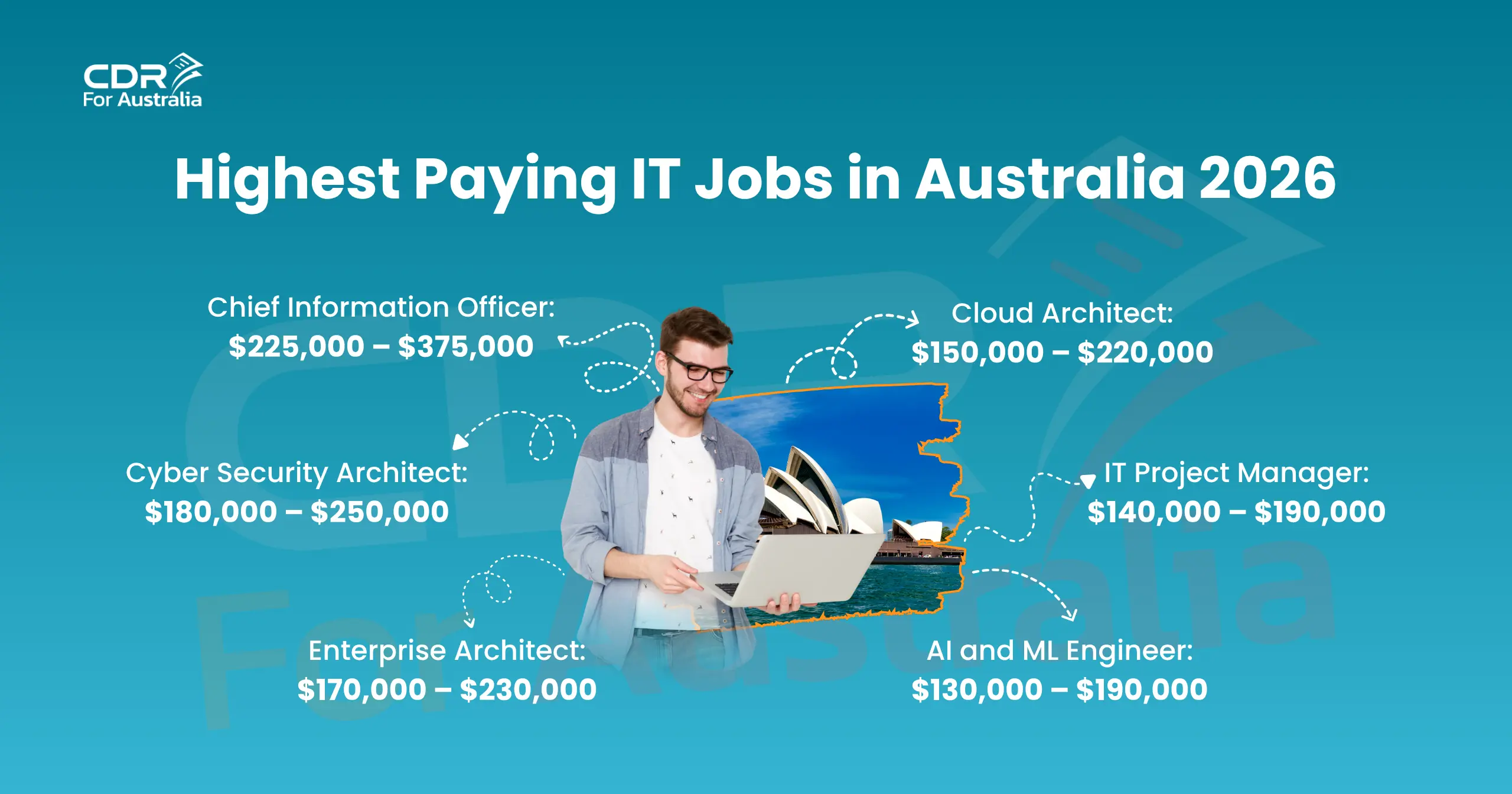
1. Chief Information Officer
At the very top sits the Chief Information Officer, CIOs own the whole technology strategy, budget, and digital transformation agenda for a business, and getting there usually takes fifteen-plus years, most of it in real leadership positions, not just technical ones.
Salary: AUD $225,000 to $375,000
2. Cyber Security Architect
Just below that is the Cyber Security Architect role. These are the people designing and running the systems that keep an organisation’s networks and data safe, and certifications like CISSP or CISM are pretty much expected alongside a solid network security background.
Salary: AUD $180,000 to $250,000
3. Enterprise Architect
Enterprise Architects aren’t far off either. This role lives between IT and the business side, making sure systems actually serve what the company is trying to do rather than just existing for their own sake. It takes years of systems architecture work, plus the ability to explain technical decisions to senior stakeholders without losing them halfway through.
Salary: AUD $170,000 to $230,000
4. Cloud Architect
Cloud Architects build and manage infrastructure across AWS, Azure, or Google Cloud. Vendor certifications help on paper, but what actually gets people hired is hands-on platform experience, the kind you can’t fake in an interview.
Salary: AUD $150,000 to $220,000
5. IT Project Manager
IT Project Managers keep tech initiatives on schedule and on budget, which sounds simple until you’ve actually tried it. PMP or PRINCE2 certification is more or less standard here, paired with real delivery experience.
Salary: AUD $140,000 to $190,000
6. AI and ML Engineer
Somewhat newer to the top tier is the AI and Machine Learning Engineer. Demand for this one has grown fast as more businesses lean on automation for decision-making, and the baseline expectation is strong Python skills plus genuine hands-on work with machine learning frameworks.
Salary: AUD $130,000 to $190,000
7. Data Engineer
Data Engineers aren’t as flashy, but someone has to build the pipelines that move and store the data everyone else in the business relies on. That means solid SQL and Python skills along with real experience on cloud data platforms.
Salary: AUD $120,000 to $180,000
8. DevOps Engineer
Right alongside them, DevOps Engineers sit at the crossroads of development and operations, managing CI/CD pipelines and cloud infrastructure. Scripting ability isn’t optional in this role.
Salary: AUD $120,000 to $178,000
9. Cybersecurity Analyst
Cybersecurity Analysts are the people watching networks day to day, catching threats and digging into incidents when something looks off. CompTIA Security+ is a common entry point, though analytical thinking matters more than any single certification.
Salary: AUD $90,000 to $150,000
10. Software Engineer
And then there’s the Software Engineer, the broadest category on this list, spanning front-end, back-end, and full-stack work. A degree helps but isn’t always necessary if the coding skills in Java, Python, or JavaScript are genuinely there.
Salary: AUD $95,000 to $150,000
For context, Australia’s national average full-time salary sits close to $107,000 a year. Executive and architecture-level IT jobs sit well above that, obviously. Even mid-level roles like software engineering and data engineering pay more than average, and entry-level tech positions usually beat non-technical graduate jobs by a fair margin too.
Which IT Jobs Are Hardest to Fill in Australia?
Not every high-paying role is hard to fill, and not every shortage role pays the absolute top dollar. It’s worth knowing where the real gaps sit if you’re trying to decide what to specialise in.
The Jobs and Skills Australia Occupation Shortage List tracks this year on year. Right now, the picture looks roughly like this:
- Cybersecurity specialists, especially in governance, risk, and compliance, remain a national shortage. ICT security employment is projected to grow 14.2 percent by 2029, more than double the national average across all occupations
- Cloud engineers and architects, as businesses keep shifting away from on-premise infrastructure
- ICT business analysts, translating between technical teams and the rest of the business
- Data engineers and analysts, riding the wave of automation and AI adoption
- Systems analysts, helping organisations pick and roll out new platforms
Software engineering is a bit more complicated than the rest. It’s still on the skilled visa list, but for the first time since reporting began back in 2021, it’s dropped off the national shortage list entirely, mostly because training pipelines have finally caught up with demand. That doesn’t make it a bad career choice. It’s just no longer one of the hardest roles to hire for. Anyone checking their own occupation code should look at the current status for Software Engineer or ICT Business Analyst before applying, since these lists move around every year.
IT Salary in Australia by Experience Level
Experience counts for a lot more in IT than in most other fields, and the jump between junior and senior pay can be steep. Roughly speaking:
Experience Level | Years of Experience | Typical Salary Range (AUD) |
Entry level | 0–2 years | $65,000 – $85,000 |
Mid-level | 3–6 years | $90,000 – $140,000 |
Senior level | 7+ years | $140,000 – $220,000 |
Executive level | Head of technology / C-suite | $225,000+ |
Location changes things too. Sydney and Canberra generally pay the most, Melbourne and Brisbane aren’t far behind, and regional areas tend to pay less, though a lower cost of living and less competition for jobs can even things out somewhat.
Best Cities in Australia for Technology Careers
These are the major tech hubs offering highest paying IT jobs in Austarlia.
City | Sectors |
Sydney | Finance, cybersecurity, enterprise software |
Melbourne | Health tech, retail platforms, data-heavy roles |
Canberra | Government-linked tech, cybersecurity, architecture |
Brisbane | Cloud engineering, infrastructure projects |
Perth | Cloud engineering, infrastructure projects |
Highest Paying IT Jobs in Australia Without a Degree
A university degree isn’t the only route into a well-paid tech career here. Australian employers tend to value practical skills and certifications just as much, sometimes more, which opens the door for people who go the vocational or self-taught route instead.
Cybersecurity analyst, cloud support engineer, network administrator, and DevOps engineer are all roles you can reach through industry certifications, TAFE courses, or bootcamps, as long as there’s real project experience behind it.
Employers hiring for these positions usually care more about what someone can actually do, backed by an AWS, Microsoft, or CompTIA certification, than which university they attended. That said, once you’re aiming for senior architecture or leadership work, formal qualifications or a recognised skills assessment start to matter more.

Looking for expert CDR Writer for Engineers Australia?

Creating a CDR Report may be difficult due to Engineers Australia’s standards and rules ( EA ). Our experienced engineers have assisted many people in obtaining approval for their report from the EA via the use of powerful projects.
IT Jobs in Australia With Visa Sponsorship
Australia sponsors skilled workers for tech roles that appear on its skilled occupation lists. A few things worth knowing:
- Employers sponsor candidates through the Skills in Demand (SID) visa, subclass 482, which replaced the old Temporary Skill Shortage visa back in December 2024. Permanent residency nomination is also possible if the occupation qualifies
- Software engineers, developer programmers, systems analysts, ICT business analysts, and cybersecurity specialists are the roles that most often attract sponsorship
- Most applicants need a positive skills assessment from a body like the Australian Computer Society or VETASSESS, confirming their background actually lines up with the ANZSCO code for the role
- Processing times and eligibility rules shift year to year, so it’s worth checking requirements directly with the Department of Home Affairs before applying
- A poorly prepared application can stall or sink a visa outcome outright, which is why many applicants turn to professional ACS skills assessment support or VETASSESS skill assessment services to get the paperwork right the first time
How to Qualify for High-Paying IT Jobs in Australia?
Landing one of the highest paying IT jobs in Australia usually comes down to three things: real qualifications, provable experience, and, for migrants, matching the right occupation code. Getting there generally follows a similar path:
- Show your skills match Australian standards. Overseas-trained engineers and tech professionals need to prove this before any employer will even consider sponsoring them.
- Prepare the right assessment. Most engineering-adjacent roles need a Competency Demonstration Report through CDR writing services, documenting technical competency against Engineers Australia’s benchmarks.
- Get the paperwork right the first time. This is often the difference between a fast approval and months of back-and-forth with the assessing authority.
- Apply once approved. A positive outcome confirms your occupation, experience, and qualifications meet the required standard, making it easier to apply directly for sponsored roles.
Getting the documentation right matters more than most people expect, and it’s usually what separates a fast approval from a drawn-out process with the assessing authority.
Skills and Certifications Employers Look For
Employers look for a fairly consistent set of skills and certifications before pay even comes into the conversation. To land these roles, candidates are typically expected to show:
- Cloud platform knowledge (AWS, Azure, or Google Cloud)
- Security certifications such as CompTIA Security+, CISSP, or CISM
- Solid programming ability in Python, Java, or JavaScript
- Communication and stakeholder management skills
- Familiarity with agile or DevOps workflows
Certifications signal that a candidate’s skills are current, which matters in a field where tools change fast. Communication becomes more important the further up the ladder someone goes, since senior roles often mean explaining technical decisions to non-technical people.
Frequently Asked Question (FAQs)
Which IT job is in demand in Australia?
Cybersecurity specialists, particularly in governance, risk, and compliance, represent the clearest shortage right now, along with cloud engineers, data engineers, and ICT business analysts.
What jobs pay $300,000 a year in Australia?
At the top end, Chief Information Officers and Chief Technology Officers can earn packages above $300,000, mostly in Sydney, Melbourne, and Canberra.
What jobs pay $150,000 a year in Australia?
Several senior tech roles land around $150,000, including experienced cloud architects, cybersecurity architects, IT project managers, and senior software engineers.
How much does an IT job pay in Australia?
It depends heavily on role and experience. Entry-level positions usually start between $65,000 and $85,000, while senior and specialist roles can go past $200,000.
Are there IT jobs in Australia for freshers?
Yes. Graduate programs, internships, and junior developer or support roles are all available, though pay at this stage is naturally lower than mid or senior level.
Can foreigners get IT jobs in Australia with visa sponsorship?
Yes. Plenty of Australian employers sponsor skilled overseas candidates, as long as the occupation is on the relevant skilled list and the candidate has a positive skills assessment.
What is the average IT salary in Australia per month?
Translated into monthly terms, most tech roles work out to somewhere between roughly $6,500 and $12,000, depending on seniority and specialisation.
Can I get high-paying IT jobs in Australia without a degree?
Yes. Roles like cybersecurity analyst, cloud support, and network administration can all be reached through certifications and hands-on experience rather than a formal degree.