


Chief Information Officer: Skills and Career in Australia
A chief information officer (CIO) sits at the top of a company’s technology function. Not just managing servers or fixing outages, this person is expected to connect IT decisions with wider business goals, something that has become harder as companies rely on dozens of interconnected systems instead of a handful of standalone tools. In most Australian organisations, this role reports straight to the CEO and sits alongside other senior leaders in finance, operations, and marketing during major planning cycles.

The scope of the job role is broad: IT strategy, cybersecurity, software platforms, budgets, vendor contracts, staff training, all of it eventually lands on the CIO’s desk. Banking, healthcare, government, and retail businesses across Australia now treat this position as essential, largely because a single system failure or data breach can cost far more than the salary of the person hired to prevent it.
Demand for experienced ICT leaders has kept climbing as more operations move online and companies adopt automation, cloud platforms, and data analytics. Officially, the role falls under ANZSCO code 135111, part of the ICT Managers occupation group. Anyone researching this career usually wants the same handful of answers: what the job involves day to day, which skills matter, what it pays, and how someone gets there.
Who Is a Chief Information Officer?
A CIO is a senior executive who owns an organisation’s information and communication technology direction. Their job is making sure the technology in place actually supports what the business is trying to do, both this quarter and five years from now. This role typically sits at the same level as the chief operating officer and chief financial officer, often with a seat on the executive board.
This is not a purely technical job, and treating it as one is a common mistake. This has to understand what the business needs and turn that into workable technology decisions. They get pulled into conversations about mergers, market expansion, and large capital spending, because almost nothing a modern business does happens without some technology layer underneath it. Smaller companies often ask their Information Officer to handle both the strategic thinking and the hands-on technical work at once. IT managers, analysts, architects, engineers, spread across multiple departments and sometimes multiple countries.
What Does a Chief Information Officer Do?
Daily tasks shift depending on company size and industry, but most CIO roles in Australia share a core set of responsibilities drawn from the official ANZSCO occupation description. These include:
- Analysing the organisation’s information needs and choosing suitable technology
- Formulating and directing ICT strategies, policies, and plans
- Directing the selection and installation of ICT resources and staff training
- Setting priorities between system development, maintenance, and daily operations
- Overseeing the security of ICT systems and protecting company data
- Managing IT budgets and controlling technology related costs
- Leading vendor selection and managing technology partnerships
- Guiding digital transformation projects across departments
- Reporting technology performance and risks to the board and senior leadership
Key Skills and Qualifications of a Chief Information Officer
Technical knowledge alone won’t get anyone into this role. Companies want candidates who can manage people, budgets, and systems simultaneously, without losing sight of where the business is trying to go. The skills and qualifications that show up again and again in CIO job listings include:
- A bachelor’s degree or higher in information technology, computer science, or a related field
- Strong background in IT governance, cybersecurity, and risk management
- Experience managing large scale technology projects and cross functional teams
- Knowledge of cloud computing, data management, and enterprise software systems
- Strong communication skills to work with non-technical executives and staff
- Budget management and vendor negotiation experience
- Strategic thinking to align technology decisions with wider business goals
- Change management skills to guide teams through digital transformation
Many professionals round this out with a recognised CIO course or executive leadership program before stepping into the role, usually covering digital strategy, governance, and change management. Employers have also started expecting familiarity with artificial intelligence, data analytics, and digital risk management.
Chief Information Officer Jobs and Industries in Australia
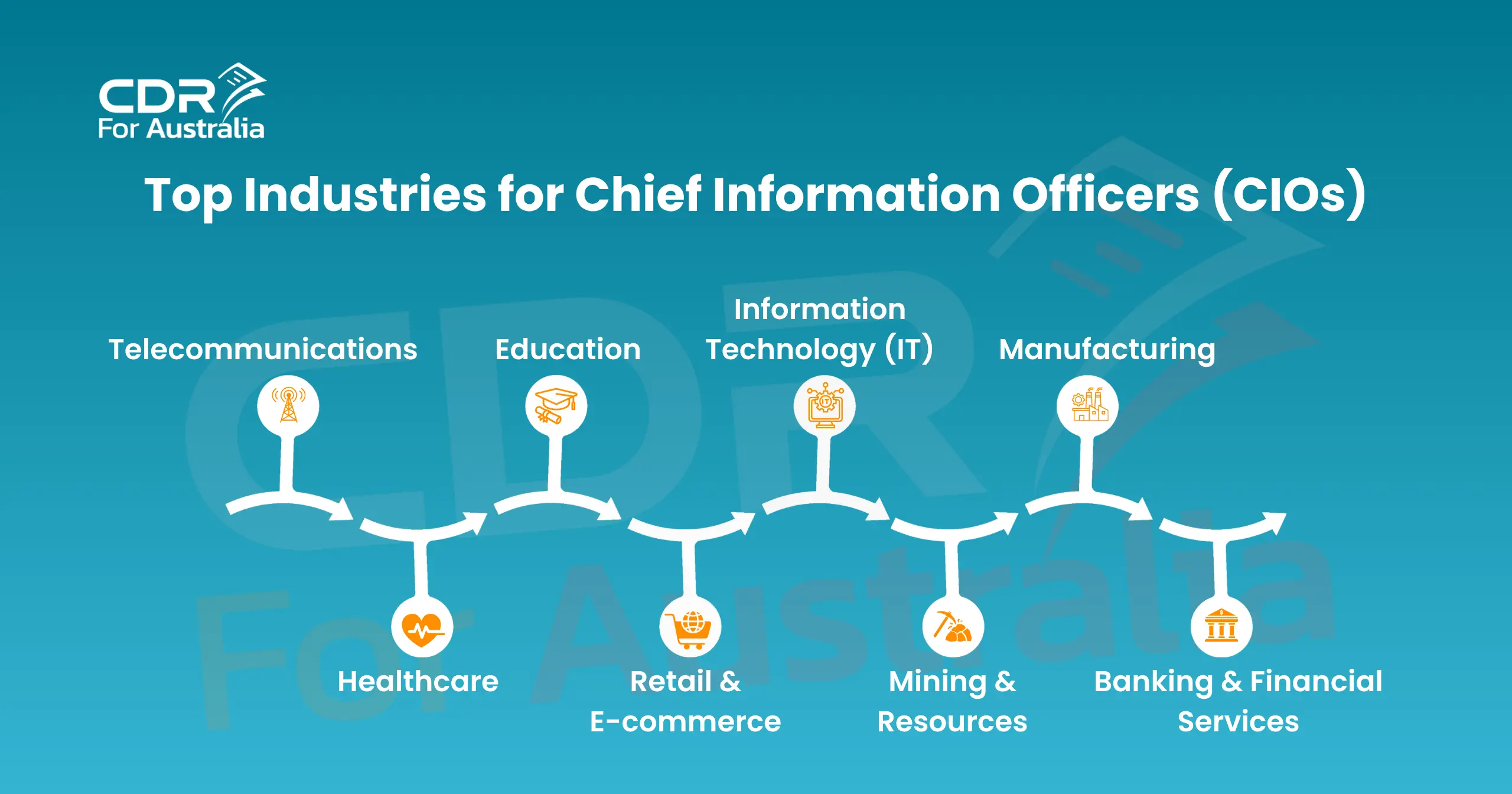
This job role shows up across nearly every major industry in Australia. According to Jobs and Skills Australia, the top employing industries for this occupation are professional, scientific and technical services, financial and insurance services, and public administration and safety, the last of which reflects how many CIOs work inside government departments. Federal and state agencies advertise these roles fairly often, a reflection of how much the public sector has invested in digital services. Beyond those top three industries, these roles are also common in:
- Banking and financial services, which rely on secure and reliable technology systems for daily transactions
- Healthcare organisations, which need safe management of patient data systems and digital health records
- Universities and TAFE institutions, which focuses on managing learning platforms and student information systems
- Large retail and e-commerce businesses, which depend on stable and scalable digital infrastructure
- Telecommunications companies, which requires to oversee large-scale network infrastructure, cloud services, and data management
- Mining and resources companies, which rely on advanced digital technologies, automation, and remote operations to improve productivity and safety
As more Australian businesses lean into automation, artificial intelligence, and cloud infrastructure, demand for experienced professionals shows no sign of slowing down.
Chief Information Officer ANZSCO Code and Skill Level
In Australia, this role sits under ANZSCO code 135111, within the ICT Managers unit group. The classification is maintained by Jobs and Skills Australia, the government body responsible for tracking occupation data and skill requirements nationally.
Under this classification, the role generally requires a skill level equivalent to a bachelor’s degree or higher. At least five years of relevant work experience can substitute for the formal qualification in some cases, which matters more than it might first appear.
Why does it matter? Because it opens the door for experienced ICT professionals without a matching degree to still qualify for skilled migration or employment as a CIO in Australia. The ANZSCO code also becomes central to any skilled migration application. Applicants have to show that their actual work experience lines up with the tasks listed under ANZSCO 135111, not just their job title. This is one reason many people applying under this code seek help with their ACS migration skills assessment, particularly when their degree isn’t a direct ICT match or their experience needs to be laid out clearly against ACS criteria.
Chief Information Officer vs Chief Technology Officer
These two roles get mixed up constantly, and it’s easy to see why. Both deal with technology at a senior level, but their focus rarely overlaps as much as the job titles suggest.
Aspect | Chief Information Officer | Chief Technology Officer |
Primary focus | Internal IT systems and operations | Product and technology innovation |
Main goal | Support business operations through technology | Build technology products and solutions |
Typical reporting line | Reports to CEO | Reports to CEO or CIO |
Key responsibility | IT strategy, security, and infrastructure | Research, development, and technical architecture |
Common industries | Banking, government, healthcare, retail | Software companies, tech startups, product firms |
Basically, a CIO looks inward, keeping the systems that run the business functioning day to day. A chief technology officer looks outward, focused on the technology that ends up in the products customers actually use. Some smaller companies fold both roles into one position, usually early stage businesses where hiring two executives isn’t realistic yet.
Chief Information Officer Salary in Australia
Pay depends heavily on company size, industry, and location, which makes a single number fairly meaningless. Official government wage data for this occupation is limited too, since detailed earnings figures often get suppressed for smaller, senior-level occupation categories. A CIO salary in Australia typically sits between AUD 145,000 and AUD 320,000 a year, depending on seniority, company size, and total compensation once bonuses and superannuation are included.
Larger corporations and government departments tend to pay more, given the scale of technology operations and risk. Executive bonuses, superannuation, and profit-sharing are all common on top of base salary in these senior roles. Professionals stepping up from a technical background often see a meaningful jump in pay once they reach the chief officer level, reflecting the added strategic and leadership weight the role carries.
Career Path to Become a Chief Information Officer
Getting to this position takes years, usually spent across several different ICT roles rather than a straight climb. Most people follow a fairly recognisable progression before reaching this level.
A typical path looks something like this:
- Entry level ICT roles, such as software developer, systems analyst, or network engineer
- IT management roles, such as IT manager or head of infrastructure, gaining experience with small teams and budgets
- Senior leadership roles, such as IT director or head of technology, overseeing larger systems and projects
- Executive appointment as a chief information officer, taking on full strategic and organisation wide responsibility
Technical expertise alone rarely gets someone through this progression. Project management and leadership ability matter just as much, and organisations tend to prefer candidates who have already led large scale technology projects across different business units. Certifications in project management, cybersecurity, or IT governance can help, and some professionals add postgraduate study along the way.

Looking for expert CDR Writer for Engineers Australia?

Creating a CDR Report may be difficult due to Engineers Australia’s standards and rules ( EA ). Our experienced engineers have assisted many people in obtaining approval for their report from the EA via the use of powerful projects.
Preparing Your Profile for a Chief Information Officer Role
Before stepping into a CIO position, it’s worth building a well documented professional profile rather than relying on job titles alone to make the case. Employers, boards, and assessing bodies are all looking for concrete evidence of leadership and measurable results, not a vague list of past responsibilities.
A few things help build that case over time:
- Keep detailed records of major projects, including budget size, team size, and business outcomes achieved
- Pursue recognised certifications such as PMP, ITIL, COBIT, TOGAF, or CISM to show structured knowledge in project management, governance, and security
- Maintain a career history that clearly shows progression from technical roles into leadership
- Track ongoing learning through a Continuing Professional Development (CPD) record, something many employers and assessing bodies now expect from senior ICT professionals
- Collect references and performance reviews that speak to leadership impact, not just technical tasks completed
Chief Information Officer Skills Assessment for Australia
ICT professionals from overseas who want to work as a CIO in Australia usually need to complete a skills assessment before applying for a skilled visa. This confirms that a person’s qualifications and work experience genuinely match the tasks listed under ANZSCO 135111, rather than just their job title suggesting a match.
For applicants whose degree doesn’t directly relate to ICT, the Australian Computer Society allows a Recognition of Prior Learning (RPL) report instead, built around skills gained through actual work experience. This report needs to describe technical projects and leadership responsibilities, not generic statements that could apply to almost any senior role.
- A Recognition of Prior Learning (RPL) report describing technical projects and leadership responsibilities
- Detailed career episode reports outlining specific technology projects and outcomes
- A properly formatted resume that follows ACS guidelines, presenting ICT employment history in a structured way
- Confirmation of the correct occupation match, by checking the full list of RPL ANZSCO codes against actual qualifications and daily work experience
Frequently Asked Question (FAQs)
Is CIO a high paying job?
Yes. A CIO role sits among the highest paying executive positions in technology. The exact number moves around based on company size and industry, but the compensation reflects the seniority and risk that comes with the job.
Is CIO a higher role than CTO?
Not automatically, no. A CIO usually runs internal IT operations, while a chief technology officer focuses on product and innovation. In some companies the CTO reports to the CIO; in others, both report straight to the CEO. It really depends on how the organisation is structured.
What does a chief information officer do?
They manage an organisation’s technology strategy, IT infrastructure, data security, and technology budgets, while also leading the IT team and working with other executives to keep technology decisions aligned with business goals.
How much does a CIO earn in Australia?
Typically somewhere between AUD 145,000 and AUD 320,000 a year, though this shifts quite a bit depending on company size, industry, and seniority.
What qualifications does a CIO need?
Most roles ask for a bachelor’s degree or higher in IT or a related field, though extensive ICT leadership experience can substitute for that in many cases, particularly for candidates further along in their careers.
What is the difference between a CIO and CTO?
A CIO focuses on internal technology systems and operations. A chief technology officer (CTO) focuses on building the technology products and services customers actually interact with.
Which ANZSCO code applies to a CIO?
ANZSCO code 135111, sitting within the ICT Managers occupation group in Australia.
Do Chief Information Officer (CIO) jobs exist in government departments?
Yes, quite commonly. Many federal and state government departments employ a CIO to manage digital services, IT infrastructure, and cybersecurity across public sector operations.
Is a CIO course useful for career growth?
It can be. A recognised course in IT governance, digital strategy, or executive leadership won’t guarantee a promotion on its own, but it strengthens a professional’s credentials and signals readiness for the role.