


Australian Qualifications Framework (AQF) Explained: All 10 Levels
Australia doesn’t run separate, disconnected systems for schools, TAFEs, and universities. The Australian Qualifications Framework (AQF) ties all three together under one national structure, which is exactly why so many people run into the term at some point while picking a course, comparing a degree earned overseas, or pulling together documents for a skills assessment. Ten levels make up the framework, starting at Certificate I and finishing at a Doctoral Degree.

Each level sits a step above the last, based on how deep the required knowledge goes, how complex the skills are, and how much independent judgement a graduate is expected to bring to their work. That structure matters more than it might first appear. An employer in Perth and one in Brisbane can look at the same Certificate III and know, without guessing, roughly what the holder can actually do.
A student can also plan several steps ahead, moving from a Certificate IV into a Diploma and later into a Bachelor Degree, without starting from zero each time. For people migrating to Australia, or studying here as international students, AQF levels carry extra weight, since assessing bodies rely on them to check whether an overseas qualification lines up with the local equivalent.
What Is the Australian Qualifications Framework (AQF)?
The AQF is the policy that governs regulated qualifications across Australian education and training. It dates back to 1995 and is managed by the Australian Government Department of Education, working alongside state and territory governments. Before it existed, qualification titles varied from state to state, and comparing courses or transferring credit between institutions could get messy fast.
It’s worth being clear about what the Australian Qualifications Framework doesn’t do: it doesn’t deliver courses, and it doesn’t hand out certificates itself. What it does is set the rules that education providers must follow when designing and accrediting a qualification. A Certificate III from a TAFE in Sydney and a Certificate III from a college in Perth represent the same standard of learning outcome, even though two entirely different organisations delivered the training. Every registered training organisation, TAFE institute, and university has to align its courses with these national criteria before it can legally issue a qualification.
Why Was the AQF Introduced?
The framework exists because of a fairly practical problem. Qualification titles differed across states and education sectors, which created genuine confusion for students, employers, and regulators trying to compare outcomes. A federal review of the Australian Qualifications Framework wrapped up in 2019, and its final report recommended a set of updates to keep the system in step with how workplaces and study patterns have changed since.
At its core, the AQF is about pathways. A student can move from a Certificate IV into a Diploma, then into a Bachelor Degree, without losing recognition for what they’ve already studied. Credit transfer and recognition of prior learning both sit inside this same idea: a person’s existing skills, work history, and study record can count toward something new, rather than forcing them to start over. That matters for adults returning to study after years away, and for anyone switching careers who already has relevant experience behind them.
There’s an international angle too. Because every qualification sits at a clearly defined level, employers and universities overseas, along with migration authorities, can understand what an Australian degree or certificate actually represents. That’s part of why the framework underpins the skills assessment process used for skilled migration assessing bodies that lean on the same level criteria to check overseas qualifications against the Australian standard. Accrediting authorities such as the Australian Skills Quality Authority (ASQA) and various state regulators apply these same criteria when approving new courses, so standards stay consistent even as new qualifications get added.
Why Does the AQF Matters If You're Migrating to Australia?
For anyone moving to Australia for work or study, an AQF level isn’t just an academic detail; it directly shapes visa eligibility, job applications, and how smoothly a migration case moves forward. The Australian Qualifications Framework is the shared reference point that every assessing body, university, and employer uses to interpret an overseas qualification, and a degree doesn’t automatically carry the same standing as an Australian one just because the course length looks similar on paper.
Job applications
Employers often check whether an overseas degree maps to a Bachelor Degree (AQF level 7) or higher before shortlisting for professional roles
Further study
Universities use the same benchmarking to decide how much credit an overseas qualification earns toward further study
Visa eligibility
Migration case officers rely on AQF-aligned skills assessment outcomes to confirm an applicant meets the qualification requirement for their nominated occupation
Application delays
A Bachelor equivalent Degree in one country might only match an AQF level 6 once properly assessed, changing which occupations and visas.
The 10 Levels of the AQF
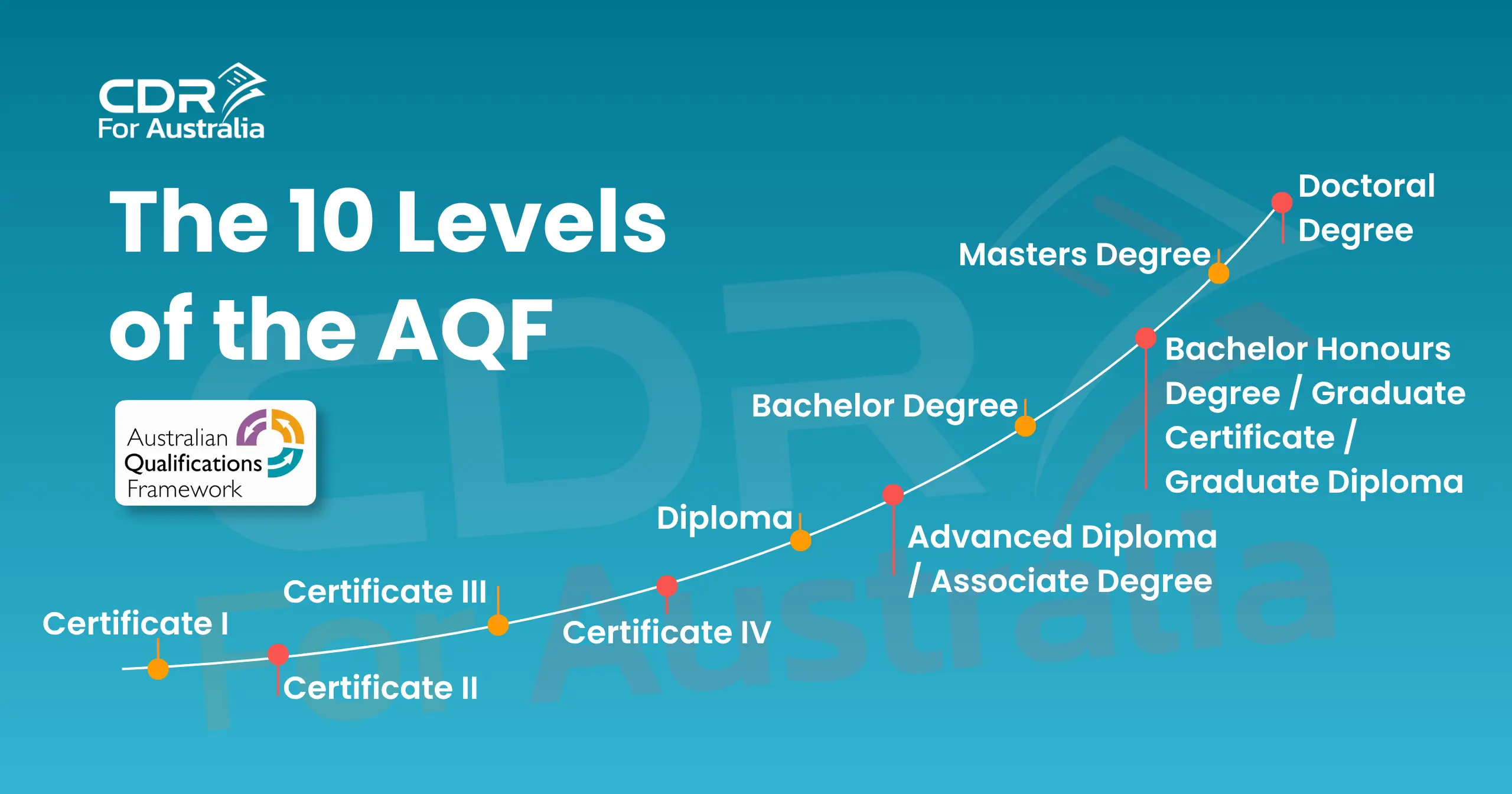
Ten levels make up the Australian Qualifications Framework, and each one sits above the last in terms of depth of knowledge, skill complexity, and the degree of independence a graduate is expected to show. Vocational education and training runs from levels 1 to 8. Higher education spans levels 5 to 10. There’s overlap at the diploma and advanced diploma stage, where either sector can deliver the same qualification type.
AQF Level | Qualification Type | What It Means |
1 | Certificate I | Basic skills for entry-level work and everyday tasks |
2 | Certificate II | Simple, defined skills for straightforward job roles |
3 | Certificate III | Practical skills for a recognised trade or skilled job |
4 | Certificate IV | Specialised skills for paraprofessional or supervisory work |
5 | Diploma | Technical know-how for advanced skilled or paraprofessional roles |
6 | Advanced Diploma / Associate Degree | Broader technical and theoretical knowledge for senior paraprofessional work |
7 | Bachelor Degree | Standard university qualification for professional careers |
8 | Bachelor Honours Degree / Graduate Certificate / Graduate Diploma | Extra specialised study on top of a bachelor degree |
9 | Masters Degree | Advanced, in-depth expertise in a specific field |
10 | Doctoral Degree | Highest qualification, based on original research |
Certificate I and II sit at the bottom of the scale and cover basic workplace and everyday skills. Most people finish these within a matter of months. Certificate III and IV step things up a notch, often serving as the entry point into a trade occupation or technical career, and generally take somewhere between six months and two years. From level 5 onward, the expectations shift toward more independent judgement and deeper theory, which is why diplomas, degrees, and postgraduate qualifications sit toward the top of the ten-level scale.
AQF Level 7 and AQF Level 8 Explained
AQF Level 7: Bachelor Degree
A Bachelor Degree is what sits at AQF level 7 in the Australian Qualifications Framework, the standard undergraduate qualification at Australian universities. Most take three to four years of full-time study and act as the usual minimum for postgraduate entry. Graduates are expected to apply broad theoretical knowledge with a solid level of independent judgement in familiar work settings, and a Bachelor Degree shows up as the baseline requirement for most professional occupations in Australia.
AQF Level 8: Honours, Graduate Certificate, and Graduate Diploma
Three separate qualification types share level 8: Bachelor Honours Degree, Graduate Certificate, and Graduate Diploma. Honours usually means one extra year on top of a standard bachelor’s degree, often built around a research project. Graduate Certificates and Graduate Diplomas work a little differently; they’re shorter postgraduate options that let someone build specialized knowledge in a particular field without signing up for a full Masters Degree straight away.
Plenty of professionals treat a Graduate Certificate as a stepping stone toward a Graduate Diploma or Masters later on, which keeps study manageable alongside a full-time job. Engineers and IT professionals often take this staged route rather than pausing their careers for two or more years of full-time postgraduate study. For IT professionals, an ACS assessment for skilled migration will often map this kind of postgraduate study against the relevant level as part of the outcome.
Vocational and Higher Education Qualifications
Two broad sectors sit inside the Australian Qualifications Framework: vocational education and training (VET) and higher education. Knowing which sector a qualification comes from, and which level it sits at, helps both job seekers and employers set realistic expectations about what training actually stands behind a certificate or degree.
Vocational Education and Training (VET)
TAFE institutes and registered training organisations deliver most VET qualifications, which sit at levels 1 to 8 and focus on practical, job-ready skills. Certificates, diplomas, and advanced diplomas fall under this umbrella, covering trades, technical roles, and paraprofessional work across nearly every industry in the country.
Higher Education Qualifications
TEQSA regulates higher education qualifications, which span levels 5 to 10 of the Australian Qualifications Framework. That range covers associate degrees, bachelor degrees, honours degrees, graduate certificates, graduate diplomas, masters degrees, and doctoral degrees.
A few qualification types, diplomas and advanced diplomas among them, can be delivered through either sector, which is part of why students can move between vocational and university study without losing credit for what they’ve already done.
Which AQF Level Do You Need for Your Profession?
Different professions map to different points on the Australian Qualifications Framework, and knowing the target level early makes it easier to plan a study or migration pathway.
Profession / Occupation | Typical AQF Level | Common Qualification |
Professional Engineer | Level 8–9 | Bachelor Honours Degree / Master of Engineering |
Engineering Technologist | Level 7 | Bachelor Degree (3-year) |
Engineering Associate | Level 6 | Advanced Diploma / Associate Degree |
IT Professional (Software Engineer, Analyst) | Level 7 | Bachelor Degree |
Registered Nurse | Level 7 | Bachelor Degree |
Accountant | Level 7–8 | Bachelor Degree / Graduate Diploma |
Teacher | Level 7–9 | Bachelor of Education / Master of Teaching |
Architect | Level 9 | Master of Architecture |
Electrician / Plumber / Carpenter | Level 3 | Certificate III |
Chef | Level 3 | Certificate III |
These are general benchmarks rather than fixed rules; the exact level required depends on the specific ANZSCO occupation code and which assessing authority reviews the qualification.

Looking for expert CDR Writer for Engineers Australia?

Creating a CDR Report may be difficult due to Engineers Australia’s standards and rules ( EA ). Our experienced engineers have assisted many people in obtaining approval for their report from the EA via the use of powerful projects.
How the AQF Applies to Skills Assessment and Migration
Engineers, IT professionals, and tradespeople applying for skilled migration all go through a similar check: assessing authorities compare an overseas qualification against its equivalent Australian Qualifications Framework level. That comparison decides whether a qualification meets the standard required for a particular occupation and visa pathway.
Even a degree that looks like a Bachelor Degree on paper still has to be checked against AQF level 7 criteria to confirm it matches the expected depth of knowledge, skill application, and independent judgement.
VETASSESS uses this kind of benchmarking across a wide range of occupations, covering both trades and professional roles, and ACS applies the same principle to IT qualifications. Processing time depends heavily on how quickly documents get verified against these standards, so checking the current VETASSESS processing time before applying is a sensible way to plan a migration timeline realistically.
Both professional and trade categories sit inside this benchmarking system. Professional roles generally need a qualification aligned with AQF level 7 or above; trade roles are usually benchmarked against Certificate III or Certificate IV outcomes. Knowing where a qualification sits on this scale before starting an application can save a lot of hassle, since mismatched or incomplete documentation is one of the more common causes of delay.
Frequently Asked Question (FAQs)
What is an AQF level 7 qualification?
It’s a Bachelor Degree. Employers commonly list it as the minimum requirement for professional roles, and it also serves as the standard entry point for postgraduate study such as a Graduate Diploma or Masters Degree.
What types of qualifications are in the AQF?
Ten qualification types sit across the ten levels, running from Certificate I at the entry point through to a Doctoral Degree at the top. A handful of qualifications, including the Senior Secondary Certificate of Education, sit outside the numbered levels altogether.
What is an AQF Level 4 qualification?
That’s Certificate IV, positioned between Certificate III and a Diploma. It suits people already working in a trade or technical role who want to move into a supervisory or paraprofessional position.
What is AQF level 8?
Three qualification types share this level: Bachelor Honours Degree, Graduate Certificate, and Graduate Diploma. All three build on an existing Bachelor Degree rather than starting study from scratch.
How do I get an AQF Certificate III?
Enrol through a TAFE institute or a registered training organisation, either as a standalone course or as part of an apprenticeship. Most Certificate III programs combine structured classroom learning with supervised, hands-on training in the workplace.
Is an AQF level 7 the same as a Bachelor Degree or equivalent?
Yes. When an overseas qualification is described as “AQF level 7 or equivalent,” it means an assessing body has reviewed the course and confirmed it matches the depth of knowledge and skill expected of an Australian Bachelor Degree.
What is a Certificate III that sits outside the AQF?
Occasionally, short or informal courses use the title “Certificate III” without being nationally accredited. Because these sit outside the regulated framework, they carry less weight with employers and generally aren’t accepted for skilled migration assessments.
How does the AQF compare to the UK system?
The two frameworks number their levels differently. A UK Bachelor’s Honours degree sits at RQF level 6, one level below where the equivalent Bachelor Degree sits under the AQF. The qualifications themselves are still treated as comparable once the course content has been checked.