


VETASSESS Processing Time 2026: Faster With Priority
If you’re waiting on a skills assessment, you already know how much the clock matters. VETASSESS processing time is often the first thing skilled migrants ask about, and for good reason a state nomination or visa invitation can hinge on how fast that outcome letter arrives. VETASSESS assesses hundreds of general and professional occupations, plus a number of trade occupations in partnership with Trades Recognition Australia, so a huge number of applicants are watching this timeline at any given moment.
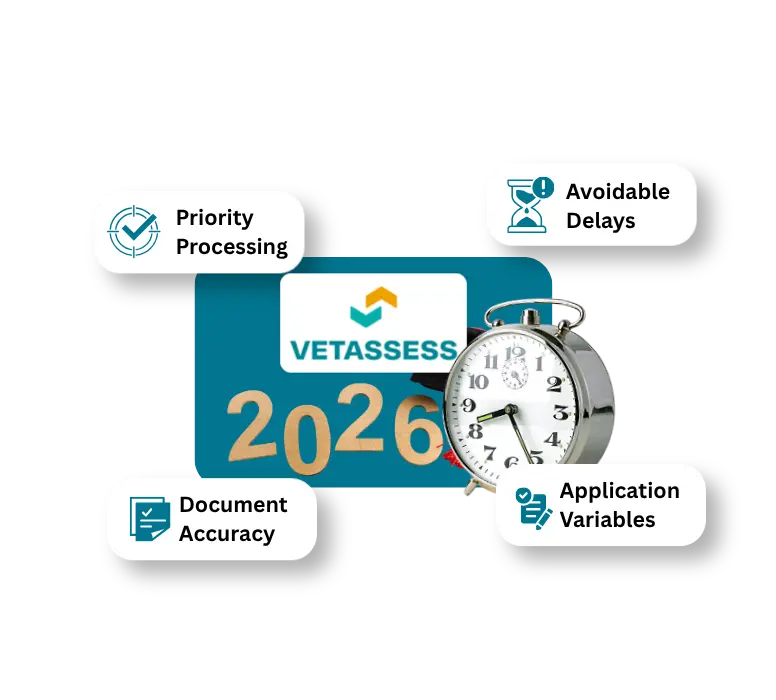
How long you VETASSESS Processing Time takes comes down to a few things: the type of application you’ve lodged, the occupation category you’re applying under, and probably the biggest factor is whether your documents are complete and clear the first time round. Applicants who send in accurate, well-organised paperwork tend to move through fairly smoothly. Those who leave out evidence or upload blurry scans usually end up waiting longer than they’d like. There’s also a Priority Processing option for anyone who needs a quicker answer, though it comes at an extra cost.
Standard VETASSESS Processing Time for Professional and General Occupations
VETASSESS revised its service standards back in December 2025, and professional and general occupations now sit at a 7-week target. That’s a target rather than a promise: complicated cases or missing paperwork can still push things out further. Still, it’s a real improvement: before the update, standard assessments were commonly taking anywhere from 8 to 15 weeks, which is a big jump for people working in engineering, IT, accounting, management, and similar fields.
Trades are handled differently, since those go through Trades Recognition Australia programs rather than the standard pathway. Timeframes there depend on the specific program and what evidence is required, so it’s worth checking the relevant TRA guidelines directly for your occupation rather than relying on a single number.
Here’s a quick snapshot of current timeframes across VETASSESS’s main services:
Service Type | Approximate Processing Time |
Professional and General Occupations | 7 weeks |
Trade Occupations | Varies by program |
Priority Processing | 10 business days |
Post-Vocational Education Work (Subclass 485) | 1 to 2 weeks |
DAMA and ILA Applications | 2 to 3 weeks |
Renewal of Skills Assessment | 2 to 5 weeks |
Outcome Review | 7 weeks |
Reassessment | 7 weeks |
Appeal | 12 weeks |
Treat this table as a rough guide rather than a guarantee. Every case is assessed on its own facts, and anything involving multiple qualifications or a long overseas employment history can easily run past the standard window.
VETASSESS Processing Fee for Standard and Trade Assessments
Fees and processing time aren’t the same conversation, but they’re closely tied together. A lot of applicants decide between standard and priority processing based on what they can afford. What you’ll pay depends on your occupation category, the service you’re requesting, and whether GST applies to you as an Australian tax resident.
Application Type | Approximate Fee (AUD, excluding GST) |
Professional and General Occupations (Full Skills Assessment) | 1,096 |
Trade Occupations, Pathway 2 (Documentary Evidence + Technical Interview) | 2,020 |
Trade Occupations, Pathway 1 (Documentary Evidence + Technical + Practical) | 5,320 |
Priority Processing (additional to standard fee) | 825 |
Skills Assessment Support (30-minute consultation) | 282 |
Renewal of Skills Assessment (within 3 years) | 473 |
Reassessment for a different occupation (within 12 months) | 745 |
Appeal of a Not Suitable outcome | 1,082 |
These amounts exclude GST and apply to applicants who aren’t Australian tax residents if you’re based in Australia, expect GST-inclusive pricing, which will be a bit higher. All figures are approximate, so double-check the official VETASSESS fees page before you lodge anything. Getting your occupation and service type right the first time also saves you from paying for a reassessment down the track, which costs both money and time you probably don’t want to lose.
VETASSESS Priority Processing Time and Fee
If your visa deadline is tight, Priority Processing can cut down the VETASSESS processing time considerably. Once VETASSESS confirms your application is eligible, you’ll get an outcome within 10 business days though the eligibility check itself usually takes around two business days, so build that into your planning.
This option is only open to professional and general occupations; trades aren’t eligible. You’ll need to pay both the standard fee and the priority fee upfront at lodgment, and because the turnaround is so short, you can’t add documents later your submission needs to be complete from the start.
- You can’t switch occupations once Priority Processing has kicked off.
- If your application turns out not to meet the eligibility criteria, VETASSESS refunds the priority fee minus a AUD 171 admin charge.
- Applications that need in-house assessment of unusual qualifications might not qualify for the 10-day turnaround.
- If you’ve already had a negative outcome for the same occupation, you generally can’t use priority processing on a fresh submission for it.
There’s also an urgent, no-cost option for applicants who already hold a visa invitation or state nomination with a short deadline and whose previous assessment has expired. This is separate from paid Priority Processing you’ll need to email evidence of your invitation to request it.
Factors That Affect VETASSESS Processing Time
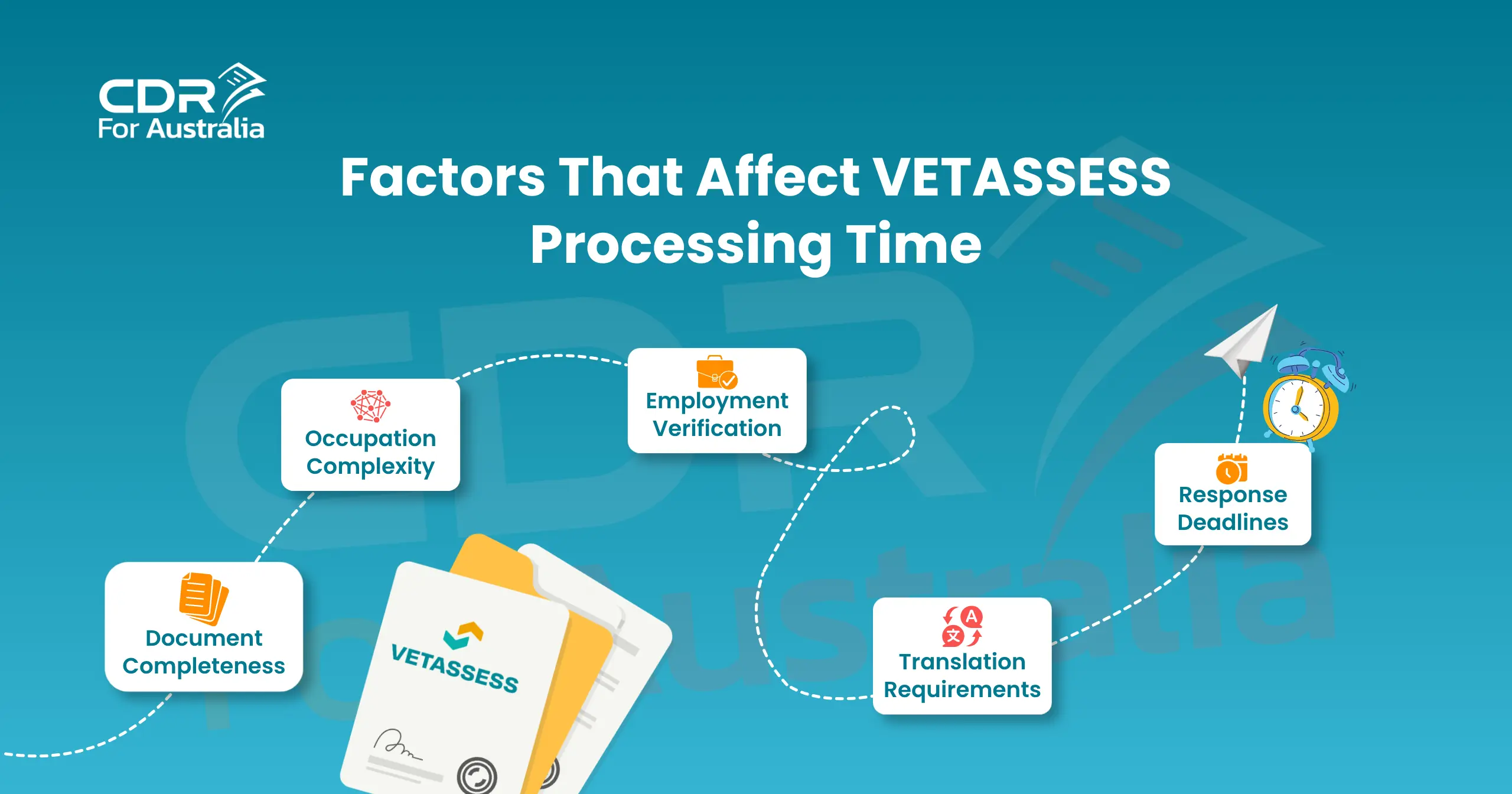
Even within the standard 7-week window, a handful of things can slow an assessment down. Knowing what they are makes it easier to avoid them.
- Document completeness: VETASSESS wants clear, legible, colour-scanned copies of everything missing payslips, thin reference letters, or hard-to-read ID documents will almost always trigger a request for more information, and that pauses the clock.
- Occupation complexity: Some occupations need extra research into overseas qualifications or unusual job titles, which naturally takes longer.
- Employment verification: It can add delays if your employer is slow to respond. VETASSESS typically tries to confirm employment claims within 10 business days, so an unresponsive employer can hold up the whole process.
- Translation requirements: are another sticking point. Anything not in English needs a certified translation from a registered service translations that don’t meet this bar will send your case back for review.
- Response deadlines: Applicants now have 28 days to respond to a request for more evidence, down from the previous 60-day window. Miss that window and your case risks being closed without a decision.
VETASSESS Skills Assessment Support
Not sure whether your documents will pass muster? You can book a Skills Assessment Support session before you lodge a paid, 30-minute phone consultation, currently priced from around AUD 282, where a VETASSESS officer walks you through the criteria for your occupation and answers your questions.
This won’t speed up the official processing time once you’ve actually lodged. What it does do is lower the odds of getting a mid-assessment document request, which is one of the main reasons cases blow past the 7-week mark. It’s especially useful if you’ve got a complicated case with multiple qualifications, employment spread across several countries before you commit to Priority Processing, since a rejected priority application still costs you an admin fee.
VETASSESS Document Checklist to Avoid Delays
VETASSESS document verification is the single best way to keep your case moving and reduce the VETASSESS processing time. You’ll generally need:
- At least one primary and two secondary identity documents
- Certified academic qualifications and transcripts
- A detailed resume covering your education and employment history
- Employment reference letters confirming duties, dates, and hours worked
- Payslips or other proof of paid employment
- Certified English translations for anything not already in English
- Supporting evidence such as contracts, promotion letters, or industry certifications, where relevant
From January 2026, applicants going through the trades pathway also need a completed Language, Literacy, Numeracy, and Digital Skills form. Leaving out any of these is one of the most common reasons applications end up taking longer than expected.
How to Check Your VETASSESS Skills Assessment Status
You can track your application through the VETASSESS online applicant portal once it’s lodged. It’ll show you what stage your assessment is at and flag any outstanding document requests. Checking in regularly means you can respond fast if VETASSESS asks for more evidence, which helps protect your timeline from stretching out any further.
If your case has been sitting open well past the standard timeframe, it’s completely reasonable to reach out to VETASSESS support directly for an update, either by phone or email. If you want more background on how skills assessments fit into the bigger visa picture, the Department of Home Affairs skills assessment page is a good place to start.
VETASSESS Skill Assessment Renewal Processing Time
Skills assessments don’t last indefinitely, so at some point you’ll likely need to renew. Renewal currently takes between 2 and 5 weeks once VETASSESS has everything it needs. If your employment history has gotten more complicated since your last assessment, expect it to sit closer to the longer end.
It pays to start the renewal process early rather than waiting until your assessment is nearly expired. State and territory nomination windows can be short, and applying for renewal ahead of time alongside a state nomination application, if that applies to you, reduces the risk of missing an opportunity simply because the renewal hasn’t come through yet. Priority Processing is available for renewals too, and it can shave a fair bit off the wait.
VETASSESS Processing Time Compared to Other Assessing Authorities
VETASSESS is just one of several bodies handling skilled migration assessments in Australia, and each one runs on its own clock. ICT occupations go through the Australian Computer Society, where standard processing generally runs 4 to 6 weeks for straightforward cases, though busy periods or incomplete documents can stretch that out. Engineering occupations sit with Engineers Australia, where applications can wait around 15 weeks just to be assigned an assessor and the Competency Demonstration Report pathway overall is often quoted at 10 to 16 weeks.
Against that backdrop, VETASSESS’s current 7-week standard for professional and general occupations lands somewhere in the middle. Whatever your occupation, it’s worth double-checking which authority actually applies before you lodge sending your application to the wrong body wastes both time and money.
After VETASSESS Processing Time Ends
Once your assessment wraps up, you’ll get an outcome letter confirming whether your occupation and qualifications were assessed as suitable. Since late 2025, VETASSESS has used the term “Suitable” in place of the older “Positive.”
A suitable outcome means you can move ahead with your visa application or state nomination, using the assessment as evidence of your qualifications and experience. If it comes back not suitable, you’ve got options a Review, a Reassessment under a different occupation, or a formal Appeal. Reviews and reassessments generally run around 7 weeks, while an appeal can take up to 12.
If you’re putting together career episodes, summary statements, or reference letters for your application, it’s often worth getting professional support to make sure everything is accurate and structured properly before you lodge these matters for both professional and trade occupations, since the documentation requirements differ. Picking the right occupation code from the outset, based on the ANZSCO classification, also cuts down the chance of delays later on.

Looking for expert CDR Writer for Engineers Australia?

Creating a CDR Report may be difficult due to Engineers Australia’s standards and rules ( EA ). Our experienced engineers have assisted many people in obtaining approval for their report from the EA via the use of powerful projects.
Getting VETASSESS Documentation Right Before Lodgment
Once your assessment wraps up, you’ll get an outcome letter confirming whether your occupation and qualifications were assessed as suitable. Since late 2025, VETASSESS has used the term “Suitable” in place of the older “Positive.”
A suitable outcome means you can move ahead with your visa application or state nomination, using the assessment as evidence of your qualifications and experience. If it comes back not suitable, you’ve got options a Review, a Reassessment under a different occupation, or a formal Appeal. Reviews and reassessments generally run around 7 weeks, while an appeal can take up to 12.
If you’re putting together career episodes, summary statements, or reference letters for your application, it’s often worth getting professional support to make sure everything is accurate and structured properly before you lodge these matters for both professional and trade occupations, since the documentation requirements differ. Picking the right occupation code from the outset, based on the ANZSCO classification, also cuts down the chance of delays later on.
VETASSESS Processing Time and Your Visa
A lot of applicants only start thinking seriously about processing time once they’re already holding an invitation with a lodgment deadline attached and by then, the options narrow fast. State and territory nomination programs often give you as little as 14 to 60 days to lodge a complete visa application after inviting you. If your skills assessment is still being processed, or has already expired, you could miss that window entirely.
The safer move is to lodge your skills assessment well ahead of submitting an Expression of Interest, or to renew early if your existing one is close to expiring. If you already hold an invitation and your assessment has lapsed, you may qualify for urgent processing at no extra cost; you’ll just need to show evidence of the invitation and its deadline.
Keeping Pace With VETASSESS's Changing Timelines
VETASSESS processing time has changed a fair bit lately with new processing targets, tighter response deadlines, updated fees, even different wording on outcome letters. So if you’re prepping a submission, you want to be working off what’s true today, not what was true a year ago. There’s a running breakdown of current VETASSESS fees and changes that’s kept up to date, which makes budgeting and planning a lot less guesswork-heavy. If you’re trying to time a lodgment around a state nomination or visa deadline, knowing what’s actually in effect right now matters just as much as getting the paperwork itself right.
Frequently Asked Question (FAQs)
How long does it take for VETASSESS results?
Standard processing for general and professional occupations currently sits at 7 weeks from a complete lodgment, though it can run longer if documents are missing or the occupation needs extra research.
How to get VETASSESS priority processing?
You can select Priority Processing and pay the fee at the time of lodgment, or request an upgrade within four weeks of lodging a standard application. Eligibility is typically confirmed within about two business days.
How long is a VETASSESS skill assessment valid for?
It’s valid for a set period after the outcome date, check your outcome letter for the exact expiry, and aim to renew before it lapses so you don’t create a gap in your eligibility.
What is the VETASSESS priority processing fee?
Currently an additional AUD 825, excluding GST, on top of the standard fee. If your application turns out ineligible, VETASSESS refunds the priority fee minus a AUD 171 admin charge.
What is the VETASSESS processing fee for a standard application?
It depends on the occupation type. A standard Full Skills Assessment for professional or general occupations runs around AUD 1,096, excluding GST, while trade assessments are charged in stages and can range from about AUD 2,020 up to over AUD 5,300, depending on the pathway.
What is the VETASSESS skill assessment renewal fee?
Lower than a full assessment. A renewal lodged within 3 years of the original outcome currently costs around AUD 473, excluding GST, while anything outside that window is charged at the full assessment rate.
How can I check my VETASSESS skills assessment status?
Log into the VETASSESS online portal to see your current stage and respond to any outstanding document requests.
How do I submit a VETASSESS application?
Nominate the correct occupation, confirm you’re eligible, gather all required documents, and lodge everything through the VETASSESS online portal along with the applicable fee.