


Top Services Provided By CDR For Australia
Most engineers who start looking into migration realise pretty quickly that the paperwork is nothing like a normal job application. There are competency standards to meet, specific formats to follow, and a real risk of rejection if any part of the report is unclear or copied. That’s usually the point where people start searching for the top services provided by CDR for Australia, especially if their qualification doesn’t fall under the Washington, Sydney, or Dublin Accords. A few try writing the whole Competency Demonstration Report themselves first.

Many end up with a summary statement that doesn’t quite map to their career episodes, or a report flagged for plagiarism after months of work. That’s the gap these services fill. Between CDR writing, VETASSESS and ACS assessments, resume and SOP support, and help with Engineers Australia registration further down the line, there’s a fairly wide net of services under one roof.
This piece goes through each of the services, what it actually covers, and who tends to need it, without wandering into generic migration advice that doesn’t apply to engineers specifically. It also looks at how the top services provided by CDR for Australia connect to each other, since most applicants end up needing more than one at some point in the process.
What CDR for Australia Actually Involves?
A Competency Demonstration Report, or CDR, is the set of documents Engineers Australia asks for when an applicant’s qualification isn’t covered by an accord agreement. It’s not one file. A full CDR is made up of a resume, three career episodes, a summary statement, and a CPD list, and each piece has to hold up on its own while also fitting together.
The reason so many people look for professional help here isn’t laziness, it’s that the criteria are genuinely specific, and Engineers Australia doesn’t give much room for vague wording. This is where the top services provided by CDR for Australia tend to come in. Applicants often only realise how tight the mapping needs to be after their first draft comes back with questions, which is frustrating when a few extra months on a visa timeline is the cost.
There’s also a language barrier at play for a lot of applicants. English might be a working language on the job site, but writing a technical narrative that satisfies an assessor is a different skill entirely. That’s part of why the top services provided by CDR for Australia exist in the first place not to replace an engineer’s actual experience, but to help present it in the format Engineers Australia expects to see.
Top Services for the Core Assessment
Three documents sit at the heart of every CDR, and Engineers Australia treats each one as a separate check. Get one wrong and the whole report can get flagged, even if the other two are solid. That’s why each one is worth looking at on its own rather than as a single combined task.
Career Episode Report Writing
Career episodes are written in the first person and describe real engineering work an applicant has done, tied back to specific competency elements. Most reports include three of these, each covering a different project or phase of a career. The career episode writing service helps applicants build these around their actual projects rather than generic descriptions, keeping the technical detail accurate to what they actually did on the job.
Summary Statement Writing
This is the document that links each paragraph of the career episodes to a competency element, and it’s also the one that trips people up the most. If a claim in the summary statement can’t be traced back to a specific paragraph, it usually gets rejected. The summary statement writing service focuses on making sure that mapping actually holds up under review, not just looking correct on the surface.
CPD, the Part People Forget
A CPD list covers the courses, workshops, or self-study an applicant has done to stay current in their field. It sounds minor next to the career episodes, but Engineers Australia does check it, and a thin or vague CPD section can raise questions about how engaged someone has stayed with their profession. Getting this section right is a smaller task, but it’s still one of the top services provided by CDR for Australia that people underestimate a thin CPD list is a small thing to overlook and an easy thing to fix.
VETASSESS and ACS: Not Everyone Goes Through EA
Here’s something a lot of applicants don’t know until they’re already partway through research: not every occupation is assessed by Engineers Australia. Trade and technical roles usually go through VETASSESS. IT professionals go through the Australian Computer Society instead.
VETASSESS Skills Evaluation
For professionals in non-engineering, trade-related occupations. The VETASSESS skill assessment service covers what documentation is needed and how eligibility actually works for these categories.
ACS Migration Assessment
ICT applicants generally need an RPL report rather than a CDR. The ACS assessment service handles that, along with project reports and employment evidence specific to IT occupations.
Both routes still come back to the same starting point: matching an occupation to the correct ANZSCO code, since that’s what decides the pathway and the documents required. It’s easy to assume every applicant needs a CDR simply because it’s the most talked-about pathway, but VETASSESS and ACS support are just as much part of the top services provided by CDR for Australia for the applicants who actually fall under those categories.
Stage 1, Stage 2, and What Comes After Migration
Once someone is actually in Australia, or planning ahead for it, the CDR conversation often shifts toward professional registration. Stage 1 is the entry-level competency check most engineers already meet through their CDR or an accredited degree. Stage 2 is a different beast; it’s what leads to Chartered Professional Engineer status, and it usually requires around five years of relevant experience on top of Stage 1.
Support at this stage looks a bit different from CDR writing. It’s less about career episodes and more about Engineering Competency Claims that demonstrate independent, advanced practice. Still, both Stage 1 and Stage 2 assistance sit comfortably among the top services provided by CDR for Australia, because migration is rarely the last step for engineers who plan to build a long career in the country.
Membership and the National Engineering Register
Membership with Engineers Australia and registration on the National Engineering Register (NER) are two things people often ask about once their skills assessment is done and dusted.
Membership support helps line up an applicant’s experience with the right category. NER registration is a bit more specific; it’s assessed using the same Stage 2 competency standards that lead to Chartered status, so it’s closely tied to that pathway rather than being a completely separate process. Some regulated industries expect NER registration specifically, which is worth knowing before assuming Chartered status alone covers everything.
Engineers Australia is, according to its own site, the body authorised to assess engineering qualifications for migration purposes under the Department of Home Affairs framework worth checking the official Engineers Australia page directly if there’s any doubt about current requirements.
Resume, SOP, and Recommendation Letters
CDR documents get most of the attention, but the supporting paperwork matters more than people expect.
Service | What it’s for |
Professional Resume Writing | An Australian-format, ATS-friendly resume built around skills and work history |
SOP Writing Service | A Statement of Purpose for migration, study, or additional visa categories |
Recommendation Letter (LOR) | A reference letter backing up an applicant’s academic or professional achievements |
Career Statements for USA | Personal statements for applications outside Australia |
A resume that follows the format Australian employers and Engineers Australia expect can make a real difference, and it’s not the same format used elsewhere. An SOP needs to sound like the applicant actually wrote it generic templates tend to stand out for the wrong reasons. Recommendation letters, when done well, back up the claims made elsewhere in an application rather than just repeating them in different words.
These supporting documents rarely get the same attention as the CDR itself, but assessors and employers do read them. A resume with inconsistent dates, or an SOP that reads like it was copied from a template, can undercut an otherwise strong application. That’s why supporting document writing sits alongside the core CDR work among the top services provided by CDR for Australia, rather than being treated as an afterthought.
Getting a Report Reviewed Before It's Too Late
A CDR can be well-written and still get knocked back for originality issues. Engineers Australia checks for plagiarism, including cases where someone has unknowingly echoed a published sample too closely.
- Professional Report Review – a full check of an existing CDR, RPL, or assessment report before it goes anywhere near submission.
- CDR Plagiarism and AI Check – catches copied text or content patterns that might get flagged during an originality check.
People with a draft already sitting on their laptop tend to reach for this rather than starting over, mostly because redoing a rejected application from scratch can add several more months to an already long process. Review and originality checking rarely get mentioned first when people list the top services provided by CDR for Australia, but they’re often what saves an application that’s already been through one rejection.
A Quick Overview of the Top Services
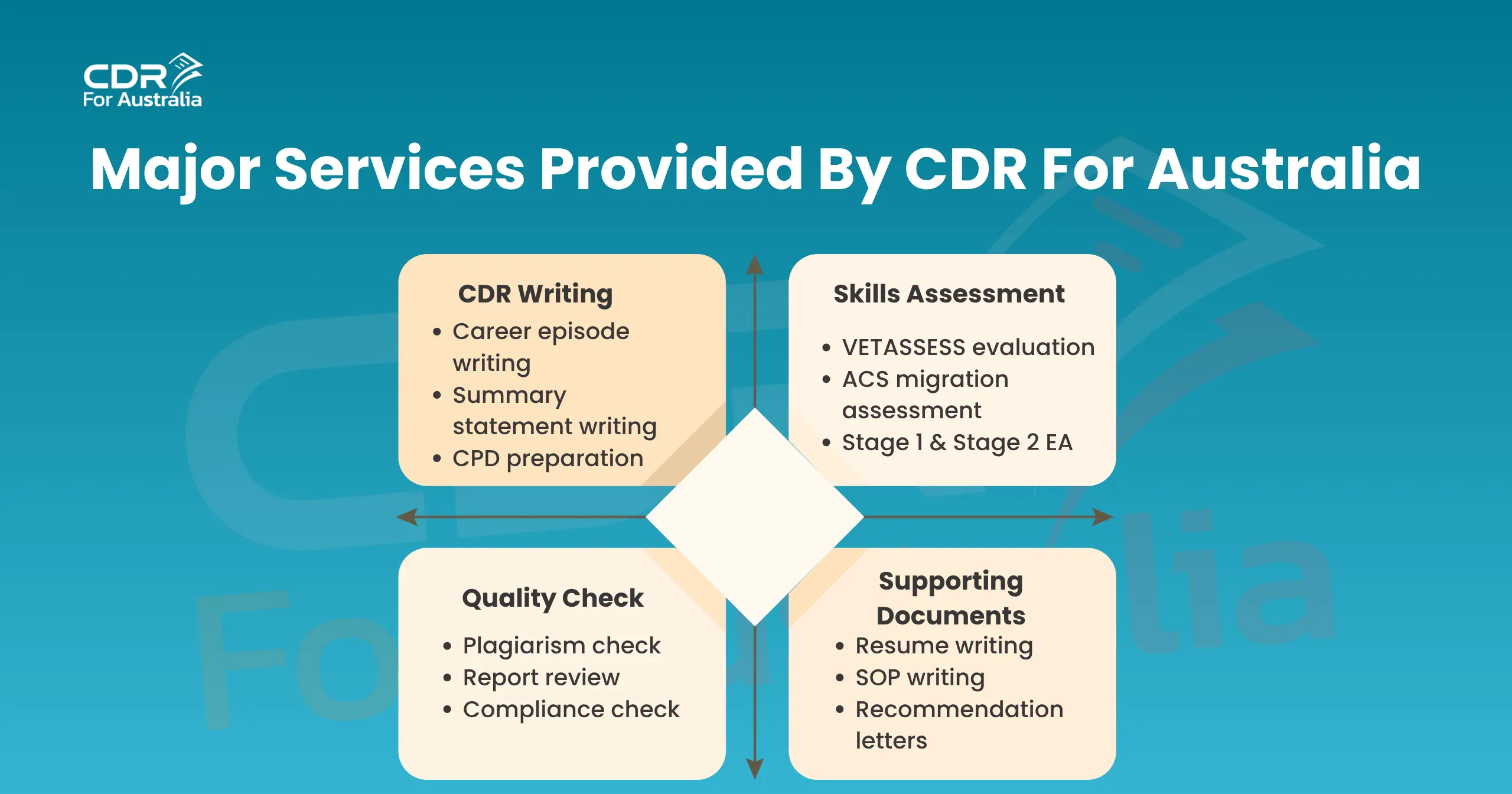
Category | Covers |
CDR Writing | Career episodes, summary statement, CPD list |
VETASSESS Support | Trade and non-engineering occupation documentation |
ACS Assessment | RPL reports for ICT professionals |
Stage 1 & Stage 2 | Competency assessment, Chartered pathway |
Membership & NER | EA membership, national register recognition |
Resume & SOP | ATS-friendly resumes, SOPs, LORs |
Review & Plagiarism Check | Accuracy, originality, compliance |

Looking for expert CDR Writer for Engineers Australia?

Creating a CDR Report may be difficult due to Engineers Australia’s standards and rules ( EA ). Our experienced engineers have assisted many people in obtaining approval for their report from the EA via the use of powerful projects.
Who Actually Needs These Services?
If a qualification doesn’t fall under the Washington, Sydney, or Dublin Accords, the CDR pathway usually applies; this covers a lot of engineers applying for Subclass 189, 190, or 491 visas, along with anyone chasing Engineers Australia membership without an accredited degree. IT professionals sit under ACS instead, and several trades go through VETASSESS rather than either of those.
Not sure which one applies? Checking the occupation against the current ANZSCO code list first saves a lot of wasted time, since the code determines both the pathway and which service actually matters.
It’s also worth mentioning that these categories aren’t always obvious from the outside. Two engineers with almost identical job titles can end up on different pathways depending on how their qualification was structured back home, which is exactly the kind of detail that gets missed without checking properly before committing to a service.
Matching the Service to Where You Actually Are
Nobody needs all of these at once. Starting from zero usually means full CDR, RPL, or VETASSESS writing support. Already have a draft and just unsure if it’s good enough? A review probably makes more sense than a full rewrite. Worried specifically about originality? That’s a plagiarism check, not a rewrite. Already migrated and thinking about Chartered status or NER down the track? That’s a different conversation entirely from the initial CDR.
A rough way to think about it:
- No draft yet: full CDR, RPL, or VETASSESS support
- Have a draft, unsure of quality: report review
- Worried about originality: plagiarism and AI check
- Already migrated, chasing further recognition: Stage 1, Stage 2, membership, or NER
- Need the extras: resume, SOP, or recommendation letter writing
Matching the actual stage of an application to the right service usually means not paying for work that isn’t needed yet.
Frequently Asked Question (FAQs)
Do I need CDR writing help or VETASSESS/ACS help?
It depends on the occupation. Engineering roles generally go through the CDR pathway, IT professionals go through ACS, and several trade or technical occupations go through VETASSESS instead. Checking the correct ANZSCO code first is the easiest way to confirm which applies.
What is CDR in Australia?
CDR stands for Competency Demonstration Report. Engineers Australia uses it to assess engineers whose degrees don’t fall under the Washington, Sydney, or Dublin Accords. It’s made up of a resume, three career episodes, a summary statement, and a CPD list.
Does CDR for Australia check for plagiarism and AI-generated content?
Yes. Reports go through a plagiarism and AI content check to catch copied text or flagged patterns before submission, since Engineers Australia checks originality as part of its assessment.
Is CDR mandatory in Australia?
Only for engineers whose qualifications aren’t recognised through an accredited pathway. Anyone with an accredited Australian qualification, or a degree covered by one of the accord agreements, may not need to submit one at all.
Can I get my existing CDR reviewed instead of rewriting it from scratch?
Yes. A report review checks an existing CDR, RPL, or assessment report for accuracy and compliance before submission, which is usually faster and cheaper than starting over.
What are the CDR rules in Australia?
Every CDR has to be original, written in first person, and clearly linked to specific competency elements. Career episodes need to describe real work, the summary statement has to reference those episodes accurately, and everything needs to follow the current Migration Skills Assessment guidelines.
What services does CDR for Australia provide besides CDR writing?
Beyond CDR writing, the site covers VETASSESS and ACS skills assessment support, Stage 1 and Stage 2 Engineers Australia registration, resume and SOP writing, recommendation letters, and CDR review and plagiarism checking.