


RPL Pathway: Recognition of Prior Learning in Australia
RPL Pathway is a process that can allow people to gain formal recognition for relevant skills and knowledge they have developed through their work, training, or informal learning, or from their hands-on activities. Applicants may also be able to demonstrate their skills through an assessment process, rather than repeating training for skills that they already possess.
Recognition of Prior Learning (RPL) is a well-known method of assessment employed by registered training organisations (RTOs) in Australia to determine if a learner’s current skills and knowledge are equivalent to those of a nationally recognised qualification or unit of competency.
The RPL Pathway can be a pathway for experienced professionals, tradespeople and other skilled workers to be assessed for a training program without having to undertake the entire training. Eligibility is, however, dependent upon the qualification, the assessment requirements, evidence provided by the applicant, and assessment organisation policies.
submit adequate evidence and may also be asked to submit further evidence, practical demonstration, an interview or gap training by the assessor.
What Is the RPL Pathway?
The RPL Pathway is a process of evaluating and recognising skills and knowledge gained through a training programme that does not follow a typical structured training pathway.
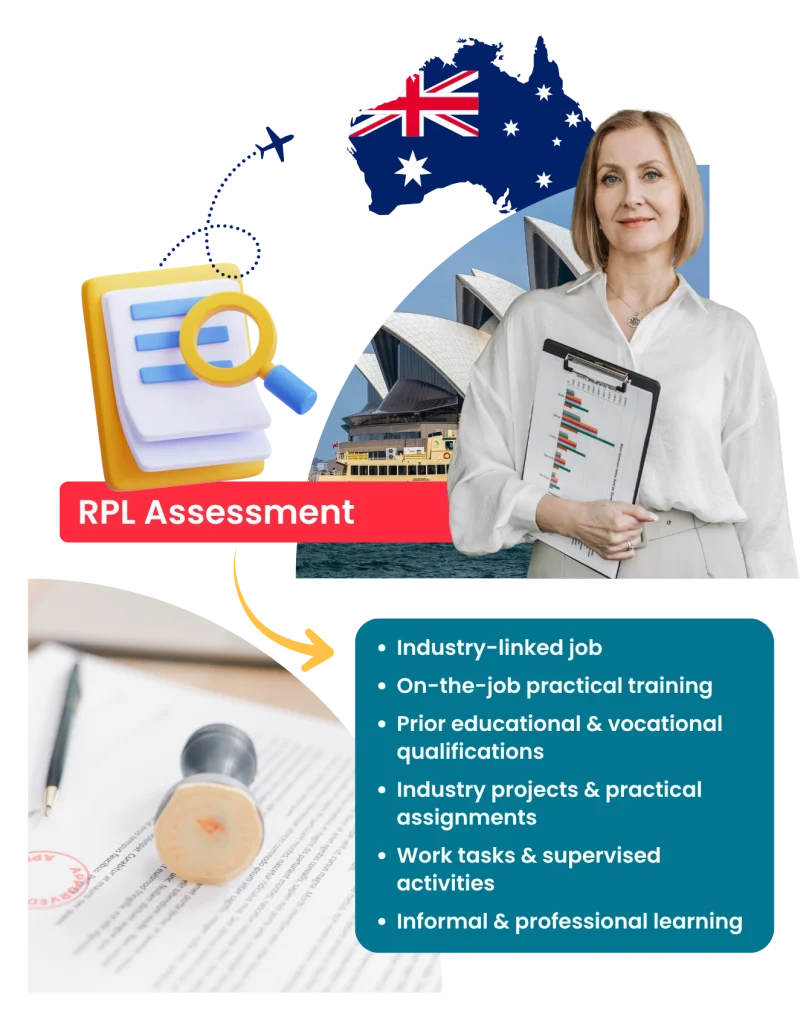
Your competencies can be acquired from:
- A job that is linked to the industry.
- On-the-job training/practical work.
- Educational and vocational qualifications gained in the past.
- Practical assignments and projects in the industry.
- Work tasks and supervised activities at work.
- Informal learning and professional learning.
An RPL assessment will not solely depend on attendance or courses completed recently, but rather look at whether your current skills meet the criteria of the RPL unit or qualification you are applying for.
For instance, a person who has worked in construction over the years might have learned much through hands-on experience. Relevant workplace evidence can contribute to proving a person’s predispositions in the workplace based on the qualification and assessment requirements.
Note: Years of experience are not a guarantee for RPL. Applicants will be required to
How Does the RPL Pathway Work in Australia?
The RPL process will differ depending on the training provider, industry and the qualification. However, the majority of applicants will go through similar stages.
Step 1: Identify the Appropriate Qualification
Work out which qualification and/or units of competency are most appropriate to your skills, work experience and career goals.
Take into account your existing duties, past qualifications, and relevant industry experience, as well as skills you can demonstrate.
The relevant training package or accredited course requirements should be matched by a suitable qualification.
Step 2: Check Your Eligibility
Discuss RPL with an appropriate registered training organisation and its requirements for RPL assessment.
The provider might want to ask about your work experience, training, skills, and what type of proof is available.
Each qualification will have its own eligibility and evidence requirements. Please verify with the provider prior to filling in your application.
Step 3: Collect Supporting Evidence
Evidence is an integral part of the RPL Pathway. Documents may need to be provided to show the acquisition and application of skills.
Useful evidence may be any or all of the following, depending on the qualification:
- Statement of service and employment references.
- Detailed descriptions of workplace responsibilities.
- Academic records and certificates that are relevant.
- Examples of work produced.
- Project documentation and reports.
- Practical work recorded by photograph or recording (where appropriate).
- Statements from the supervisor or workplace verification.
- Evidence of professional learning and professional learning activities.
- Other documents that the assessor has requested.
Provide authentic or authentic-like evidence that is relevant and reflects the experience. Sensitive information in the workplace needs to be shared only with the appropriate authorisation and, where required, information should be redacted.
Step 4: Complete the Assessment
The assessor will check your evidence against the competency requirements.
Assessment could be in the form of a portfolio review, interview, practical demonstrations, workplace observation or another activity.
If material submitted does not sufficiently demonstrate competencies, the assessor can seek clarification and/or additional evidence.
Step 5: Address Any Skills Gaps
If gaps are identified in the assessment, the training provider could indicate what other evidence, assessment activities, or training would be needed.
Targeted training may be required by some applicants, instead of full qualification. What is available is determined by the assessment of the provider and requirements for training.
Step 6: Receive the Assessment Outcome
The provider shares the result of the assessment.
If all requirements are fulfilled, an eligible applicant could be awarded the appropriate qualification or statement of attainment. Where evidence is inadequate, further needs may be identified.
The final result will depend on the training provider and assessment process for the authorised training provider.
Who Can Consider the RPL Pathway?
If you have extensive work experience, but not a formal qualification to validate your skills, the RPL Pathway may be a good option.
Potential applicants include:
Experienced Workers
Practically trained people who have acquired skills through work may be able to demonstrate these skills as part of an RPL assessment.
Skilled Tradespeople
People who have been trained in an eligible trade may have gained knowledge through training such as apprenticeship or supervised work, industry experience, or other training methods.
That experience will be judged to be relevant to the qualification in question by the relevant provider.
Professionals with Previous Training
Candidates who have undertaken previous courses or training may be able to provide evidence to demonstrate existing skills.
Workers Seeking Career Progression
Those wanting to enhance their working lives might want to ask themselves if they are able to obtain a suitable nationally recognised qualification to pursue their professional goals.
Applicants with Overseas Experience
Those who have acquired their skills in other countries may also need to explore RPL. Qualifications, assessment criteria and evidence provide a basis for acceptance.
Overseas experience does not automatically confer an Australian qualification, and applicants should check with the provider for their requirements before applying.
What Documents Are Required for the RPL Pathway?
There isn’t a universal checklist of documents for all RPL applications. Evidence needed will vary according to qualification, units of competency, industry and assessment type.
The following documents might serve as good points of departure.
|
Evidence type |
What it can demonstrate |
|
Employment references |
Previous roles, duties, and employment |
|
Statement of service |
Employment duration and position details |
|
Academic certificates |
Previous formal education and training |
|
Training records |
Skills developed through structured learning |
|
Work samples |
Practical application of relevant competencies |
|
Project reports |
Experience with specific tasks and responsibilities |
|
Supervisor statements |
Verification of workplace activities |
|
Professional development records |
Additional learning and skills development |
|
Assessment records |
Previously completed relevant assessment |
Not all applicants will require all of the above documents. Adhere to the particular evidence needs outlined by your RTO.
How to Prepare Strong Supporting Evidence
Structure your documents so that the assessor is able to see what you did, how you completed the task, and which competencies your evidence reflects.
If appropriate, provide background information for each task, what you did, how and what tools you used, and the results.
Make sure that your documents are coherent and correct. Never overstate work, alter certificates or pass off someone else’s work as your own.
If evidence is not available, request from the provider whether another form of evidence or assessment would be acceptable.
RPL Pathway vs Traditional Training
The RPL Pathway is not a typical training pathway as it assesses skills and knowledge that are already in place, rather than requiring the applicant to undertake all learning activities from the start.
Factor | RPl Pathway | Traditional Training |
Main approach | Assessment of existing skills and knowledge | Structured learning and assessment |
Suitable applicants | People with relevant existing competencies | People developing or updating their competencies |
Evidence | Previous work, training, and other relevant evidence | Coursework, practical activities, assessment, and other requirements |
Duration | Depends on evidence and assessment, and any skills gaps | Depends on course structure and study requirements |
Training needs | Additional training may be required for identified gaps | Training forms part of the planned program |
Outcome | Depends on meeting the applicable competency requirements | Depends on completing the applicable learning ad assessment requirements |
None of these options is necessarily the best for all applicants. The best method will vary based on your abilities, learning goals, evidence available, and career goals.
What Is the Difference Between RPL and a Migration Skills Assessment?
It is especially vital for those who are thinking of working or migrating to Australia to understand the difference between an RPL qualification assessment and a migration skills assessment.
The processes may include education and work experience review, but they have different purposes.
Recognition of Prior Learning
RPL is typically employed by an RTO to determine if a person’s existing skills and knowledge satisfy the requirements of a unit of competency or a qualification.
This will vary depending on the appropriate qualification and assessment requirements.
Migration Skills Assessment
An assessment undertaken by the assessing authority of a specific occupation and migration purpose.
For instance, Engineers Australia reviews relevant engineering skills and competencies for migration purposes in accordance with its relevant migration skills assessment pathways. The criteria may be different for other occupations and may need to be assessed by another authorised body.
Specific qualifications, work experience, competency demonstration, or other documents as may be required by the assessing authority may be required for a migration skills assessment.
Does an RPL Qualification Guarantee a Positive Migration Skills Assessment?
A qualification achieved through RPL does not ensure a positive migration skills assessment outcome, successful visa invitation, or visa or grant.
Each migration assessing authority has its own assessment criteria and assessment process. They might take the qualification, the institution that awarded the qualification, the background of the applicant and other requirements of the occupation into account.
When selecting an RPL qualification, if you are looking for skilled migration, you need to understand the need for your occupation and the assessing authority for that occupation.
Can the RPL Pathway Help with Australian Skilled Migration?
This will depend on your profession, qualifications and desired migration route.
It cannot be assumed that an RPL qualification meets the requirements of an Australian skilled migration program, but it may be relevant to a person’s wider professional development.
Here are some questions to think about when deciding whether to seek RPL for migration purposes:
- Identify your nominated occupation: Confirm the occupation that aligns with your qualifications and work experience.
- Check the assessing authority: Determine which organisation assesses your occupation.
- Review the official criteria: Understand the specific qualification and evidence requirements for the relevant assessment pathway.
- Check qualification recognition: Confirm whether the proposed qualification and issuing provider will be relevant to your intended purpose.
- Consider employment evidence: Some assessment pathways require specific documentation of employment, duties, dates, or competency levels.
- Review visa requirements separately: Meeting a skills assessment requirement does not automatically satisfy every visa eligibility criterion.
Migration skills assessments by Engineers Australia are different to an RTO doing RPL. The pathway might vary depending on the applicant’s qualifications and circumstances.
So, it is worthwhile for applicants to check with the appropriate assessing body to make sure they meet the current requirements before spending time or money on a particular qualification or assessment.
Common Mistakes to Avoid When Applying Through the RPL Pathway
Careful preparation of evidence can aid in understanding and meeting assessment process requirements.
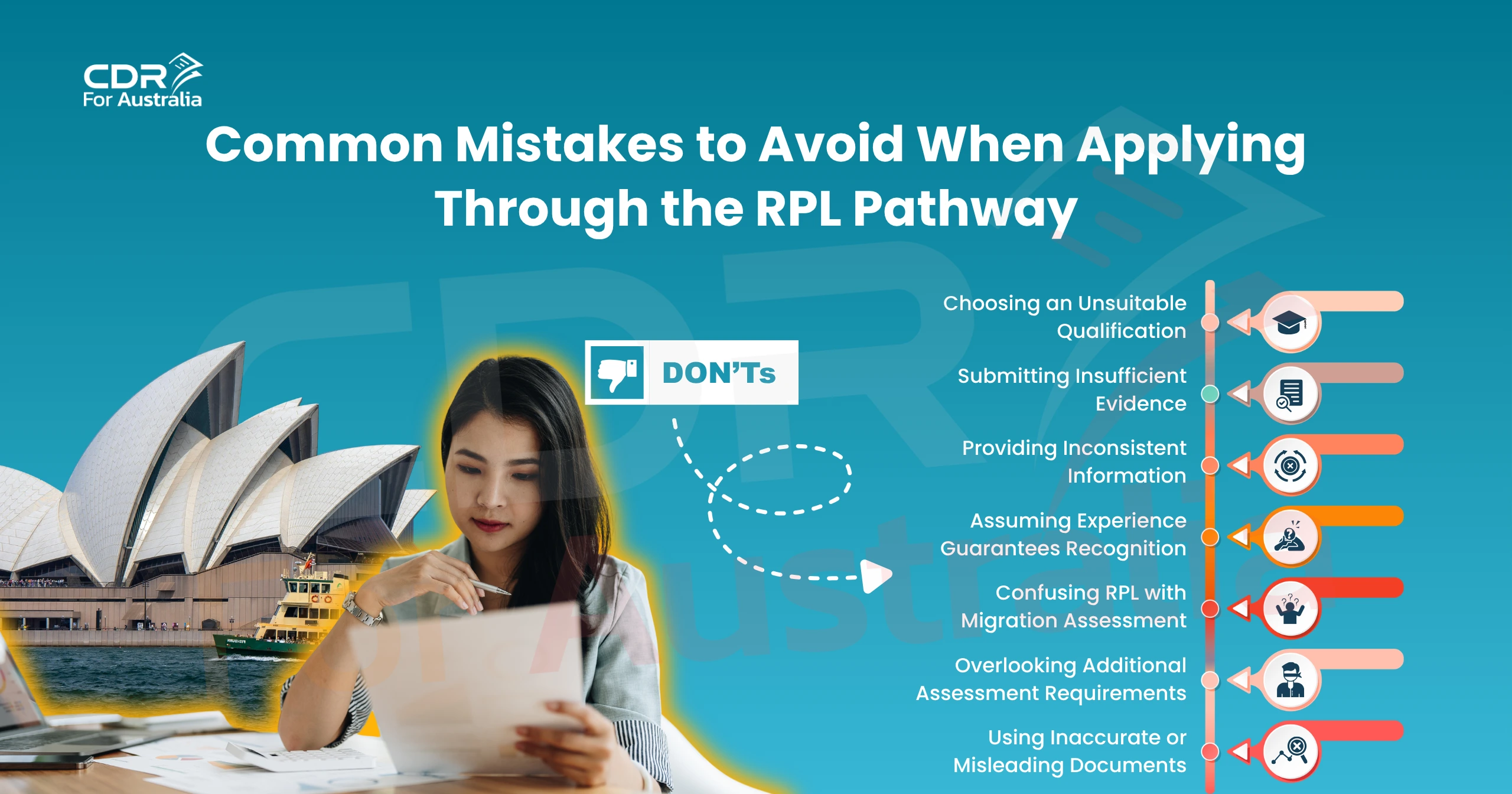
Choosing an Unsuitable Qualification
The qualifications may not match the outcome you are looking for if you do not have the skill set and/or career goals.
Do research before starting on the qualification and its units of competency.
Submitting Insufficient Evidence
It is important to note that a CV or employment reference might not show all of the required competencies.
Inquire with the provider what supporting information is required and arrange paperwork accordingly.
Providing Inconsistent Information
The employment dates, job titles, certificates, and descriptions of employment may need to be clarified.
Make sure you are using the correct and consistent application.
Assuming Experience Guarantees Recognition
Relevant years of experience can be considered, but it is the responsibility of the assessor to decide whether there is evidence available to demonstrate that the requirements are met.
Be ready to present skills and not just length of service.
Confusing RPL with Migration Assessment
An RPL outcome is not a migration skills assessment.
Before choosing a service, see what exactly you are looking for.
Overlooking Additional Assessment Requirements
Interviews, practical demonstrations, additional documentation, and gap training may be required by the provider.
Give adequate time to fulfill any extra requirements.
Using Inaccurate or Misleading Documents
Any evidence submitted should be original and verifiable. Misstatements or altered documents can adversely affect an application and can have significant implications.
How CDR For Australia Can Help You Prepare
The RPL Pathway can be difficult to understand when you are not aware of the requirements to achieve a qualification, the standards for evidence, and the different types of assessment (training vs migration).
CDR For Australia provides persons with an understanding of the documentation needs and to arrange relevant documentation for skills and professional assessment.
Depending on your circumstances and the service required, we can help you:
- Understand the purpose of your intended assessment.
- Determine relevant documentation and evidence.
- Organise information about your education and professional experience.
- Get a supporting document up to scratch – more clarity and presentation.
- Differentiate between RPL and occupation-specific migration assessments.
- Determine whether formal assessment needs to be verified before proceeding.
We can’t make the evaluation or the choice regarding the skills assessment for migration by anyone other than the authorised training provider or migration skills assessing authority.
Before you go on, let us know your occupation, qualifications (if any) and whether you are seeking a nationally recognised qualification or a Migration Skills Assessment requirement. This information will help you determine which of the processes is applicable to you.

Looking for expert CDR Writer for Engineers Australia?

Creating a CDR Report may be difficult due to Engineers Australia’s standards and rules ( EA ). Our experienced engineers have assisted many people in obtaining approval for their report from the EA via the use of powerful projects.
Start Exploring Your RPL Pathway
Work experience and practical knowledge can provide a basis for a formal skills assessment. The first thing you must do is figure out which qualification or assessment process will fit your objectives.
If you’re considering a nationally recognised qualification, want to find out about your current skills, or want to know about how your qualifications fit into an Australian pathway, preparation will help you make an informed decision.
CDR For Australia can provide you with a grasp of applicable documentation and help you to arrange information for your intended assessment.
Talk to CDR For Australia about your situation and what the next steps should be. Please ensure that you check with the authorised training provider or migration assessing authority prior to committing to an assessment to determine applicable requirements.
Frequently Asked Question (FAQs)
What does RPL Pathway mean?
RPL Pathway is a pathway for assessing existing skills and/or knowledge in relation to the requirements of a qualification or unit of competency. It can accept skills acquired from work, training or other learning activities.
Who is eligible for the RPL Pathway in Australia?
Participants must meet the criteria of the qualification, have the necessary skills and knowledge, possess evidence, and meet the requirements of the training provider’s assessment process. Applicants are advised to check the requirements with an appropriate RTO.
Can I obtain a qualification through RPL without attending classes?
An applicant may gain the required competencies in some cases without embarking on a full traditional training program. The provider may want to conduct interviews, practical demonstrations, further assessment, gap training, etc.
What evidence is required for RPL?
Records of employment, references, certificates, work samples, project reports, training records and supervisor statements can be used as evidence. Specific requirements may vary with the qualification and units being evaluated.
How long does the RPL Pathway take?
There is no fixed processing time. The time required will vary based on the qualification, quantity and quality of evidence, the process used to assess evidence, the provider’s workload, and other requirements.
Speak with your preferred RTO to get a quote depending on your situation.