


Relevant Skilled Employment Assessment
If you are a skilled worker and have professional engineering work experience and wish to use your work experience for your Australian skilled migration pathway, your work experience may need to be assessed by Engineers Australia. An RSEA will look at your engineering job and the evidence you submit in order to assess whether your employment can be considered as relevant skilled employment aaseesment.
Qualifications are just one of the requirements for engineers to apply for migration to Australia. Your professional experience and job duties, and documents to support that work may also be relevant, especially if you want to have your engineering work formally evaluated.
We support engineers at CDRForAustralia to understand the requirements, assist with the construction of their employment evidence, and prepare their documentation for Engineers Australia assessment.


What Is a Relevant Skilled Employment Assessment?
The Relevant Skilled Employment Assessment is a service offered by Engineers Australia to assess documentary evidence of an applicant’s engineering employment.
The assessment will be based on how you’re working, not just your job title. Your documents should show: when you worked, who you worked for, full-time or part-time work, how you were paid, and what engineering activities you carried out.
There is an assessment pathway for engineering occupation categories where relevant skilled employment can be assessed for this category of occupations, except for engineering manager, because relevant skilled employment forms part of the assessment pathway for this occupation category.
The assessment is not to determine if your engineering qualification is suitable for migration, but rather it is an assessment of your qualifications. Qualifications and skills are evaluated by Engineers Australia through its Migration Skills Assessment process, and relevant skilled employment is the assessment of evidence of professional employment.
Why Is Relevant Skilled Employment Important?
Experience in engineering could be valuable to a migration profile. But a CV that states engineering in the job description does not automatically qualify the job for being considered relevant skilled work.
There must be supporting documentation relating to the job.
An applicant, for instance, could have been working as a civil engineer for a few years. If the applicant submits only a basic employment certificate listing only the job title and employment dates, the applicant might not have sufficient information to show that the applicant performed engineering responsibilities.
A detailed employment reference supplemented by appropriate secondary evidence is a much better documentary record of the employment.
This is why it is important that the applicant has to plan their evidence of employment before they apply for the position, and not try to ‘piece it together’ after.
Who Can Apply for Relevant Skilled Employment Assessment?
Engineers Australia offers a suitable skilled employment assessment for applicants wishing to have their engineering employment assessed.
You can ask for an Employment assessment carried out as:
- An employee of an engineering organisation
- A staff member of a private company
- A public-sector officer, such as a member of a public or government body, or a person working for a public or government body.
- Self-employed engineering professional
- A contractor or consultant (if available, there is supporting evidence).
The requirements for evidence may be different if you were self-employed or employed by an organisation.
Your job should also be real and be connected to your nominated engineering profession. A job title of “engineer” is not sufficient to imply or prove that the work was professional engineering employment.
Engineers Australia Relevant Skilled Employment Requirements
The main component of a Relevant Skilled Employment Assessment is the evidence you present.
Employer applicants will need to provide a reference letter and secondary evidence of employment.
Employment Reference Letter
The employment reference should be on official company stationery and contain sufficient detail for Engineers Australia to ascertain your employment.
Typically, the reference should contain:
- Your full name
- Your position or job title
- The employer’s name
- Exact employment start and end dates
- Whether your employment was full-time or part-time
- Number of working hours
- Your salary or pay rate
- Detailed engineering duties
- Name and position of the person issuing the letter
- Official work contact details
- Signature or appropriate endorsement
- Company stamp, where applicable
Engineers Australia guidance gives instructions to include detailed engineering duties, not generic descriptions, in the reference. Candidates should, therefore, not include references of the form “performed engineering duties.
Detailed Engineering Duties
Your duties within your employment reference are extremely crucial.
For instance, one could argue that the description is weak and comes across as, “The boy looks like a boy.
“Worked on engineering projects and performed general engineering tasks.”
This is not an explanation of what you actually did.
A more meaningful description would be to name the specific responsibilities, e.g.
- Developed engineering drawings and specifications.
- Carried out engineering calculations and reviewed project needs.
- Reviewed technical drawings/specifications.
- Coordinated engineering activity with contractors and project team.
- Oversaw the project implementation and checked against engineering standards and specifications.
Your responsibilities should be honest and representative of your job. Please don’t take on additional responsibilities just because they are listed in another engineer’s letter of reference.
Secondary Evidence of Employment
Not just an employment reference may be needed.
Secondary evidence to support the employment period is also required by Engineers Australia. This may include government-issued or official employment-related records depending on circumstances and country in employment.
Examples can include:
- Income tax return acknowledgement or receipt
- Social security records
- Provident fund or retirement contribution statements
- Superannuation records, where applicable
- Work permits
- Residence permits
- Official government employment documents
- Employment contracts or other official records
The secondary evidence should substantiate the claimed employment period and indicate the employee and employer.
Provident fund, social security, or tax documents may be of great help in employment history for applications from overseas who have a provident fund, social security, or tax documentation.
Relevant Skilled Employment for Self-Employed Engineers
Self-employment does not rule out an engineer from seeking the appropriate skilled employment evaluation. But proving self-employment may be harder to prove as there may be no employer reference.
Engineers Australia offers a set of criteria for the self-employed.
Evidence can consist of:
- Written communications from clients and/or contracting organisations
- Services provided shown on contract(s)
- It is not possible to provide exact dates of engagement.
- Number of hours worked
- The amount paid for a job is referred to as salary, hourly or daily rate.
- The invoices that have been issued to the clients should be provided.Original Invoices to Client.
- Business registration documents
- Business tax records
- Business bank statements
- Organisation charts
- Personal income tax statements
- Payroll records for employees (if applicable)
- Compliance documents for professionals/business (e.g., pharmacy, legal, accountancy)
The function of these documents is to prove the business or professional practice and that the work (claims) you are claiming as engineering was carried out by you during the requisite time.
What Makes Employment Experience Relevant?
The big question that applicants are asking is “What is RELEVANT about the job?”.
These answers are based on the nomination of the engineering occupation and nature of the work done.
The employment should be related and include a degree of engineering activity rather than administration or sales or other unrelated duties.
For instance, a construction company engineer could do a number of different activities. These may be professional engineering tasks or administrative / business tasks.
Your evidence in relation to employment should, therefore, make it very clear what you do as an engineer.
Note the contrast between:
General description:
In charge of construction works and project administration.
More specific description:
Engaged in reviewing structural drawings, monitoring works in progress with regard to technical requirements, coordinating technical problems with consultants and contractors, and preparing engineering reports for works progress and compliance.
Documents Required for Relevant Skilled Employment
Having your documents ready can help ease the assessment process.
One of the most common employee documentation packages includes:
|
Document |
Purpose |
|
Employment reference |
Confirms role, dates and engineering duties |
|
Employment contract |
Supports employment conditions |
|
Payslips |
Supports salary and employment period |
|
Tax records |
Provides official employment evidence |
|
Provident fund/social security records |
Supports employment duration |
|
Work permit |
Supports legal employment where applicable |
|
Performance review |
May support duties where appropriate |
|
Job offer letter |
Can provide additional role information |
Not all applicants will have all of the documents. The evidence depends on the circumstances of your employment and the Engineers Australia requirements.
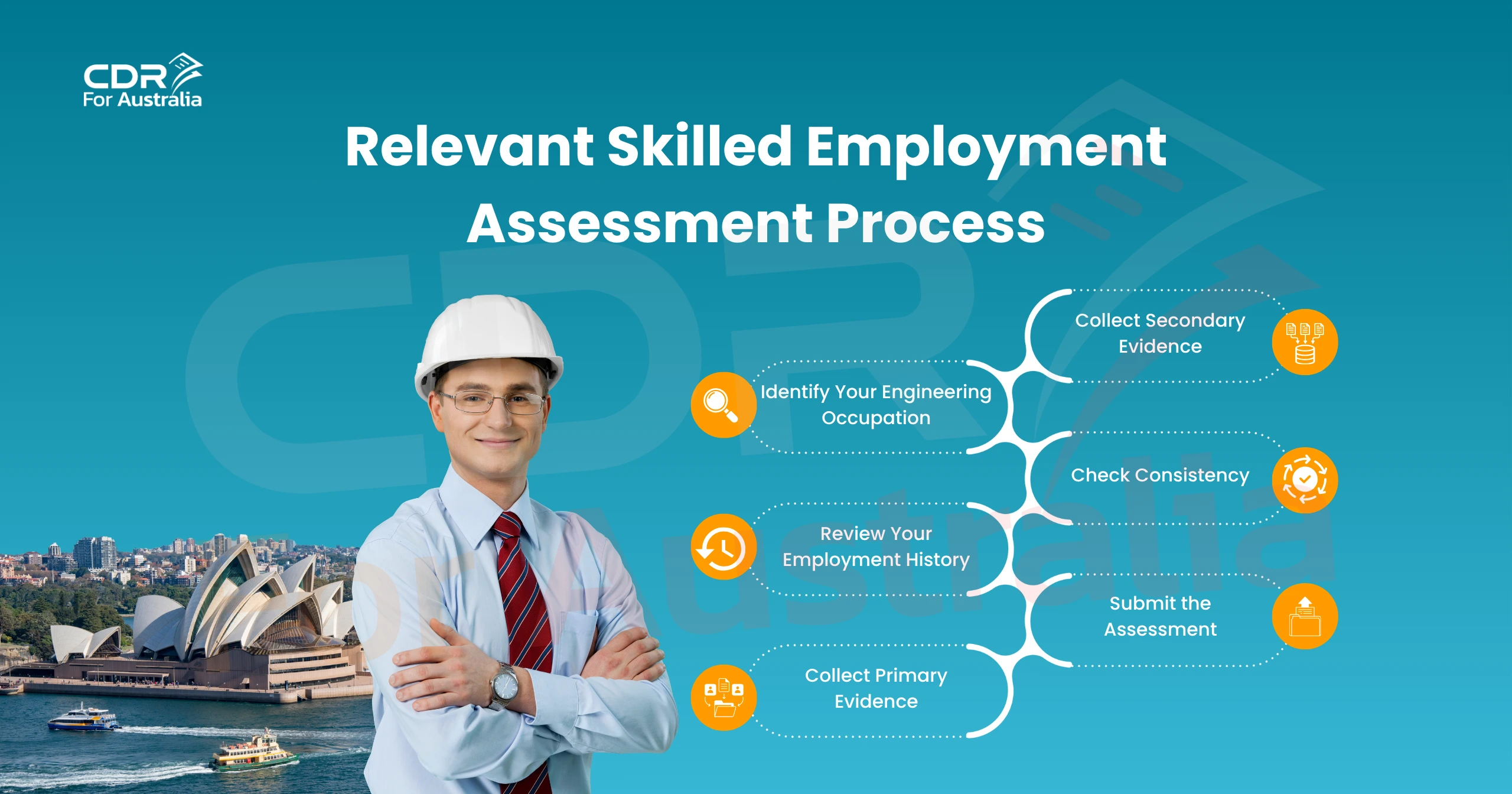
Relevant Skilled Employment Assessment Process
This process can be approached in a number of stages.
Step 1: Identify Your Engineering Occupation
First, determine the engineering occupation that you are seeking assessment in.
Based on their work, engineers are classified into four main engineering occupations:
- Professional Engineer
- Engineering Technologist
- Engineering Associate
- Engineering Manager
The route followed will depend on qualifications, an engineering background, and nominated occupation.
Step 2: Review Your Employment History
Make a timeline of your jobs.
Write down for each job:
- Employer
- Job title
- Start date
- End date
- Working hours
- Salary
- Location
- Engineering duties
- Projects
- Available evidence
This will enable you to find gaps in advance of when you’re ready to apply.
Step 3: Collect Primary Evidence
Obtain employment reference letters from your previous and current employers.
Ensure that dates, employment terms, and specific engineering responsibilities are correct in the letters.
Step 4: Collect Secondary Evidence
Collect paperwork that substantively underpins the job.
If possible, have your secondary evidence span the entire employment period you are claiming.
Step 5: Check Consistency
The story of your documents should be the same.
For instance, if your employment reference includes a date range of January 2021 through December 2023, the supporting documentation should include a March 2021 start date unless there is a good reason.
Be sure to examine names, dates, job titles, salaries, and periods of employment.
Step 6: Submit the Assessment
Once the necessary paperwork is completed, the application can be made via the Engineers Australia system.
Engineers Australia is saying that applicants ought to submit their application assessment-ready and submit required documentation with the application.
Common Problems With Employment Evidence
There are various issues with documentation that can make it challenging to evaluate an employment claim.
Generic Employment Letters
What is written in the letter could be a working letter, which just confirms your job title and dates of employment and does not provide sufficient explanation of your engineering work.
Missing Employment Dates
The dates of the assessment requirements are not specific and may be represented by “2019–2022.
No Secondary Evidence
An employment certificate may not be enough to establish independent evidence of employment.
Inconsistent Information
Employment letters and contracts, payslips, tax records and other documents should be compared to determine differences where applicable and explain them.
Unsupported Claims
Don’t assume engineering duties that you didn’t do.
Poor-Quality Documents
Documents must be easy to read and understand. High-resolution colour scans of original documents are required for relevant employment evidence for Engineers Australia.
How CDRForAustralia Can Help
There are a lot of details involved in preparing an employment assessment application.
At CDRForAustralia, we can assist you in organizing your employment details and what may help to support your employment situation.
We may be able to help you by providing:
- Checking your work record
- Identifying engineering experience that may be relevant
- Reviewing your work reference details
- Checking consistency of employment dates
- Supporting evidence organisation
- Recognizing missing or potentially weak documentation
- Organizing your employment information properly
- Offering advice on the Engineers Australia assessment process.
Fabricating experience or adding duties that you did not perform is not recommended. The application should be based on true experience in the profession and original supporting documents.
How Long Does the Assessment Take?
There may be variations in processing time based on the application and if further information is needed.
Engineers Australia currently claims that applications for Migration Skills Assessment are normally sent to an assessor within approximately 15 weeks. It’s not to say that the whole assessment will be finished in 15 weeks; it is an assignment timeframe.
Documentation can impact the overall process, both in terms of quality and completeness.
Applicants should thus not base their migration plans on any expected fixed date for the assessment to be completed.
Relevant Skilled Employment Assessment Fees
Engineers Australia fees may vary; please see the latest official fee schedule prior to submitting an application.
Engineers Australia charges a separate Relevant Skilled Employment Assessment fee of AUD 485 (excl GST) or AUD 533.50 (inc GST) for 2026-2027.
If a relevant skilled employment assessment is performed alongside another assessment (e.g. Competency Demonstration Report or Accredited Qualification assessment) the cost will vary.
Please check the fee on the ground prior to payment; it may change.
Does Engineers Australia Award Migration Points?
Engineers Australia evaluates engineering skills, qualifications and other engineering work experience, but does not award migration points for the evaluation process.
For information on the points test, visa eligibility and visa experience for a specific visa, please refer to the Australian Department of Home Affairs or a suitably qualified migration specialist.
This distinction matters, as the assessment for employment by Engineers Australia and the assessment of visa eligibility by the Department of Home Affairs are two separate assessments.

Looking for expert CDR Writer for Engineers Australia?

Creating a CDR Report may be difficult due to Engineers Australia’s standards and rules ( EA ). Our experienced engineers have assisted many people in obtaining approval for their report from the EA via the use of powerful projects.
Prepare Your Relevant Skilled Employment Assessment Carefully
While your work experience can be a valuable component of your Australian engineering migration journey, quality and documentation are important.
A good application should include a clear and believable engineering resume that includes accurate dates and accurate responsibility statements with supporting evidence.
Take time to carefully read through each employment time period and ensure your documents substantiate your claims before you submit your application.
In case you’re not sure what kind of documentation is suitable for your situation, professional advice can assist you in determining documentation gaps and also prepare your application more systematically.
Need assistance in preparing your Relevant Skilled Employment Assessment? Speak to CDRForAustralia about your engineering work experience and supporting documents.
Frequently Asked Question (FAQs)
What is a Relevant Skilled Employment Assessment?
It is a service provided by Engineers Australia which evaluates documentary evidence of the engineer’s professional employment as a basis for determining if the engineer’s claimed professional employment can be recognised as relevant skilled employment.
Do I need a Relevant Skilled Employment Assessment?
This will be based on your migration situation and on what Engineers Australia needs to review. Not all applicants will need the same type of assessment services.
Can I use employment from outside Australia?
Yes. Engineers Australia may evaluate relevant engineering employment evidence that is from outside Australia provided that it relates to an employment that meets the relevant requirements and can be substantiated by appropriate documentation.
Can self-employed engineers apply?
Yes. Engineers Australia has a procedure available to consider the assessment of self-employed engineering employment, but applicants must submit evidence of their employment, including appropriate client documentation, invoices, business records and any other evidence.
Is an employment certificate enough?
Not necessarily. Engineers Australia has specific requirements for employment evidence, such as details of your position and evidence to substantiate the employment.