


Chartered Engineer vs Professional Engineer: Key Differences
Titles like Chartered Engineer (CEng) vs Professional Engineer (PE or P.Eng.) are common in the professional recognition pathway for engineers. Both show professional engineering competence but are part of different professional registration systems and may have different legal and professional meanings in different countries.
It is important that engineers planning to work or seek professional recognition in Australia be aware of the differences between these credentials and Australia’s professional engineering framework, the Chartered Professional Engineer (CPEng) offered by Engineers Australia.

What Is a Chartered Engineer?
Chartered Engineer (CEng) is a professional engineering designation, which is mainly employed in the engineering registration system in the United Kingdom.
CEng registration provides evidence that an engineer has gained and applied the necessary professional skills in his/her education, engineering experience, professional development, and assessment against the competency standards.
The CEng qualification is recognised under the engineering profession in the United Kingdom, via the Engineering Council and professional engineering institutions.
A Chartered Engineer can work in various different areas including:
- Engineering design
- Project management
- Technical leadership
- Engineering consultancy
- Risk management
- Asset and infrastructure management
- Economic Research and Development
The specific professional rights and requirements for CEng vary according to the engineer’s professional role and the jurisdiction.
What Is a Professional Engineer?
Professional engineer is a term used in various countries, but in some, this term is used with a different meaning and for different purposes.
Professional Engineer (PE) is typically a state-specific designation. In Canada, engineers can use the P.Eng. designation after they are registered by the engineering regulators of the province or territory where they practice.
Common items included in professional engineering registration requirements are:
- Engineering education
- Relevant professional experience
- Competency demonstration
- Professional ethics
- Regulatory requirements
- Examinations (or assessments) as per jurisdiction
The term “Professional Engineer” must not be interpreted as one common title.
Chartered Engineer vs Professional Engineer
The primary distinction is the fact that the engineer is recognized under a professional registration system.
Feature | Chartered Engineer (CEng) | Professional Engineer (PE/P.Eng.) | Australia |
Common designation | CEng | PE / P.Eng. | CPEng |
Main association | UK engineering registration framework | US state / Canadian provincial systems | Engineers Australia |
Professional assessment | Competence-based professional review | Requirements vary by jurisdiction | Competency-based assessment |
Legal authority | Depends on jurisdiction | Often linked to regulated engineering practice | Depends on registration and state/territory requirements |
International recognition | Broad international recognition | Recognition varies by jurisdiction | Australian professional framework |
Australian equivalent | Not automatically equivalent | Not automatically equivalent | CPEng is Australia’s Chartered designation |
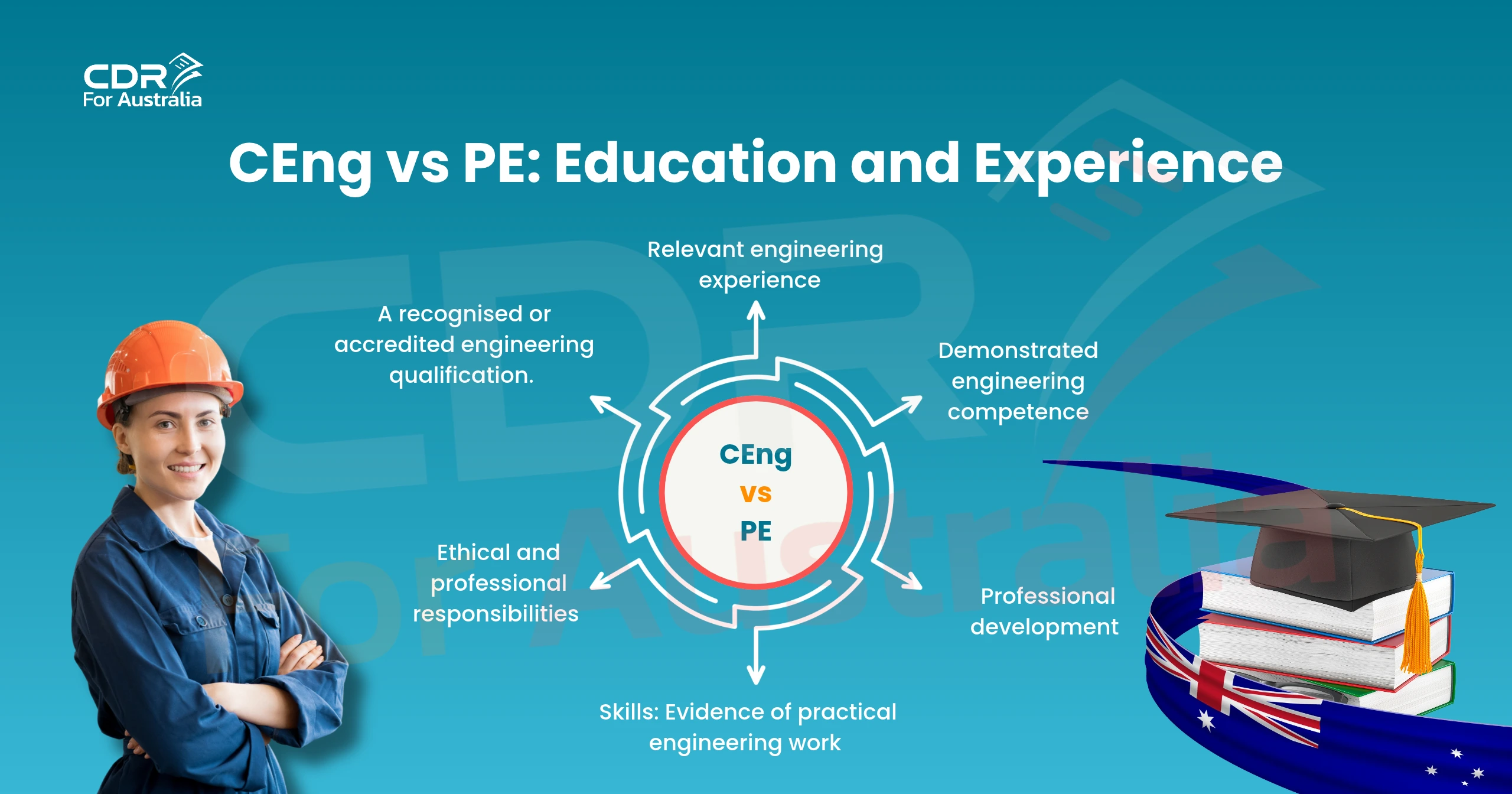
CEng vs PE: Education and Experience
For both the CEng and PE/P.Eng. pathways, the engineer needs to be technically capable of more than just academic achievement.
Professional recognition can involve:
- A recognised or accredited engineering qualification.
- Relevant engineering experience
- Professional development
- Demonstrated engineering competence
- Ethical and professional responsibilities
- Skills: Evidence of practical engineering work
The specific needs vary, however.
For instance, PE registration in the UK follows the framework of the professional engineering profession, whereas PE licensure in the USA is regulated on a state-by-state basis.
Engineers should always review requirements in the specific countries, regulators, and engineering discipline before assuming that a degree will meet the requirements of another country’s credentialing system.
CEng vs PE vs CPEng in Australia
There is a professional engineering framework in Australia.
The Chartered Professional Engineer (CPEng) designation is linked to Engineers Australia and is awarded upon meeting Engineers Australia’s professional competency requirements.
This means:
CEng ≠ PE/P.Eng. ≠ CPEng
While these can be used to prove engineering competency as a profession, they are offered by different systems.
It should not, therefore, be automatically assumed that an overseas CEng or PE/P.Eng. credential is an Australian CPEng credential.
Can a Chartered Engineer Work in Australia?
While a Chartered Engineer may be able to work in Australia, CEng does not guarantee Australian professional registration for all engineering jobs.
The needs may vary based on:
- Engineering occupation
- State or territory
- This is a type of engineering work.
- Employer requirements
- Regulatory requirements
- Professional registration requirements
- Awards given for qualifications and experience gained overseas can be recognized.
Engineers intending to practise in Australia should check the requirements applicable to their particular occupation and location.
Can a Professional Engineer Work in Australia?
Likewise, a PE or P.Eng. qualification from another country does not automatically qualify an engineer to be registered as a professional engineer in Australia.
Australian employers and regulators should look to an engineer’s:
- Academic qualifications
- Engineering experience
- Professional registration
- Competency evidence
- Professional memberships
- Engineering discipline
- The applicable Australian registration requirements may apply.
The path to go is dependent on the engineer’s situation.
Engineers Australia and Professional Recognition
Engineers Australia is the national professional engineering organisation for Australia. It offers pathways to professional recognition and evaluates engineering qualifications and competencies for a variety of purposes.
Engineers Australia acknowledges 3 groups of occupations:
- Professional Engineer
- Engineering Technologist
- Engineering Associate
- Engineering Manager
Engineers Australia’s professional competency framework also provides the credential of Chartered.
It is therefore important for engineers wanting to be recognized in Australia to be aware of the difference between overseas credentials and Australian registration.
Does CEng Equal CPEng in Australia?
No, CEng and CPEng are NOT the same professional designations, but they are from different systems.
CEng is related to the UK engineering registration system, while CPEng is a professional designation in Australia related to Engineers Australia.
It is not enough for an engineer to have a CEng qualification to be a CPEng.
Similarly, it is not automatically assumed that an engineer will be a CPEng in Australia because they hold an overseas PE/P.Eng. designation.
The pathway for recognition or registration will be determined by the engineer’s qualification, experience, discipline, and professional activities in Australia.
Which Credential Is Relevant for Australian Engineers?
No one credential fits all engineers.
When planning to work in Australia, an engineer should note the difference between:
- Academic recognition: whether or not an engineering qualification is recognized or assessed.
- Migration assessment: whether the engineer is able to meet the requirements for an applicable migration skills assessment.
- Professional recognition: recognition of engineering competence of professionals.
- Professional registration: registration which may be required for specific engineering practice in a specific Australian state or territory.
- Chartered status: professional recognition via the appropriate Australian professional structure.
These are related, but different concepts.
CEng vs PE vs CPEng: Quick Comparison
Question | CEng | PE/P.Eng. | CPEng |
Is it an Australian designation? | No | No | Yes |
Is it internationally recognized? | Yes, subject to jurisdiction | Yes, subject to jurisdiction | Yes, particularly within Australia’s professional framework |
Does it automatically provide Australian registration? | No | No | Not necessarily for every regulated activity |
Is it a professional engineering credential? | Yes | Yes | Yes |
Is it awarded under the same system? | No | No | No |
Relevant to Australian engineers? | Potentially | Potentially | Directly relevant to Australian professional recognition |
Important Consideration for Engineers Seeking Migration to Australia
Registration and migration skills assessment are not synonymous.
An engineer might also be asked to solve individual needs of the following:
- Engineering qualification recognition
- Migration skills assessment
- If required, English-language requirements.
- Professional registration (if required).
- The 5th engineering requirement is state and territory specific.
- Work and professional recognition
So, before deciding on a pathway, engineers should determine the exact reason for pursing professional recognition.

Looking for expert CDR Writer for Engineers Australia?

Creating a CDR Report may be difficult due to Engineers Australia’s standards and rules ( EA ). Our experienced engineers have assisted many people in obtaining approval for their report from the EA via the use of powerful projects.
Choosing the Right Engineering Recognition Pathway
Whether you decide to choose CEng, PE/P.Eng., or Australian professional recognition will depend on your location to practise and your reason for wanting professional recognition.
Where you have an overseas engineering qualification, e.g. CEng, PE/P.Eng., it is important to understand how it relates to the Australian engineering framework, as well as assuming automatic recognition.
Engineering professionals should take account of the following when planning to work in Australia:
- Their profession or job as an engineer
- Existing academic qualifications
- Professional engineering experience
- Current professional registration/membership
- The requirements of the relevant State or Territory of Australia
- If they require skills assessment and/or professional registration, the type of skills assessment and professional registration that is required for them
It is essential that engineers understand the differences and prepare appropriate documentation and have the right pathway to apply for professional recognition in Australia.
Frequently Asked Question (FAQs)
Is CEng the same as PE?
No. CEng and PE are two engineering professional qualifications. They may differ from country to country and from jurisdiction to jurisdiction in their requirements, registration and legal purpose.
Is CEng equivalent to CPEng in Australia?
Not automatically. CEng and CPEng are not the same professional designations, and are offered as part of two different professional frameworks.
Can a PE work in Australia?
It is possible for a PE from another country to have their overseas registration recognized in Australia but registration in Australia is not automatic. These requirements vary by engineering position, location, and regulations.
Can a PE work in Australia?
CPEng is a professional designation accredited by Engineers Australia and is recognised in Australia. It doesn’t require an academic engineering degree.
Does CEng help with Australian migration?
Migration assessment is dependent on visa and skills-assessment requirements and an overseas professional engineering credential may be a component of a professional background for an engineer. CEng does not necessarily meet Australian migration requirements.