


CDR for Civil Engineers Australia: Process and Requirements 2026
If you’re a civil engineer trained outside Australia and you want Engineers Australia to recognise your qualification, you’ll almost certainly run into the term CDR. A CDR for Civil Engineers is a written report that proves your education, on-site experience, and technical judgment meet the standard expected of a civil engineer in Australia. It’s not a formality. Engineers Australia is the government-appointed body that assesses this occupation, and every CDR for Civil Engineers gets checked against a fixed set of competency elements before an outcome is issued.

Anyone whose degree wasn’t earned through a Washington Accord, Sydney Accord, or Dublin Accord program has to go through this route, regardless of job title or years on the job. Why does this matter so much? Because most points-tested visas, including Subclass 189, 190, and 491, won’t let you lodge an Expression of Interest without a positive skills assessment in hand first.
Civil engineering sits under ANZSCO code 233211, and it’s consistently one of the highest-volume occupations Engineers Australia assesses each year. With that much competition, a CDR for Civil Engineers Australia needs to be specific, well organised, and entirely your own writing assessors cross-check every claim against the documents submitted alongside it.
Who Needs a CDR for Civil Engineers Australia?
Not everyone goes through the CDR pathway. If your degree isn’t accredited under the Washington, Sydney, or Dublin Accord, this is the route you’ll take. That covers a large share of engineers trained in India, Pakistan, Bangladesh, Nepal, and the Philippines, since most programs there fall outside Engineers Australia’s automatic recognition list.
It also covers engineers who studied in an Accord country but whose specific program wasn’t accredited at the time. A CDR for Civil Engineers is required no matter how experienced you are; the assessment runs on documented project evidence, not on your job title or years worked. Someone with an Australian degree, or a degree from a fully accredited program elsewhere, typically skips this pathway entirely and applies through the shorter qualification-based route.
Experience doesn’t change which pathway applies. An engineer with fifteen years on major infrastructure projects still needs this report if their original degree sits outside the accredited list. It’s the qualification that decides the route, not the resume.
ANZSCO Code for Civil Engineers (233211)
Civil engineering sits under a specific code in the Australian and New Zealand Standard Classification of Occupations, and this code decides which competency standard applies and which visa subclasses you can use.
Detail | Information |
ANZSCO Code | 233211 |
Occupation | Civil Engineer |
Skill Level | Level 1 (bachelor’s degree or higher) |
Assessing Authority | Engineers Australia |
Related codes | 233212 Geotechnical Engineer, 233213 Quantity Surveyor, 233214 Structural Engineer, 233215 Transport Engineer |
Visa list | MLTSSL eligible for Subclass 189, 190, and 491 |
Civil engineers under this code plan, design, and oversee infrastructure work roads, bridges, drainage systems, dams, water supply networks, and similar projects. Before you start writing a CDR for Civil Engineers Australia, double check that your day-to-day project work actually fits this code and not a neighbouring one like structural or geotechnical engineering.
Choosing the wrong code early on causes headaches later. The Civil Engineer ANZSCO 233211 page breaks down duties, specialisations, and visa eligibility in more depth if you want to confirm this before gathering documents.
There’s another layer to this. Engineers Australia sorts every applicant into one of four occupational categories, and this decides the competency level a civil engineering CDR needs to demonstrate:
Professional Engineer
The category most civil engineers apply under, requiring a bachelor’s degree or an equivalent engineering knowledge base.
Engineering Technologist
Suited to civil engineers with a more applied, technology-focused qualification, closer to implementation than design theory.
Engineering Associate
Usually diploma-level engineers with a narrower scope of practice, focused on technical support rather than full design responsibility.
Engineering Manager
For applicants whose work centres on managing engineering teams and projects rather than doing hands-on technical design work.
Most people preparing a CDR for Civil Engineers apply under Professional Engineer, since it lines up with a standard four-year degree. Get this category wrong early on and it changes how your Career Episodes need to be read, so it’s worth pinning down before you start drafting.
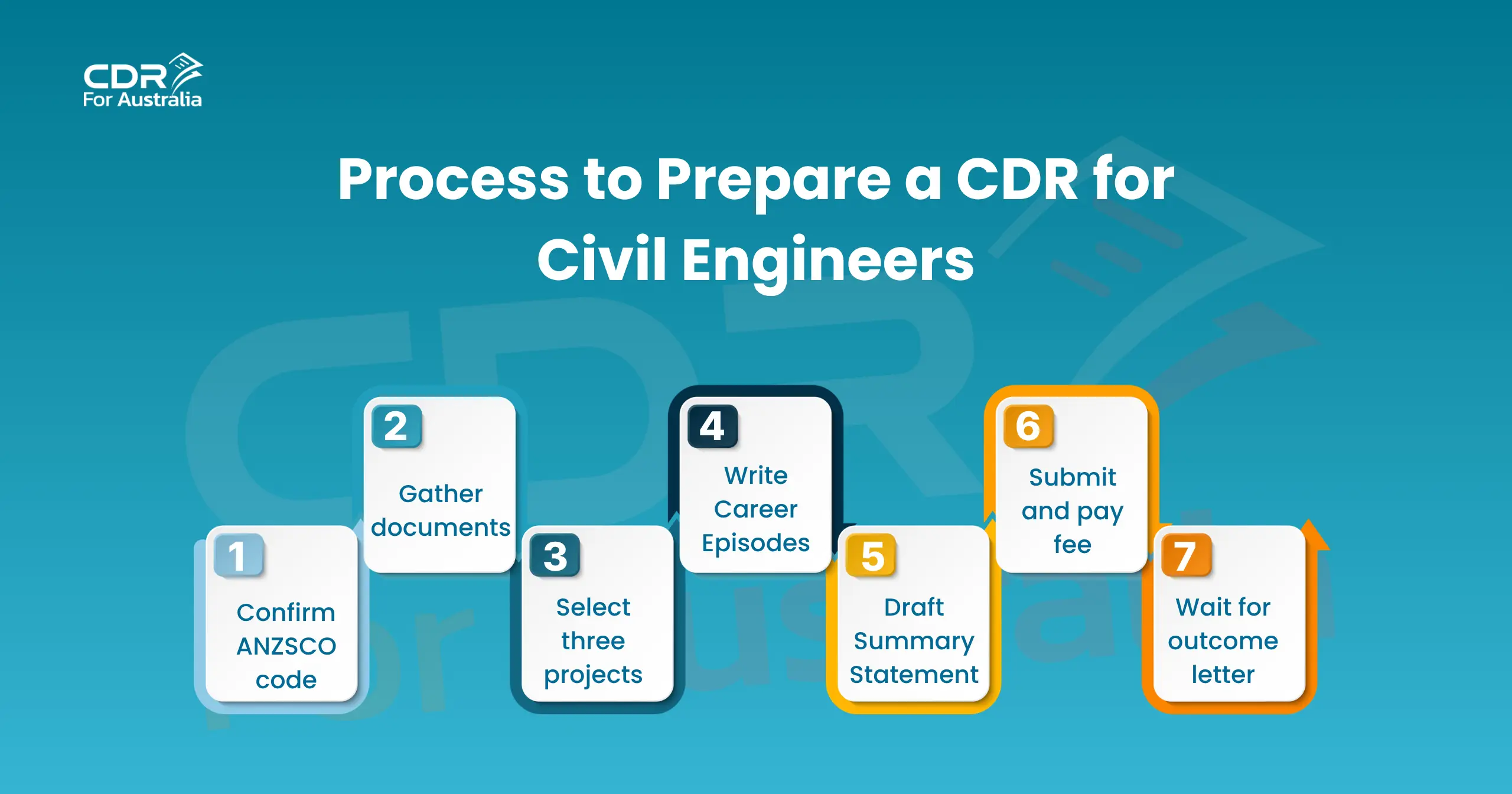
Step-by-Step Process to Prepare a CDR for Civil Engineers
- Confirm the correct ANZSCO code and check whether your degree qualifies for the accredited pathway or the CDR pathway.
- Collect all supporting documents, transcripts, employment evidence, English test results.
- Select three projects that clearly show independent engineering decisions, not just team involvement.
- Write the three Career Episodes in first person, focusing on your specific role, technical decisions, and outcomes.
- Prepare the CPD report, listing formal and informal learning activities from recent years.
- Draft the Summary Statement, mapping each competency element to the correct paragraph in your Career Episodes.
- Run the full report through a plagiarism and formatting check before submission.
- Create an account on the Engineers Australia online portal and upload your documents.
- Pay the relevant assessment fee and wait for your outcome letter.
Plenty of applicants finish a full draft on their own and still bring in a second set of eyes before hitting submit. Our CDR Reviewing service checks competency mapping, formatting, and originality so nothing slips through at the last stage.
What Goes Into a CDR for Civil Engineers?
Start with the CPD Continuing Professional Development. It’s short, usually around 250 words, and lists courses, workshops, seminars, or private study you’ve completed. Then come the three Career Episodes, which honestly carry the most weight in the whole report. Each one is written in first person, sits somewhere between 1,000 and 1,500 words, and walks through a real project or work situation you were personally involved in.
These aren’t summaries of what your team achieved, they’re evidence of what you specifically did. After the episodes comes the Summary Statement, a structured table that links each competency element back to the exact paragraph where it’s demonstrated in your Career Episodes. Weak mapping here is one of the most common reasons a report gets sent back for revision, simply because assessors rely on it to verify claims quickly. Last is the resume Australian format, reverse chronological, listing education and work history.
Since the Career Episodes and Summary Statement do most of the heavy lifting, a lot of applicants get help with these two sections specifically. Our Career Episode Writing service focuses on structuring project write-ups properly, and the Summary Statement Writing service makes sure each competency element is cross-referenced the way assessors expect.
Visa Pathways for Civil Engineers Assessment
Once Engineers Australia issues a positive outcome, that letter opens the door to several skilled visa categories, since civil engineering sits on the Medium and Long-term Strategic Skills List.
- Subclass 189: Skilled Independent visa, no sponsorship required
- Subclass 190: Skilled Nominated visa, state or territory sponsored
- Subclass 491: Skilled Work Regional (Provisional) visa
- Subclass 186: Employer Nomination Scheme, if a job offer is in place
- Subclass 485: Graduate visa stream, for recent graduates in some cases
The outcome letter itself doesn’t expire with Engineers Australia. But the Department of Home Affairs sets its own validity rules for each visa, so check current visa requirements before leaning on an older assessment.
Documents Required for a CDR for Civil Engineers
Before writing anything, gather what Engineers Australia will actually ask for. Missing or unclear documents cause more delays than almost anything else in this process.
- Current passport or national identity document
- Updated resume in Australian format
- Academic transcripts and degree certificates
- English language test result (IELTS, PTE Academic, TOEFL iBT, or OET)
- Evidence of employment, offer letters, experience letters, or payslips
- Three Career Episodes, Summary Statement, and CPD report
- Passport-size photograph and any name-change documents, if applicable
Scan quality matters more than people expect. An application can get rejected simply because a certificate is blurry or partially cut off, so it’s worth checking every file before it goes anywhere near the online portal.
CDR Pathway vs Accredited Qualification Pathway
Not every civil engineer has to write a CDR. If your degree comes from a program accredited under the Washington, Sydney, or Dublin Accord, you can usually apply through a shorter pathway built around transcripts and employment evidence rather than written project accounts. The CDR pathway works differently; it’s built entirely around demonstrated competency, which means describing specific projects, explaining your personal contribution, and tying each contribution back to a defined competency element.
That takes longer to prepare, no question, but it’s the only route open to engineers whose qualification isn’t on the accredited list. Not sure which pathway fits your degree? Our CDR Writing Services team can review your qualification and work history before you commit to either one.
EA Skill Assessment Fees for Civil Engineers
What you pay depends on which assessment category and add-on services you choose. Engineers Australia publishes fixed fees for the 2026–27 period, and the CDR route costs more than the accredited pathways because it involves a much more detailed competency review.
Service | Fee (incl. GST, AUD) |
Standard CDR assessment | $1,034 |
CDR + relevant skilled employment assessment | $1,512.50 |
CDR + overseas engineering PhD assessment | $1,336.50 |
Fast-track processing (additional fee) | $396 |
Review fee | $368.50 |
Appeal fee | $704 |
Fast-track processing gets your application assigned to an assessor within 20 business days, but that’s not the same as a faster final decision, since the overall timeline still hinges on document quality. None of these fees cover professional writing or review support; that’s a separate cost if you choose to use it. Fees get reviewed every July, so it’s worth confirming current numbers on our pricing page or directly through Engineers Australia before you pay.

Looking for expert CDR Writer for Engineers Australia?

Creating a CDR Report may be difficult due to Engineers Australia’s standards and rules ( EA ). Our experienced engineers have assisted many people in obtaining approval for their report from the EA via the use of powerful projects.
Competency Standards in a CDR for Civil Engineers
Every CDR for Civil Engineers gets measured against three broad areas. Assessors want specific, personal contributions, not a group summary of what the wider team pulled off. A Career Episode that lists outcomes without explaining the reasoning behind a design choice or a site decision usually falls short, even if the project itself was impressive.
- Knowledge and skill base: engineering sciences, technical knowledge, and design theory
- Engineering application ability: how you actually used that knowledge to solve a real problem on a real project, not the theory, the application
- Professional and personal attributes: ethics, communication, teamwork, and risk management on site
Common Reasons a CDR for Civil Engineers Gets Rejected
Plagiarism tops the list, and it’s an easy trap to fall into. Engineers Australia runs every submission through similarity-detection software, so copying from a sample report almost always gets caught. Beyond that, a few patterns come up again and again:
- Weak competency mapping, where the Summary Statement doesn’t clearly connect to specific paragraphs in the Career Episodes
- Writing about what the team achieved rather than what you personally decided or calculated
- Vague project descriptions or the wrong ANZSCO code
- Incomplete supporting documents
- Inconsistent dates between the resume, employment letters, and Career Episodes a small thing that raises a surprising number of red flags
A well-prepared report avoids all of this simply by staying specific, personal, and properly referenced from start to finish.
Frequently Asked Question (FAQs)
How much does a CDR report cost?
The standard CDR pathway costs AUD 1,034 (incl. GST) with Engineers Australia for the 2026–27 period, and this figure is reviewed every July. That’s separate from any professional writing or review support you choose to use.
What happens if CDR gets rejected?
A negative outcome doesn’t have to be the end of it; you can request a review, submit further information if asked, or reapply with a revised CDR for Civil Engineers. If the rejection came down to plagiarism or poor competency mapping, expect to rewrite most of the report before resubmitting.
How long does a CDR assessment take?
Under standard processing, applications generally get assigned to an assessor within about 15 weeks. That’s just the assignment stage, not the final decision; actual review time depends heavily on document quality and whether the assessor comes back asking for more information. Fast-track processing shortens the assignment step to around 20 business days, though it still doesn’t guarantee a quicker final outcome.
How to prepare a CDR report?
Start by confirming your ANZSCO code, then gather documents, pick three suitable projects, and write your Career Episodes in detail. The Summary Statement and CPD come after the episodes are done, followed by a full plagiarism and formatting check before you submit.
What is the CDR pathway for engineers in Australia?
It’s the assessment route for engineers whose qualification isn’t accredited under the Washington, Sydney, or Dublin Accord. Instead of relying on academic transcripts alone, it requires a full Competency Demonstration Report.
Is there a sample available for a CDR for Civil Engineers Australia?
Sample structures exist and are commonly used to understand formatting and tone, but every CDR has to reflect your own genuine project experience. Mirroring a sample too closely gets treated as plagiarism by Engineers Australia; it’s not worth the risk.
What documents are checked during the EA skill assessment?
Academic transcripts, degree certificates, resume, English test results, employment evidence, and the CDR documents themselves Career Episodes, Summary Statement, and CPD all get checked for consistency and authenticity.
Can a civil engineer apply without three separate Career Episodes?
No. Engineers Australia requires exactly three, each based on a distinct project or work period, unless you qualify for a different assessment pathway altogether.