


Biomedical Engineering Salary in Australia: High Paying Roles 2026
Biomedical engineering salary in Australia varies a lot depending on where you work, who employs you, and how many years of experience you have. The field combines medical science with mechanical, electrical, and software engineering, so the job can look quite different depending on whether you’re servicing hospital equipment, developing implants for a manufacturer, or preparing compliance reports for a regulator. Knowing where the pay typically lands is useful if you’re considering a job offer, planning your career, or trying to understand what income to expect in Australia.

Walk into a public hospital in NSW, Victoria, or Queensland and there’s a decent chance a clinical biomedical engineer is somewhere in the building, keeping imaging machines, surgical tools, and monitoring equipment running properly. On the private side, names like Cochlear, ResMed, and Stryker hire biomedical engineers for a different mix of work: regulatory compliance, quality assurance, and getting new products through development.
Fresh graduates almost always start toward the bottom of the pay scale, then climb as they pick up experience, certifications, and more specialised skills. Below, we’ll break down what this occupation pays at each career stage, in which cities, and across which sectors, along with the factors pushing salaries up or down through 2026.
Average Biomedical Engineering Salary in 2026
Pull together the job platform data and compensation surveys from 2026, and the average biomedical engineering salary in Australia lands somewhere between $80,000 and $140,000 a year. That’s a big spread, but it makes sense once you realise the title covers everything from hands-on equipment maintenance to senior product development.
Source | Average Annual Salary (AUD) | Notes |
Indeed | $98,000 | Based on salaries submitted by employees across Australia |
Glassdoor | $83,500 | Top earners reach around $128,000 annually |
SalaryExpert | $140,000 | Reflects a mix including senior and specialised roles |
None of these figures are wrong, exactly. A graduate biomedical technician in a public hospital and a senior regulatory affairs engineer at a multinational device company are both technically in “biomedical engineering,” yet their pay packets look nothing alike. Where a source’s average lands often just reflects which end of that spectrum it happened to sample more heavily.
Biomedical Engineering Salary by Experience Level
Nothing moves the needle on pay quite like time in the industry. As biomedical engineers work their way from graduate roles into more specialised or senior positions, their salary tends to climb in a fairly predictable pattern.
Experience Level | Typical Annual Salary Range (AUD) |
Entry Level (0–2 years) | $58,000 – $78,000 |
Early Career (2–4 years) | $65,000 – $85,000 |
Mid Career (4–9 years) | $85,000 – $105,000 |
Senior (10–20 years) | $105,000 – $145,000 |
Highly Experienced (20+ years) | $120,000 – $175,000 |
Hospital graduates tend to start a touch lower than those who go straight into a medical device manufacturer, but they usually get a clearer promotion path and more job security in exchange. Once engineers hit mid-career, the extra pay tends to come with extra responsibility: running projects, managing equipment procurement, coordinating with clinical teams. By the time someone’s spent a decade or more in the field, they’ve often moved into leadership, regulatory affairs, or a specialised technical niche, which is exactly where the top salaries in this profession show up.
Top Paying Biomedical Engineering Roles
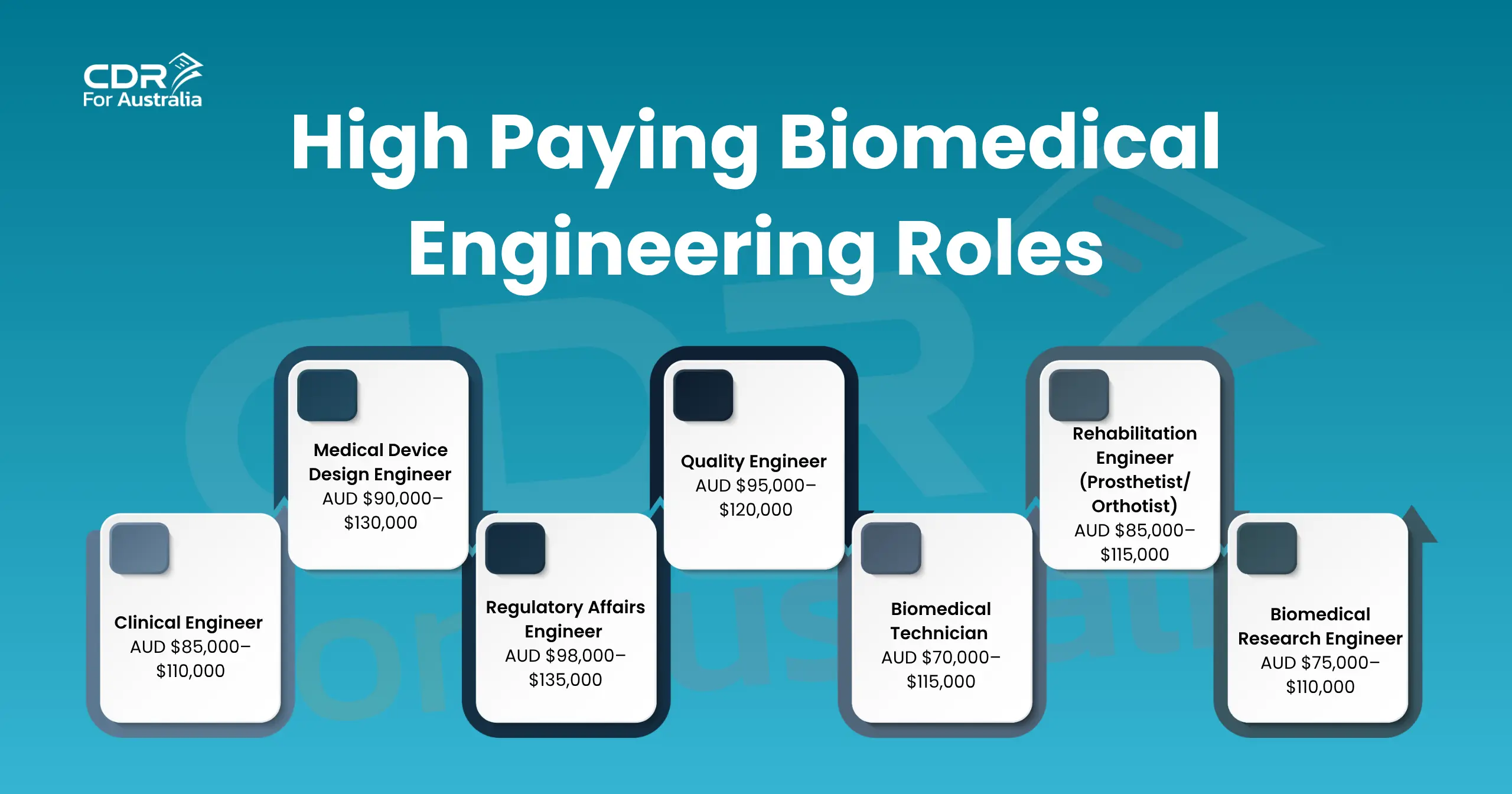
“Biomedical engineer” is really an umbrella term rather than one specific job. Underneath it sit several distinct roles spread across hospitals, device manufacturers, and research institutions, each with its own duties, entry requirements, and pay band. Here’s a rundown of the roles that most commonly fall under this title in Australia.
1. Clinical Engineer
Clinical engineers are the people keeping a hospital’s equipment actually working: installing, testing, calibrating, and repairing imaging systems, ventilators, patient monitors, and surgical devices, plus training clinical staff to use it all safely.
Getting into this role generally means a bachelor’s degree in biomedical, electrical, or mechanical engineering, along with a solid handle on Australian medical equipment safety standards. Public health employers often lean toward candidates registered with Engineers Australia.
Average Salary: AUD $85,000 – $110,000
2. Medical Device Design Engineer
This is the role behind new medical devices, from surgical instruments to implantable tech like pacemakers and cochlear implants. Expect a lot of prototyping and testing, and close, ongoing collaboration with clinical and manufacturing teams.
Most employers want a bachelor’s or master’s degree in biomedical engineering, strong CAD and prototyping ability, and hands-on familiarity with ISO 13485 product development standards.
Average Salary: AUD $90,000 – $130,000
3. Regulatory Affairs Engineer
Nothing gets sold in Australia without clearing regulatory hurdles first, and that’s this role’s job: preparing technical files, dealing directly with the Therapeutic Goods Administration, and making sure a product is genuinely safe and compliant before it ever reaches a shelf or an operating theatre.
You’ll typically need an engineering, science, or biomedical degree here, plus real working knowledge of TGA regulations and international frameworks like ISO 13485 and EU MDR.
Average Salary: AUD $98,000 – $135,000
4. Quality Engineer
Quality engineers keep a constant eye on testing, documentation, and compliance so that devices don’t slip below the required safety and performance bar. Day to day that means running audits, chasing down non-conformance reports, and keeping certifications current.
This one usually calls for a background in biomedical or industrial engineering, a genuinely sharp eye for detail, and experience working inside quality management systems like ISO 13485.
Average Salary: AUD $95,000 – $120,000
5. Biomedical Technician
Biomedical technicians are the ones doing the routine servicing, maintenance, and calibration work on hospital and clinic equipment day in, day out. Plenty of graduates use it as a stepping stone toward a full clinical engineering role, though the position itself pays better than the “technician” label might suggest.
A diploma or bachelor’s degree in biomedical engineering or a related technical field is the usual entry point, backed up by genuine hands-on equipment servicing experience.
Average Salary: AUD $70,000 – $115,000
6. Rehabilitation Engineer (Prosthetist/Orthotist)
This role is part engineering, part clinical care: designing and fitting prosthetic limbs, orthotic devices, and mobility aids for patients working through injury, illness, or disability. There’s a lot of direct patient contact involved, more than most other roles on this list.
Getting there usually means a bachelor’s degree in prosthetics and orthotics or biomedical engineering, plus clinical placement hours and, in most states, professional registration.
Average Salary: AUD $85,000 – $115,000
7. Biomedical Research Engineer
Based mostly in universities, hospitals, and research institutes, these engineers spend their time developing new technology, whether that’s tissue engineering, new biomaterials, or diagnostic tools. Expect a heavy dose of experimental design, data analysis, and grant applications.
A postgraduate degree, usually a Master’s or PhD in biomedical engineering, is close to mandatory here, along with solid research and lab skills.
Average Salary: AUD $75,000 – $110,000
Public Hospitals vs Private Industry: Pay by Sector
Experience isn’t the only lever here, which sector you work in matters almost as much. Hospital pay tends to follow a set, predictable scale, while private device companies are usually willing to pay a premium for skills that are harder to find.
Sector | Average Pay | Focus Area |
Public Hospitals | $60,000 – $110,000 | Equipment servicing and compliance |
Private Industry | $95,000 – $140,000 | Product development and regulatory affairs |
Research & Academia | $75,000 – $100,000 | Grant-funded research and biomaterials |
Landing a private-sector role usually means you’ll need to be comfortable with documentation and know your way around Therapeutic Goods Administration rules and ISO 13485, since these jobs come with real accountability for whether a product actually gets approved for market.
Factors That Affect Biomedical Engineering Salary
A handful of factors, working together, decide where any one engineer sits on the pay scale:
- Years of experience: the jump becomes noticeable after the first four or five years on the job.
- Sector: private device companies typically out-pay public hospitals and research institutions.
- Location: Sydney and Melbourne salaries tend to beat regional areas and smaller capitals.
- Specialisation: regulatory affairs, quality systems, imaging tech, and implant design skills all command a premium.
- Qualifications: a postgraduate degree or a recognised certification tends to speed up the path to senior roles.
- Employer size: multinationals generally offer a higher base salary and more structured bonuses than small local firms.
How to Increase Your Pay as a Biomedical Engineer
If you’re trying to push your own biomedical engineering salary up over time, it usually comes down to a mix of skill-building and how you position your career. A few approaches tend to work well:
- Pick up a postgraduate qualification. A Master’s in biomedical or clinical engineering can be the thing that gets you noticed for senior technical or leadership roles.
- Learn the regulatory side properly. Getting comfortable with TGA rules and ISO 13485 opens up better-paying roles at private device companies.
- Don’t be afraid to switch employers. A move every few years tends to bring a bigger pay bump than waiting around for an internal promotion.
- Get registered. Being listed with Engineers Australia or on the National Engineering Register tells employers your competency has been checked, which helps when you’re negotiating salary.
- Keep your paperwork in order. Engineers with well-documented career episodes and a tidy resume tend to move through hiring and promotion rounds faster, and faster movement usually means faster pay growth.

Looking for expert CDR Writer for Engineers Australia?

Creating a CDR Report may be difficult due to Engineers Australia’s standards and rules ( EA ). Our experienced engineers have assisted many people in obtaining approval for their report from the EA via the use of powerful projects.
Starting Your Biomedical Engineering Journey in Australia?
For engineers trained overseas, there’s a fairly well-worn path into an Australian biomedical career, one that runs through skills recognition and the skilled migration system. Here’s roughly how it plays out.
Step 1: Confirm the right occupation code. Biomedical Engineer sits under ANZSCO code 233913. Before doing anything else, check that this code actually appears on the skilled occupation list tied to the visa subclass you’re aiming for.
Step 2: Complete a skills assessment with Engineers Australia. This is the piece almost every applicant has to get through. In practice, it means putting together a Competency Demonstration Report covering career episodes, a summary statement, and evidence of ongoing professional development. Anyone without an accredited degree will need to demonstrate their competencies against the required engineering elements in more detail.
Step 3: Meet the English language requirement. Most visa subclasses expect a minimum score on an approved test like IELTS or PTE, unless prior study or citizenship gets you an exemption.
Step 4: Submit an Expression of Interest (EOI). With the skills assessment approved, the next move is lodging an EOI through SkillSelect, which scores you on age, qualifications, work experience, and English ability.
Step 5: Secure an invitation and apply for a visa. From here, points and demand for the occupation determine whether you land an invitation for a skilled independent visa, a state-nominated visa, or an employer-sponsored pathway if a job’s already lined up.
Step 6: Check state and professional registration requirements. Some states, and some biomedical roles in particular, especially clinical and hospital positions, ask for extra registration or induction once you’re actually working in Australia.
A clean, well-documented CDR that clears Stage 1 competency assessment tends to move through the system with fewer hiccups, simply because assessors can verify the claims more easily. Jobs and Skills Australia also notes that registration requirements can vary by state and territory, so it pays to check the local licensing rules before accepting a role.
Frequently Asked Question (FAQs)
Is biomedical engineering in demand in Australia?
It is, and that’s not likely to change soon. An ageing population, wider use of medical technology, and the constant need for equipment servicing and compliance work across both public and private healthcare keep demand fairly steady.
Can biomedical engineers get PR in Australia?
Yes. Permanent residency is available through the skilled migration visa categories, as long as you pass an Engineers Australia skills assessment and hit the points threshold for your occupation code, biomedical engineering included.
Which engineer is highly paid in Australia?
Mining, petroleum, biomedical and specialised software engineers tend to top the salary tables nationally, though biomedical engineers in senior regulatory or product development positions can get close to that upper range.
What is the entry level biomedical engineering salary in Australia?
Typically somewhere between $58,000 and $78,000 a year, with the exact figure shaped by the employer, the state, and whether the job’s in a public hospital or a private company.
What is the biomedical engineering salary in Australia per month?
Working off the average annual figure of around $98,000, that comes out to roughly $8,100 a month before tax. It’s just an average though a fresh graduate will see less, and a senior engineer in the private sector often earns more.
What is the average biomedical engineer salary in Sydney and Melbourne?
Both cities sit above the national average, mainly because most hospital networks and device companies have their offices there. More employers competing for talent tends to push salaries up.
What is the biomedical engineering starting salary in Australia?
Generally between $58,000 and $70,000 a year for a fresh graduate. Where you land in that range depends on the employer’s size, the state, and whether it’s a public hospital or private company.
How does biomedical engineering pay compare to nursing?
Biomedical engineering generally pays less than specialised medical roles like doctors or surgeons, but it often sits above general nursing salaries, especially in senior or private-sector positions. The trade-off is a shorter and less costly training path compared to most clinical medical careers.