


AIMS Skills Assessment for Australian Migration
Considering migrating to Australia as a Medical Laboratory Professional? If your nominated occupation is covered by the Australian Institute of Medical and Clinical Scientists (AIMS), it may be a requirement for Australian migration to undertake an AIMS Skills Assessment.
The Department of Immigration (Department) and Skills Australia (Skills) jointly oversee the assessment of a skilled visa for several medical laboratory occupations through AIMS. For some occupations, because of their professional nature, the education and skills required may need to be demonstrated based on the education and skills requirements set by AIMS, based on your qualifications and level of professional experience.
We are able to help overseas applicants through the AIMS assessment process, compile supporting documents, review their professional profile and add it to the AIMS application, and prepare for submission at CDR for Australia.
What Is an AIMS Skills Assessment?
AIMS Skills Assessment is a test of your skills, work experience and qualifications to determine if they meet the criteria for an occupation evaluated by the Australian Institute of Medical and Clinical Scientists.
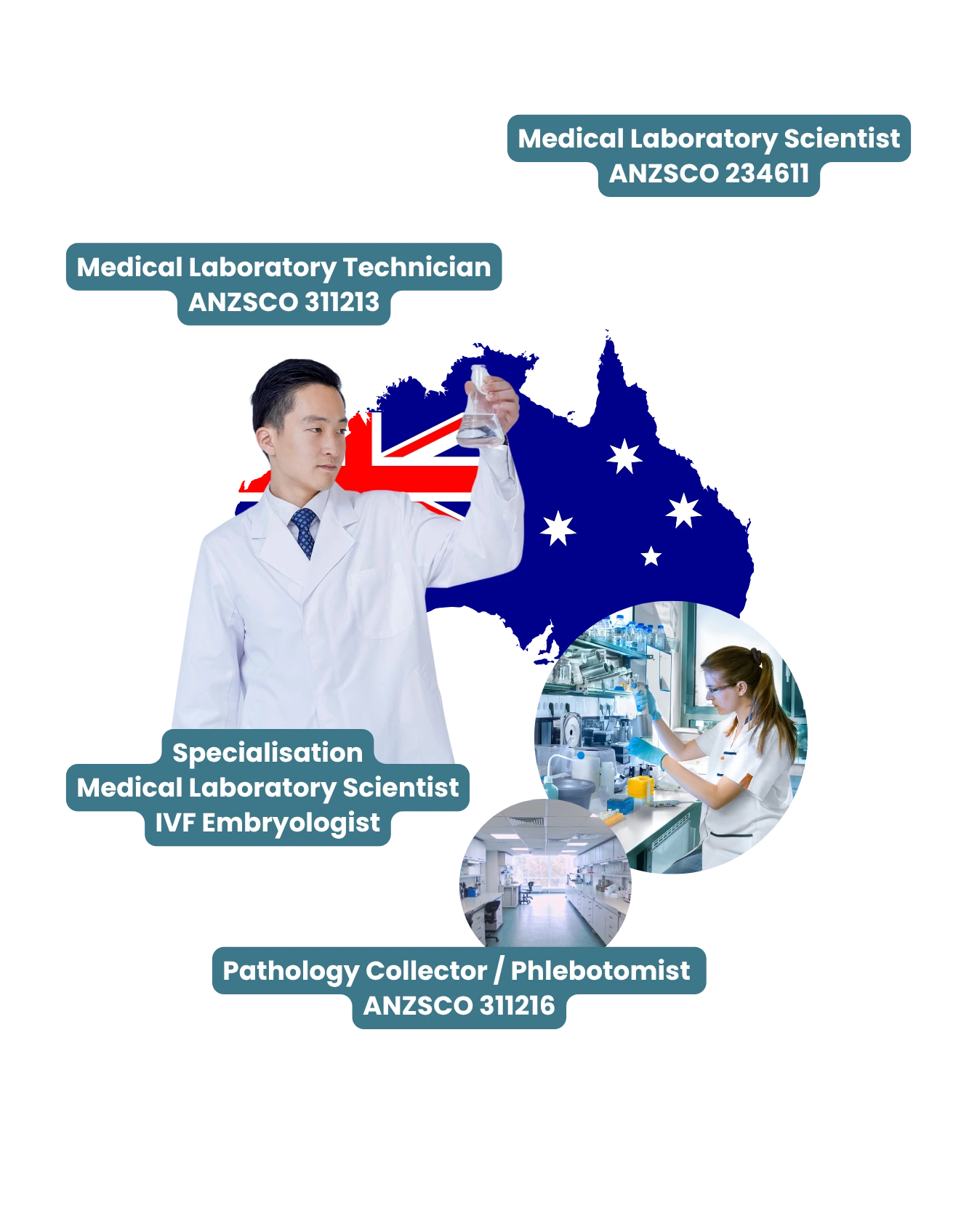
AIMS evaluates applicants on a spectrum of similar medical laboratory careers for Australian migration purposes, such as:
- Medical Laboratory Scientist – ANZSCO 234611
- Medical Laboratory Technician – ANZSCO 311213
- Specialisation: Medical Laboratory Scientist – IVF Embryologist
- Pathology Collector / Phlebotomist – 311216
This assessment will lead to determining whether the occupation you wish to nominate you is appropriate to your qualifications and professional background.
A positive skills assessment result is not a visa in itself; it is just one component of the visa application process. Instead, it may be included as part of the broad skilled visa immigration pathway, along with other visa conditions determined by the Department of Home Affairs of the Australian Government.
Who Needs an AIMS Skills Assessment for Australian Migration?
An AIMS assessment may be required if you are an overseas qualified professional who wishes to nominate an occupation assessed by AIMS for a pathway in the Australian skilled migration program.
Applicants may include:
- Medical Laboratory Scientists
- Medical Laboratory Technicians
- Medical Scientists
- Laboratory Science graduates
- Pathology professionals
- IVF Embryologists
- Pathology Collectors
- Phlebotomists
Eligibility is based on individual qualifications, academic content, work experience and other evidence.
If you have a job title that is similar to one that has been assessed by AIMS, it does not guarantee you a positive assessment. Your relevant learning and work experience must meet the specified assessment criteria.
AIMS-Assessed Occupations for Migration
Medical Laboratory Scientist – ANZSCO 234611
Medical Laboratory Scientist is a major occupation assessed by AIMS.
Laboratory investigations on blood, body fluids, tissues and other biological specimens may be conducted by professionals involved in this field. They can help in the diagnosis, treatment and prevention of disease.
Candidates applying for evaluation as Medical Laboratory Scientists must be able to establish that their academic qualifications and professional experience are suitable for the job.
Medical Laboratory Technician – ANZSCO 311213
AIMS also evaluates candidates who are applying to become Medical Laboratory Technicians.
Generally, Medical Laboratory Technicians conduct laboratory testing and other laboratory-related technical tasks within an appropriate level of supervision.
Applicants will be required to provide evidence of the necessary education, practical training and relevant professional experience to meet the requirements of the applicable AIMS.
IVF Embryologist
The Medical Laboratory Scientists who specialise as IVF Embryologists have a specific assessment pathway at AIMS.
Qualification for the pathway may result in completion of the relevant professional examination after the assessment – depending on the assessment outcome and the individual circumstances of the applicant.
Pathology Collector / Phlebotomist – ANZSCO 311216
AIMS also evaluates those who apply for evaluation to become a Pathology Collectors / Phlebotomist.
The work is concerned with the taking of specimens such as blood specimens for analysis in the laboratory.
The AIMS requirements are currently in effect; candidates are advised to read carefully before preparing their applications.
AIMS Skills Assessment Requirements
Some requirements are dependent on the job and your personal situation. Hence, it is important to always read the current AIMS guidelines when applying.
Supporting evidence could be:
- Passport or ID cards
- Degree certificates
- Academic transcripts
- Course information
- Professional qualifications
- Employment references
- Employment verification documents
- Evidence of relevant experience of work.
- English language evidence if applicable
- Evidence of registration/licensing as required.
- Copies of documents, certified.
- Documents translated into English (when necessary)
The documents submitted should provide a consistent picture of your academic and professional background.
Academic Qualification Requirements
One of the primary factors in an AIMS assessment is your academic qualification.
Medical Laboratory Scientist applicants are required to have appropriate qualifications that reflect education and training in medical laboratory science relevant to the qualification.
AIMS assesses overseas qualifications based on its assessment requirements. The assessment can take into account:
- Qualification level
- Duration of study
- Course content
- Laboratory subjects
- Practical training
- Experience in a clinical or laboratory environment
- Professional experience
- The relevance of the nominated occupation
An assessment may be based on just a degree title. A transcript of academic records and other supporting documentation may be significant to illustrate the content and breadth of your academic training.
Work Experience Requirements
Another factor that can play a significant role in your AIMS Skills Assessment is your professional experience.
Your work history should be evident in your employment documents and explain the type of work you have done.
Information that is relevant can include:
- Employer name
- Position title
- Work start/end dates
- The full-time or part-time category
- Weekly working hours
- Main responsibilities
- Laboratory areas in which you worked
- Professional duties
- Relevant technical skills
The agreements of employment should reflect your actual duties.
Don’t use a job description that is used for any position. If your employment history is clear and concise, the assessing authority will have a clearer picture of your employment history.
English Language Requirements for AIMS Assessment
Another criterion to consider in preparing an AIMS application is English language requirements.
AIMS has English language requirements for applicants who are applying for a skills assessment for migration. These requirements may be subject to change and applicants are advised to check the most up-to-date requirements with AIMS prior to making their application.
If an English test is required, make sure that:
- Your test is accepted by AIMS.
- The scores you’ve achieved meet the criteria.
- Reporting of the test result is allowed for the purpose to which it was applied.
- Your evidence is presented in the appropriate form.
It is important to note that the language requirements may be changed and information from external sources might be outdated.
AIMS Skills Assessment Process
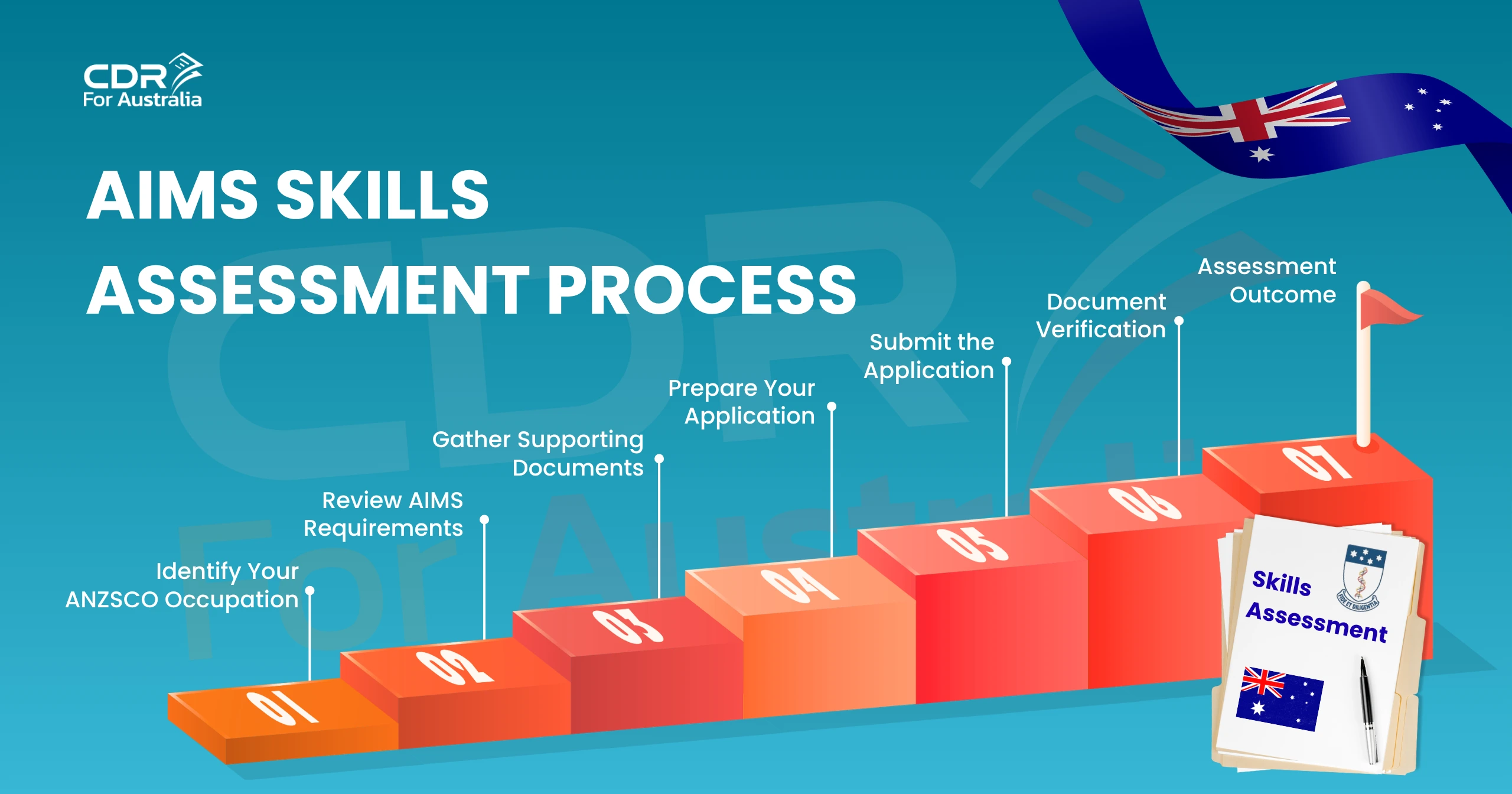
There are a number of steps in the process for assessing an AIMS.
Step 1: Identify Your ANZSCO Occupation
Prior to applying, determine which occupation is best suited to your skills and work experience.
For example:
Medical Laboratory Scientist – ANZSCO 234611
or
Medical Laboratory Technician – ANZSCO 311213
Choosing the right occupation is crucial as assessment requirements may vary from pathway to pathway.
Step 2: Review AIMS Requirements
Check AIMS guidelines for the most recent information for your nominated occupation.
Pay attention to:
- Qualification requirements
- English requirements
- Employment requirements
- Identity documentation
- Professional registration
- Certification requirements
- Examination requirements
- Application procedures
Step 3: Gather Supporting Documents
Draft all necessary documents prior to filing an application.
This can include your academic documents, evidence of employment, identity documents, and evidence of English language.
Make sure that names, dates, qualifications and employment information are consistent across documents.
Step 4: Prepare Your Application
Fill in the appropriate AIMS form in detail.
Avoid leaving sections of the answer blank. If a question is not relevant to your situation, follow directions given by AIMS.
Step 5: Submit the Application
Make sure to apply and submit the supporting documents in accordance with the updated AIMS application guidelines.
If additional information is required during the assessment process, it will be requested by AIMS.
Step 6: Document Verification
AIMS may confirm your education, employment, English ability and identity, and other evidence.
Therefore, it is important that all data provided in the application is correct and factual.
Step 7: Assessment Outcome
Once assessed, you will be notified of the outcome of your assessment.
You may be assessed as being equipped for the nominated occupation, or you may need to undertake additional assessment requirements, depending on your pathway and situation.
AIMS Professional Examination
A person applying might be required to take an AIMS professional examination.
This requirement will be determined by the assessment pathway and the results of the qualification assessment.
The Medical Laboratory Scientist Professional Examination consists of an examination on some of the following laboratory science areas:
- Anatomical Pathology
- Chemical Pathology
- Genomic Pathology
- Haematology
- Immunopathology
- Medical Microbiology
- Transfusion Science
The necessary sessionists should prepare for the examination based on the latest AIMS examination information.
All applicants do not have to take the professional examination. The number of required hours depends on your individual assessment pathway.
AIMS Skills Assessment Processing Time
An application may take longer to process if you are unable to provide all the information requested.
The following are factors that may impact the processing:
- Missing documents
- Complex academic qualifications
- Overseas qualification verification
- Employment verification
- Additional information requests
- Third-party responses
- Address documentation and/or translation concerns
AIMS’ current estimated processing information is published on its website, and applicants are advised to verify the migration time on the official website before making their migration timelines.
It is best to send in a full application and not rush to file an application without documents.
AIMS Skills Assessment Fees
AIMS charges fees for its assessment and professional examination services, if applicable.
The amount may vary according to:
- Type of assessment
- Occupation
- From within or without Australia
- Whether a professional examination is required
Assessment fees are subject to change, so please check with AIMS before paying the fee for the most up-to-date information.
Common AIMS Skills Assessment Mistakes
When it comes to paperwork, an AIMS application can get quite complicated if the applicant doesn’t provide everything or if the information is not consistent.
Choosing an Incorrect Occupation
The nominated occupation you choose should be suitable for your skills and work experience.
Submitting Incomplete Academic Documents
Lack of transcripts, ambiguous certificates, or incomplete educational documentation can cause problems with assessment.
Providing Weak Employment Evidence
Your job documents should make it clear your professional experience and responsibilities, the dates, and working arrangements.
Inconsistent Information
The information on your CV, application form, employment references and other documents should be consistent.
It might be necessary to provide further clarification, for instance if there are discrepancies in the employment dates or job titles.
Ignoring Current AIMS Guidelines
Requirements may evolve as time goes by. This may be out-of-date information published several years ago.
Please refer to the latest AIMS guidelines when applying.
Assuming a Degree Guarantees a Positive Result
An assessment of a positive result does not automatically follow working in a medical laboratory setting.
AIMS will review your overall application.
Confusing AIMS Membership With Skills Assessment
Migration Skills Assessment is not a part of AIMS membership.
For those wishing to migrate to Australia, membership assessment is not the route to take but rather the right migration skills assessment pathway.
AIMS Skills Assessment for Skilled Migration
A favourable skills assessment result can be a crucial element of Australia’s skilled migration.
Your assessment could be useful when you are submitting an Expression of Interest or other migration application, depending on your occupation and visa pathway.
There are potential visas to consider for skilled migration, including:
- Skilled Independent visa
- Skilled Nominated visa
- Skilled Work Regional visa
Getting a positive AIMS assessment does not, however, immediately mean that you are invited and get a visa.
You will also need to meet the criteria set by the Department of Home Affairs and any relevant state/territory nomination authority.
How CDR for Australia Can Help
Making an AIMS Skills Assessment application can be difficult, particularly if you have studied in a different country.
We at CDR for Australia can assist with your application preparation and documentation if you are thinking of taking an AIMS assessment.
Our AIMS Assessment Support includes:
- Initial profile evaluation
- Occupation assessment guidance
- ANZSCO occupation guidance
- Qualification document review
- Academic transcript review
- Employment evidence review
- Document organisation
- Application preparation support
- English requirement guidance
- Professional examination guidance
- Pre-submission document checking
We are aiming to make you realize what evidence you need and to show you your profile in a professional way.
Why Choose CDR for Australia?
Professional Documentation Support
Assist applicants in structuring their academic and professional information in the evaluation process.
Personalised Assessment Guidance
Each applicant is unique with their own education and employment history. Your personal situation is taken into account.
Complete Application Review
We can check your documents for missing information, inconsistencies, and presentation before submission.
Migration-Focused Assistance
Our service is offered to professionals who are currently in the process of preparing for the Australian migration process and require assistance with preparing for skills assessment.
AIMS Skills Assessment Checklist
As you start your application, think about if you have:
- Recognized the right occupation to assess for AIMS
- Reviewed AIMS eligibility criteria.Reviewed current AIMS eligibility requirements.
- Produced an appropriate set of qualification papers
- Collected academic transcripts
- Produced suitable evidence of employment
- Checked English-language requirements
- Prepared identity documents
- Provided translations or certifications as needed
- Checked your application for errors and mistakes
- Verified the up-to-date AIMS charges
- Determined if a professional exam would be applicable to you

Looking for expert CDR Writer for Engineers Australia?

Creating a CDR Report may be difficult due to Engineers Australia’s standards and rules ( EA ). Our experienced engineers have assisted many people in obtaining approval for their report from the EA via the use of powerful projects.
Get Help With Your AIMS Skills Assessment
Your AIMS Skills Assessment can be an important part of your Australian migration journey. It is important to carefully prepare your documents and understand what is required before submission to avoid unnecessary delays in document processing and issues.
For a Medical Laboratory Scientist, Medical Laboratory Technician or IVF Embryologist intending to migrate to Australia or a Pathology Collector/Phlebotomist, CDR for Australia can assist you in the preparation process of the required assessment.
Talk to CDR for Australia now and get expert advice on your Australian migration AIMS Skills Assessment.
Frequently Asked Question (FAQs)
What is AIMS Skills Assessment for Australian migration?
AIMS Skills Assessment is a medical laboratory assessment which is administered by the Australian Institute of Medical and Clinical Scientists for eligible occupations. It may be applied in the context of Australian skilled migration to be assessed by AIMS.
What is the AIMS assessment authority?
The Australian Institute of Medical and Clinical Scientists (AIMS) is the body that assesses relevant medical laboratory occupations for migration purposes.
What is the ANZSCO code for Medical Laboratory Scientist?
Medical Laboratory Scientist has the ANZSCO code 234611.
What is the ANZSCO code for Medical Laboratory Technician?
Medical Laboratory Technician has an ANZSCO code of 311213.
Do I need an AIMS Skills Assessment to migrate to Australia?
AIMS is the relevant assessing body for a nominated occupation where AIMS is the skills assessment body. Generally, if your nominated occupation is listed as a skill assessment body as AIMS, you will need to have the relevant skills assessment completed before submitting an application for the relevant skilled migration pathway.