


ACWA Skills Assessment Australia
For community services workers looking to migrate to Australia, a positive result for their ACWA Skills Assessment may be a critical part of the skilled migration process. ACWA (now Community Work Australia) evaluates qualifications, work experience, English skills and other documentation to ensure that an applicant qualifies for an eligible community work occupation.
Community Work Australia is the skills assessing authority for a variety of community and welfare occupations. It is assessed through its current pathways, which include General Skilled Migration occupations, along with some occupations under Designated Area Migration Agreements (DAMA) and the Aged Care Industry Labour Agreement (ACILA).
A skills assessment does not constitute a visa application. This assessment is to establish if your skills and experience are appropriate to the job you have nominated. A successful result can then form part of the wider Australian migration process, which will depend on the visa pathway.
We can assist applicants to know what is required for the assessment, collate their evidence, identify what may be missing and advise on a structured application prior to submission at CDR for Australia.
The decision on which occupation to choose is the applicant’s responsibility and the applicant is advised to read the relevant assessment criteria and ANZSCO occupation information before making a choice.
What Is an ACWA Skills Assessment?
An ACWA Skills Assessment is an assessment of your ACWA skills against the requirements for a nominated community work occupation.
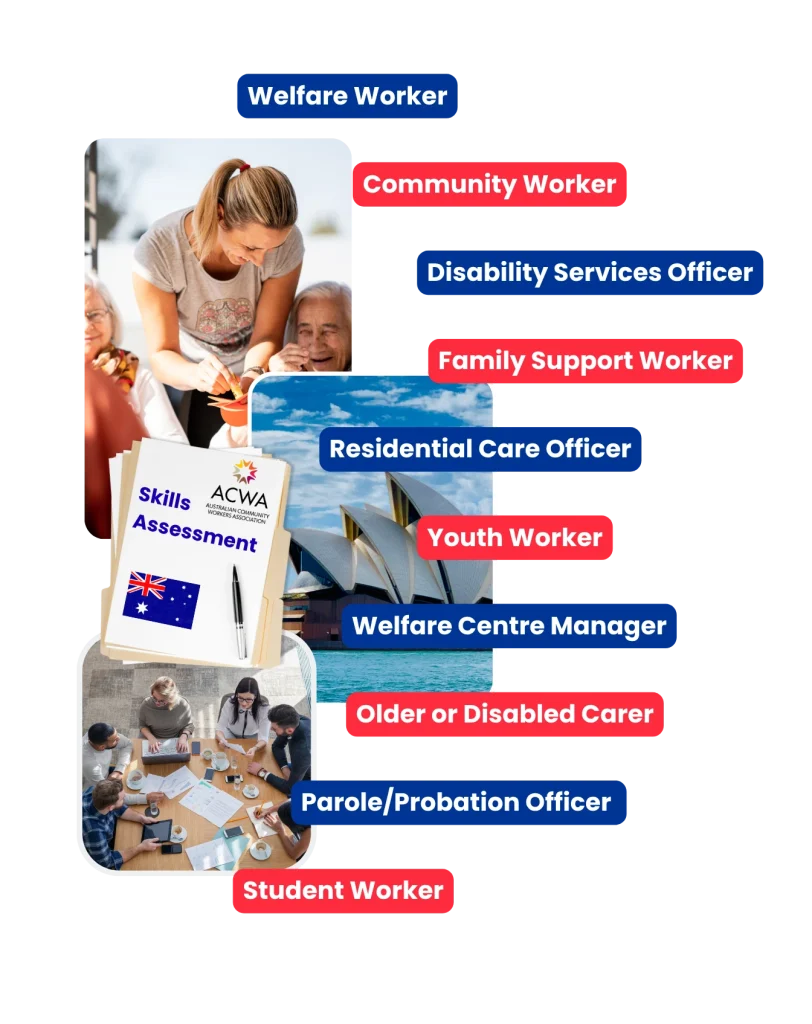
Community Work Australia is currently evaluating the following occupations:
- Welfare Worker
- Community Worker
- Disability Services Officer
- Family Support Worker
- Residential Care Officer
- Youth Worker
- Welfare Centre Manager
- Older or Disabled Carer
- Parole/Probation Officer (DAMA only)
- Student Worker in Residential Child Care for Children and Youth: DAMA only
- A DAMA will not accept Refugee Workers as part of its population
The occupation and path that you are able to pursue will depend on your qualifications, your work history and your migration program.
Applicants are advised to carefully consider their skills and responsibilities in relation to the skills and responsibilities of the occupation they wish to nominate for.
Who Needs an ACWA Skills Assessment?
If you are a qualified community services worker and you want to apply for an occupation assessed by Community Work Australia for an Australian migration pathway, you may need to get an ACWA Skills Assessment.
It may be relevant if you:
- Possess an overseas community services/welfare qualification
- Be experienced in community or welfare services work
- Are interested in moving to Australia through one of the eligible skilled migration options.
- Interested in proving that your qualifications/experience match your nominated occupation
- Considering a DAMA pathway which would involve an occupation assessed by Community Work Australia
- If you need an assessment for an eligible aged-care related labour agreement pathway, then please reach out to the staff.
It is crucial to choose the proper occupation and migration pathway before starting an application. Community Work Australia can help applicants find out if their skills and experience might match an occupation it has assessed by offering an eligibility tool.
ACWA Skills Assessment Eligibility Requirements
There are different eligibility requirements for the different occupations and pathways. Community Work Australia evaluates applications for a range of purposes, such as qualification relevance, employment, industry currency and English language skills.
Relevant Qualification
You must be qualified for the occupation you have nominated, and qualified in the required education.
The necessary level of qualification may vary by occupation. For instance, Community Worker occupations have a skill level requirement of appropriate to AQF Level 5, whereas other occupations may have different skill level requirements.
If you have a postgraduate qualification, you may still have to submit evidence of your base qualification (undergraduate). According to Community Work Australia, applicants will need to include documentation to support their qualification, such as a bachelor’s degree (if applicable).
Relevant Employment Experience
Work experience typically should include a history of work activities relevant to the occupation you wish to be nominated for.
Community Work Australia takes into account:
- The site and job category that were offered, e.g., your place of work and position.
- Job responsibilities
- Post-qualification employment
- How much time did you spend at work? How many hours did you work?
- The nature of work or employment.The character of the work or employment.
- Relationship between your employment and nominated occupation
- Industry currency
For instance, Community Worker assessment criteria differentiate between professional community and human services jobs and support jobs. Just being employed in the same job location does not guarantee that the job has the appropriate skill level.
English Language Proficiency
In certain occupations in the General Skilled Migration (GSM) category, English proficiency may be required by submitting a valid pathway.
The English requirements for Community Work Australia are specific results to be obtained from accepted English tests and have been revised from 7 August 2025. It also indicates that now, employment is not considered an indicator of English proficiency for this purpose.
Always refer to the current English entry requirements for your nominated occupation and pathway before sending your application, as this may differ from the above.
Industry Currency
An important component of the assessment can also be from the perspective of industry currency.
Community Work Australia will assume that your skills are current if your qualification and/or recent professional work experience demonstrates this. Specific currency requirements will vary based on the nominated occupation and assessment pathway.
So, applicants should not depend on a previous qualification. Current skills may need to be demonstrated through relevant evidence and/or experience gained in the workplace.
Documents Required for ACWA Skills Assessment
One of the most fundamental requirements of an application for an ACWA Skills Assessment is to prepare the appropriate documentation.
Based on the Community Work Australia document checklist, applicants might be required to submit evidence regarding identity, English ability, qualifications and employment based on their situation.
Examples of common documentation include:
Identity Documents
Applicants may need:
- Passport biography page
- Birth certificate
- Government-issued identification
- Driver’s license or National identity card.
- Documentation of name change, if required.
Most applicants will require at least 3 pieces of identification, covering their passport biography page and other official identification. Typically, applicants should have a minimum of 3 identity documents, including their passport biography page and other official identification.
Academic Documents
Depending on your circumstances, you may need:
- Degree certificate
- Diploma or certificate
- Academic transcripts
- Completion letter
- Qualification details
- Evidence of course dates
- Documents that support qualifications (underpinning)
Have the same name and date on academic records and identity documents.
Employment Evidence
Evidence of employment can be provided in the form of:
- Employer reference letters
- Statements of service
- Employment contracts
- Payslips
- Tax documents
- Position descriptions
- Evidence of employment dates
- The use of a timesheet to record working hours.
Evidence of employment should make it clear what your professional responsibilities were and how high your level of work was.
Resume/CV
A detailed and accurate CV can help provide a clear overview of your:
- Education
- Professional experience
- Job titles
- Employers
- Employment dates
- Responsibilities
- Relevant experience in the community
Your CV should be uniform with other evidence to be submitted with your application.
ACWA Skills Assessment Process
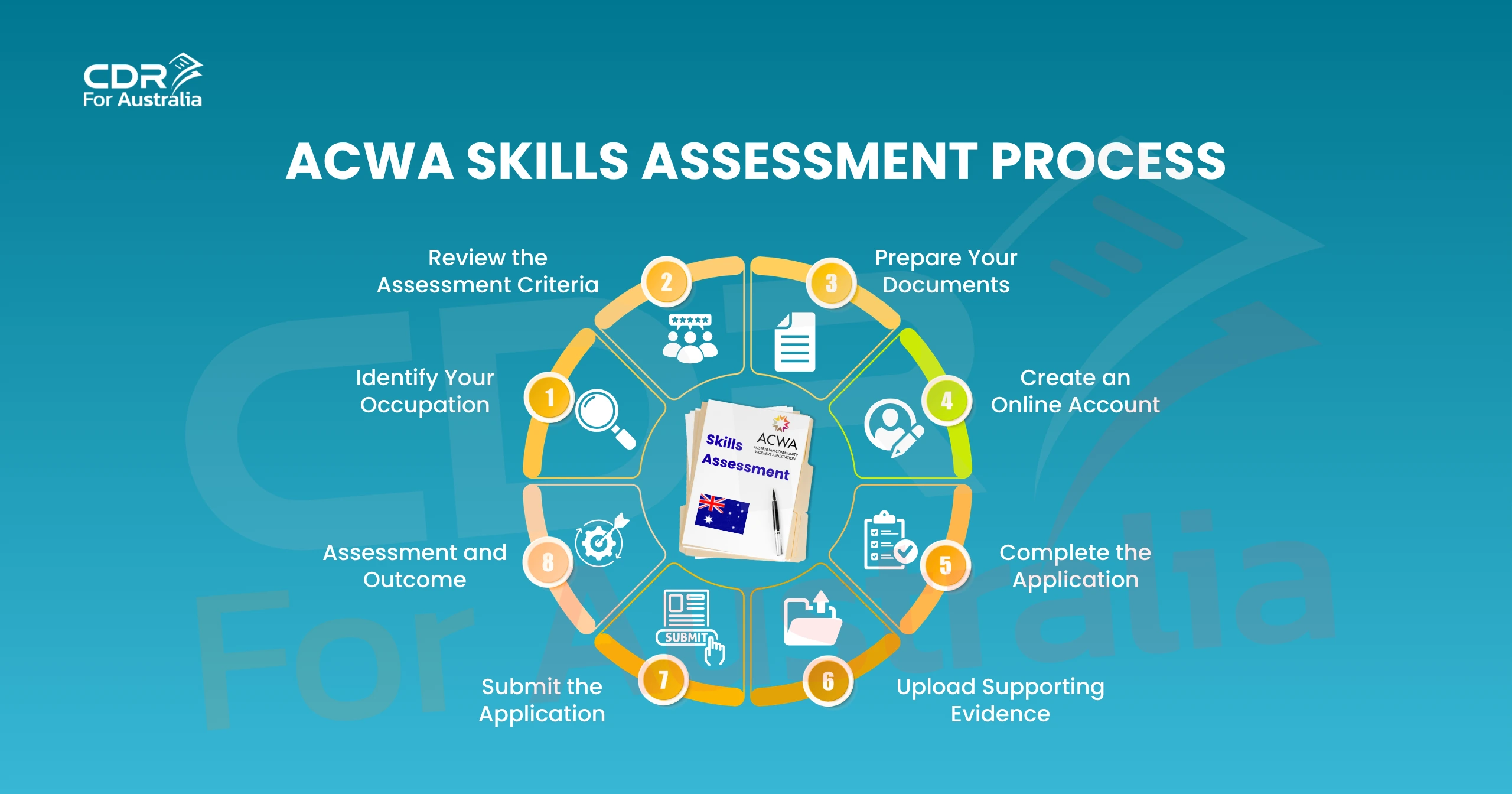
The process of applying for the job has several crucial steps.
Step 1: Identify Your Occupation
The first step is to find the Community Work Australia occupation that best fits your skills, training and work.
Try not to choose a career based on a similar-sounding job title. It is important to consider your actual duties, qualifications and experiences as well as your skill level.
Step 2: Review the Assessment Criteria
Read through the assessment criteria for the occupation selected.
Check:
- Qualification requirements
- Employment requirements
- English requirements
- Currency requirements
- Required evidence
- Migration pathway
Community Work Australia suggests applicants self-evaluate against the criteria to determine if they meet the requirements before applying.
Step 3: Prepare Your Documents
Gather and arrange documents to support the application prior to application preparation.
A thorough documentation package will minimize the risk of delays due to lack of or confusing evidence.
Step 4: Create an Online Account
All skills assessment applications must be sent via Community Work Australia’s online skills assessment portal.
Applicants may apply through the website, track the application process and download the letter or certificate of the outcome.
Step 5: Complete the Application
Input your personal, educational, employment and other relevant information correctly.
You must choose the right migration program, for example:
- General Skilled Migration
- DAMA
- Aged Care Industry Contract
The available pathway is determined by the circumstances and the occupation being nominated.
Step 6: Upload Supporting Evidence
Provide documents in the format requested by Community Work Australia.
When you submit, be sure that:
- Documents are readable
- Names are consistent
- Dates are accurate
- Information about the job is consistent with documentation of evidence
- Details for qualification are fully complete.
- Evidence in English meets requirements as appropriate.
Step 7: Submit the Application
Upon completion of the application, submit it to the online application and pay the required assessment fee.
Skills assessment applications are not accepted via email by Community Work Australia.
Step 8: Assessment and Outcome
Once your application and supporting evidence have been submitted, it goes to the assessment officer for review.
A possible status for an application is:
- Draft
- Submitted
- In Progress
- Documents Requested
- Not Suitable
- Suitable
This is conveyed on the portal of the applicant / by e-mail.
ACWA Skills Assessment Processing Time
The processing time may vary depending on the number of applications, the type of assessment, documentation, and other factors.
Applicants should always refer to the latest Community Work Australia processing-time information before applying instead of using out-of-date information provided elsewhere.
If further documentation or clarification is required, it’s important to ensure that the answer is both correct and timely to prevent further delays.
Community Work Australia also indicates that fast-track requests are subject to an application’s formal submission and are regarded on an individual basis. Fast-tracking may not occur.
Common Reasons for ACWA Skills Assessment Problems
A skills assessment may be complicated if the evidence is not clear that the applicant possesses the skills.
Common problems include:
Choosing the Wrong Occupation
A job title is not sufficient to base your occupation on. The responsibilities and the level of professional skill should relate to the nominated occupation.
Insufficient Qualification Evidence
Submitting an incomplete transcript, missing qualification certificates, or failing to submit underpinning qualifications may cause issues when being assessed.
Weak Employment Evidence
Job letters with just your job title and employment dates might not provide enough information about your work.
Inconsistent Information
When there is a difference between CV, applications, reference letters, payslips, and academic records, it can cause questions.
Missing English Evidence
If the pathway calls for English evidence, an invalid or out-of-date test result may cause issues.
Poorly Organized Documentation
The absence of documents based on the checklists will lead to the loss of evidence and further requests.
How We Can Help With Your ACWA Skills Assessment
It can be difficult to prepare an application for a skills assessment, especially if you have qualifications and work experience from overseas.
Our ACWA Skills Assessment support is based on assisting applicants to create a well-structured and clear application.
The following can be part of our support:
- Occupational and eligibility assessment
- Qualification documentation review
- Employment evidence review
- Annual review of employment history and CVs.
- Document checklist preparation
- Defining survey evidence gaps.Survey evidence gap identification.
- Application preparation guidance
- Review of supporting documents
- English evidence checklist
- Submission-readiness review
- Support on dealing with documentation issues
We want to aid you in creating an application that is clearly organized and shows your qualifications and experience in relation to the required assessment criteria.
ACWA Skills Assessment vs Australian Visa Application
There is an important point to note: A skills assessment is not a visa application.
Skills assessment refers to determining the fit of your skills and experience for a nominated occupation.
A visa application is made to the Australian Government and has its own eligibility criteria.
A simplified pathway can look like:
Qualification & Experience → ACWA Skills Assessment → Positive Assessment → Expression of Interest/Relevant Migration Pathway → Visa Application
A positive skills assessment does not guarantee an Australian visa. Requirements for the visa pathway you wish to apply for must be met individually.

Looking for expert CDR Writer for Engineers Australia?

Creating a CDR Report may be difficult due to Engineers Australia’s standards and rules ( EA ). Our experienced engineers have assisted many people in obtaining approval for their report from the EA via the use of powerful projects.
Why Choose Professional ACWA Assessment Support?
A thorough application will make your work history clearer for the assessing authority to understand.
You can help yourself by getting some professional preparation:
- Recognize missing information at an early stage
- Identify evidence appropriate to claims
- Present employment information regularly
- Take care not to make common documentation errors.
- Know and apply the assessment criteria
- Ensure your application is organized in a logical manner.
- Minimize the chance of unnecessary delays.
While professional help may lead to a positive outcome, it’s Community Work Australia that ultimately decides the outcome.
Start Your ACWA Skills Assessment Journey
If your occupation is one that Community Work Australia covers, your ACWA Skills Assessment may be a crucial element of your Australian migration journey.
Preparation is the secret to a successful application: select the right occupation, know the current eligibility conditions, gather the documents needed, record employment history in detail, and provide correct information via the application form.
Professional application-preparation support can help you pinpoint any areas that might require improvement before you submit your application if you aren’t sure your qualifications and experience align with the requirements.
Looking to take your ACWA Skills Assessment? Let CDR for Australia help you today with your documents, eligibility assessment, and application.
Note: Assessment criteria, occupation lists, fees, English requirements, and processing times are subject to change. Please check the latest requirements with Community Work Australia prior to applying.
Frequently Asked Question (FAQs)
What is ACWA Skills Assessment?
The skills assessment process for community work occupations that is currently available from Community Work Australia is called ACWA Skills Assessment. Assesses candidates against criteria for their chosen career.
Is ACWA still the name of the assessing authority?
Community Work Australia is the current organisation responsible for skills assessment of the relevant community work occupations. The problem is that there are still several applicants and websites that refer to this process as ACWA Skills Assessment.
Which occupations does Community Work Australia assess?
Occupations include Welfare Worker, Community Worker, Disability Services Officer, Family Support Worker, Residential Care Officer, Youth Worker, Welfare Centre Manager, Aged or Disabled Carer, and selected DAMA occupations.
Do I need work experience for an ACWA Skills Assessment?
The amount of work experience required will differ depending on the occupation/pathway. Community Work Australia takes a variety of factors into account, such as employment following qualification, professional responsibilities, skill level and industry currency.
Do I need an English test?
In case of applicable General Skilled Migration occupations, English ability needs to be proven by means of an accepted form of evidence. Any current requirements will be reviewed against the Community Work Australia requirements for the occupation.